 Add to Chrome
 Add to Firefox
 Add to Edge
What do Reward Models Memorize?
Jul 27, 2026
This paper studies what discriminatively trained reward models (RMs) memorize by measuring counterfactual memorization on two human preference datasets. We show that RMs 1) misallocate memorization to easy, high margin preference pairs, 2) memorize dataset-specific shortcuts (e.g., model identity, user sampling strategy), and 3) overgeneralize simple heuristic correlates of human preference (e.g., length, compliance) when confronted with unseen preference pairs. Overall, our findings indicate that discriminative training of RMs from human preference data results in biased RMs not yet capable of judging response quality in context-dependent scenarios.

Manifold-Constrained Hyper-Connections for Parameter-Efficient Finetuning
Jul 20, 2026Most parameter-efficient finetuning (PEFT) methods adapt weights or activations, thus leaving one of the key Transformer components unchanged: residual connections. This paper investigates Manifold-Constrained Hyper-Connections (mHC), a generalisation of residual connections, as a novel PEFT approach, wrapping frozen OLMo-2 backbones with learned residual routing modules. We find that mHC can finetune frozen Transformers, but that its role differs fundamentally from the original pre-training setting: in finetuning, fixing the residual mixing matrix to identity often improves performance. As a standalone PEFT method, mHC does not consistently outperform LoRA. However, at matched trainable parameter budgets, mHC+LoRA combinations improve language-modelling loss and show task-dependent benchmark gains at both 1B and 7B scale. Overall, our results identify residual routing as a distinct and promising novel PEFT axis.
A (More) Realistic Evaluation Setup for Generalisation of Community Models on Malicious Content Detection
Apr 02, 2024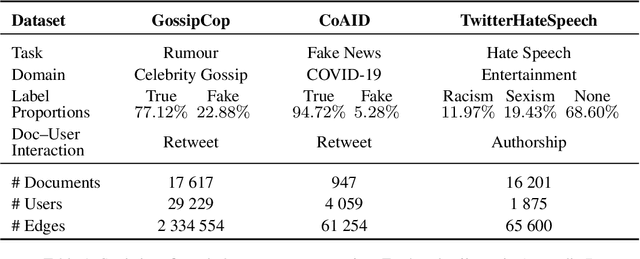
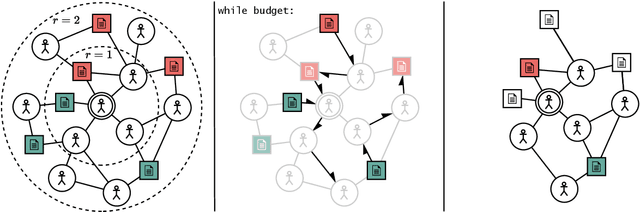
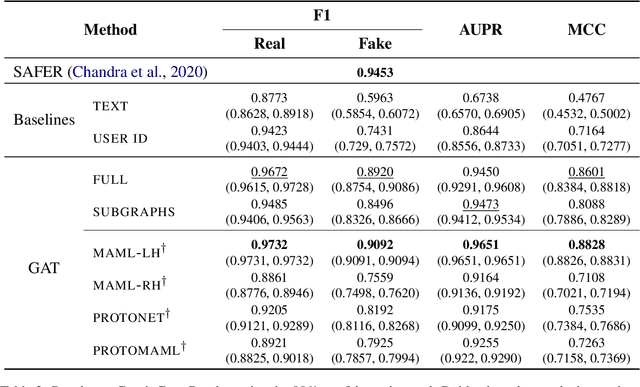
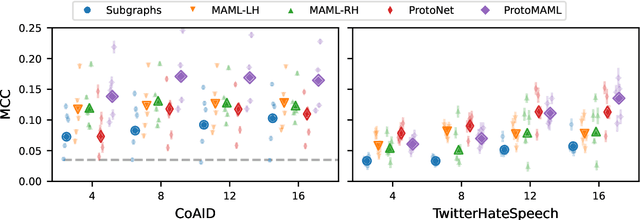
Community models for malicious content detection, which take into account the context from a social graph alongside the content itself, have shown remarkable performance on benchmark datasets. Yet, misinformation and hate speech continue to propagate on social media networks. This mismatch can be partially attributed to the limitations of current evaluation setups that neglect the rapid evolution of online content and the underlying social graph. In this paper, we propose a novel evaluation setup for model generalisation based on our few-shot subgraph sampling approach. This setup tests for generalisation through few labelled examples in local explorations of a larger graph, emulating more realistic application settings. We show this to be a challenging inductive setup, wherein strong performance on the training graph is not indicative of performance on unseen tasks, domains, or graph structures. Lastly, we show that graph meta-learners trained with our proposed few-shot subgraph sampling outperform standard community models in the inductive setup. We make our code publicly available.