 Add to Chrome
 Add to Firefox
 Add to Edge
Fairness in Link Prediction Beyond Demographic Parity: A Reproducibility Study
Aug 10, 2026
In fair ranked link prediction, demographic parity ($Δ_\mathrm{DP}$) is a common fairness metric. Yet, Mattos et al. (2025) argue that it fails to detect exposure bias because it ignores where links appear in the ranking. In this study, we reproduce this claim by showing that $Δ_\mathrm{DP}$ can indicate aggregate parity even when some subgroup-pair links are systematically ranked lower than others. The proposed rank-aware Normalized Discounted KL-divergence (NDKL), however, does detect such disparities. We also reproduce the effectiveness of MORAL, a post-processing method that improves exposure-based fairness while maintaining competitive utility. Beyond reproduction, we assess robustness using synthetic homophily settings, categorical sensitive attributes, and additional fairness and utility metrics, including subgroup-pair-adapted Attention-Weighted Rank Fairness (AWRF). Overall, our results show that exposure-based metrics uncover biases hidden by $Δ_\mathrm{DP}$ and that MORAL reduces these biases with minimal utility loss across diverse settings and datasets. We release a corrected, reproducible implementation at https://github.com/Floris93100/reproducing-MORAL.
* Published in Transactions on Machine Learning Research (05/2026)

Manifold-Constrained Hyper-Connections for Parameter-Efficient Finetuning
Jul 20, 2026Most parameter-efficient finetuning (PEFT) methods adapt weights or activations, thus leaving one of the key Transformer components unchanged: residual connections. This paper investigates Manifold-Constrained Hyper-Connections (mHC), a generalisation of residual connections, as a novel PEFT approach, wrapping frozen OLMo-2 backbones with learned residual routing modules. We find that mHC can finetune frozen Transformers, but that its role differs fundamentally from the original pre-training setting: in finetuning, fixing the residual mixing matrix to identity often improves performance. As a standalone PEFT method, mHC does not consistently outperform LoRA. However, at matched trainable parameter budgets, mHC+LoRA combinations improve language-modelling loss and show task-dependent benchmark gains at both 1B and 7B scale. Overall, our results identify residual routing as a distinct and promising novel PEFT axis.
Forecasting Smog Clouds With Deep Learning
Oct 03, 2024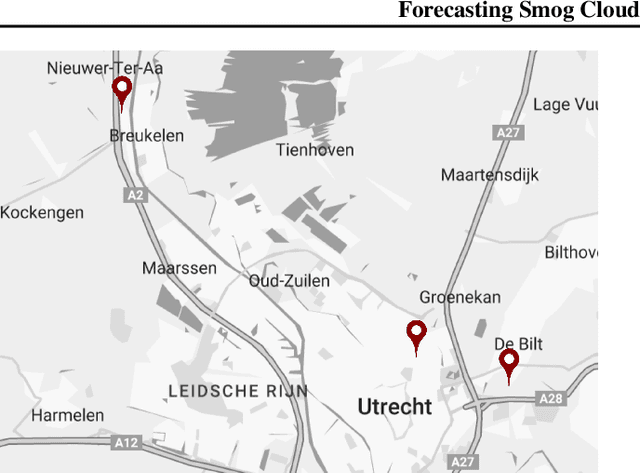
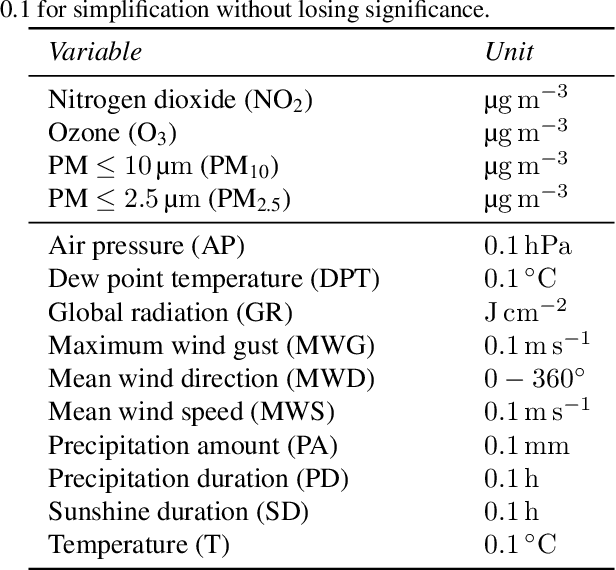
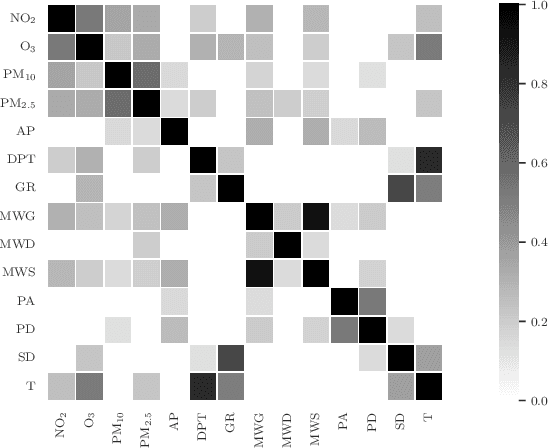

In this proof-of-concept study, we conduct multivariate timeseries forecasting for the concentrations of nitrogen dioxide (NO2), ozone (O3), and (fine) particulate matter (PM10 & PM2.5) with meteorological covariates between two locations using various deep learning models, with a focus on long short-term memory (LSTM) and gated recurrent unit (GRU) architectures. In particular, we propose an integrated, hierarchical model architecture inspired by air pollution dynamics and atmospheric science that employs multi-task learning and is benchmarked by unidirectional and fully-connected models. Results demonstrate that, above all, the hierarchical GRU proves itself as a competitive and efficient method for forecasting the concentration of smog-related pollutants.