 Add to Chrome
 Add to Firefox
 Add to Edge
Can Training Dynamics of Scale-Invariant Neural Networks Be Explained by the Thermodynamics of an Ideal Gas?
Nov 10, 2025
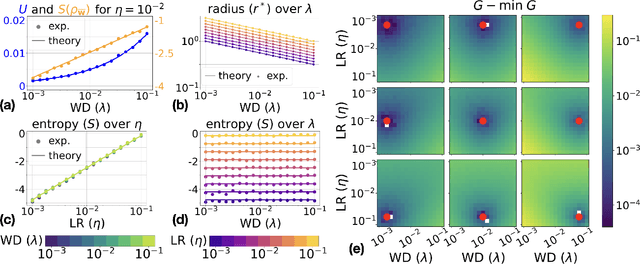
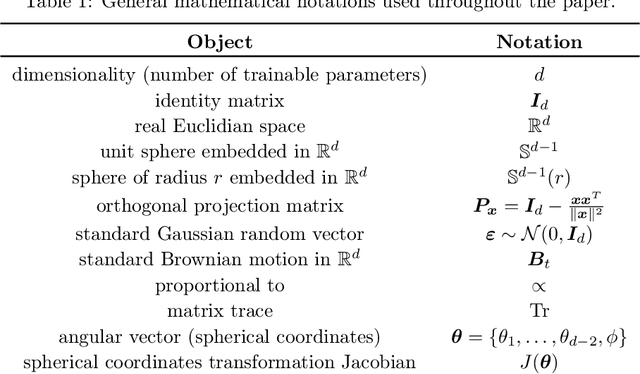
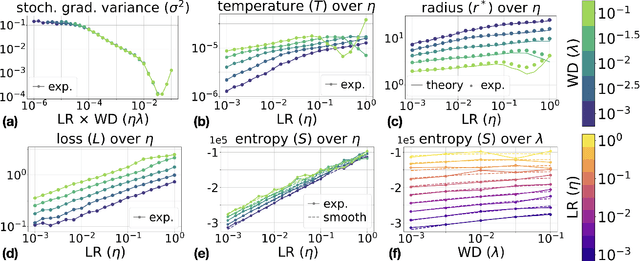
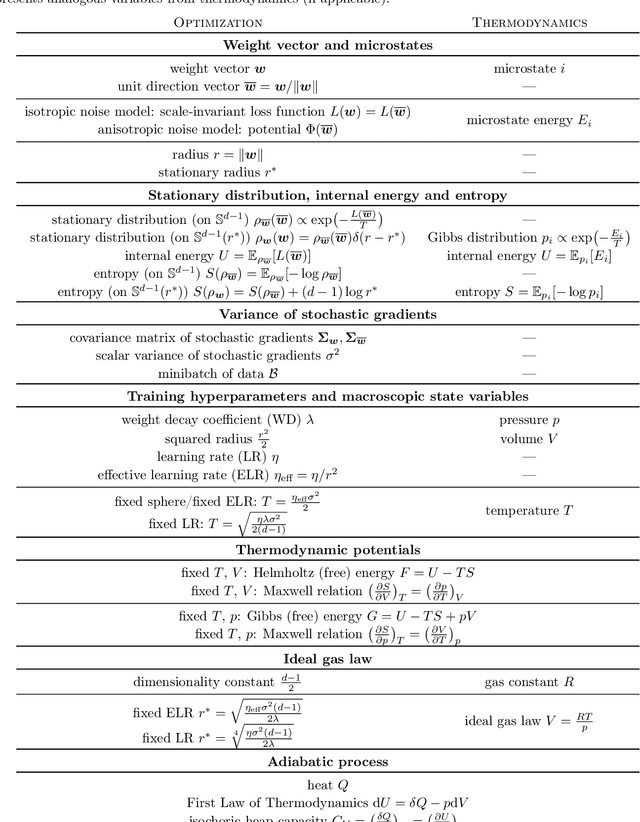
Understanding the training dynamics of deep neural networks remains a major open problem, with physics-inspired approaches offering promising insights. Building on this perspective, we develop a thermodynamic framework to describe the stationary distributions of stochastic gradient descent (SGD) with weight decay for scale-invariant neural networks, a setting that both reflects practical architectures with normalization layers and permits theoretical analysis. We establish analogies between training hyperparameters (e.g., learning rate, weight decay) and thermodynamic variables such as temperature, pressure, and volume. Starting with a simplified isotropic noise model, we uncover a close correspondence between SGD dynamics and ideal gas behavior, validated through theory and simulation. Extending to training of neural networks, we show that key predictions of the framework, including the behavior of stationary entropy, align closely with experimental observations. This framework provides a principled foundation for interpreting training dynamics and may guide future work on hyperparameter tuning and the design of learning rate schedulers.

SGD as Free Energy Minimization: A Thermodynamic View on Neural Network Training
May 29, 2025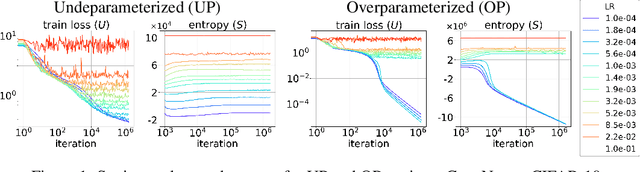
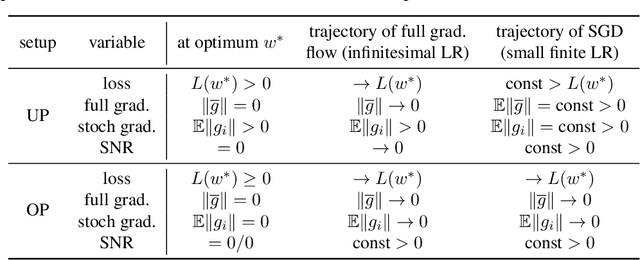
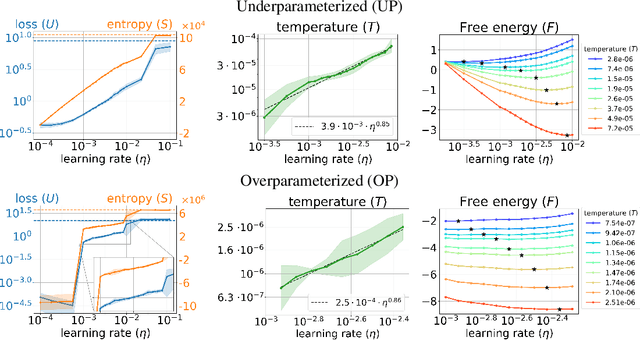
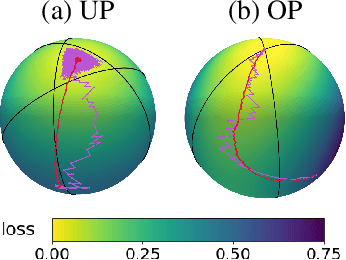
We present a thermodynamic interpretation of the stationary behavior of stochastic gradient descent (SGD) under fixed learning rates (LRs) in neural network training. We show that SGD implicitly minimizes a free energy function $F=U-TS$, balancing training loss $U$ and the entropy of the weights distribution $S$, with temperature $T$ determined by the LR. This perspective offers a new lens on why high LRs prevent training from converging to the loss minima and how different LRs lead to stabilization at different loss levels. We empirically validate the free energy framework on both underparameterized (UP) and overparameterized (OP) models. UP models consistently follow free energy minimization, with temperature increasing monotonically with LR, while for OP models, the temperature effectively drops to zero at low LRs, causing SGD to minimize the loss directly and converge to an optimum. We attribute this mismatch to differences in the signal-to-noise ratio of stochastic gradients near optima, supported by both a toy example and neural network experiments.