 Add to Chrome
 Add to Firefox
 Add to Edge
On-device Large Multi-modal Agent for Human Activity Recognition
Dec 17, 2025
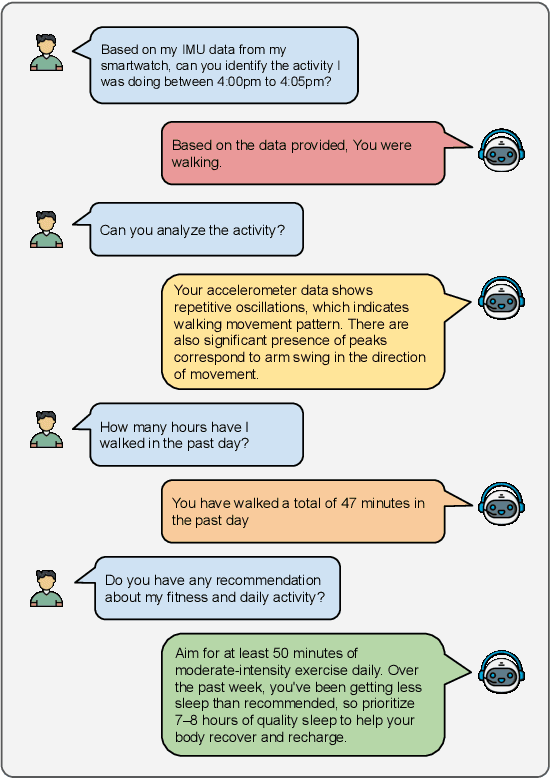
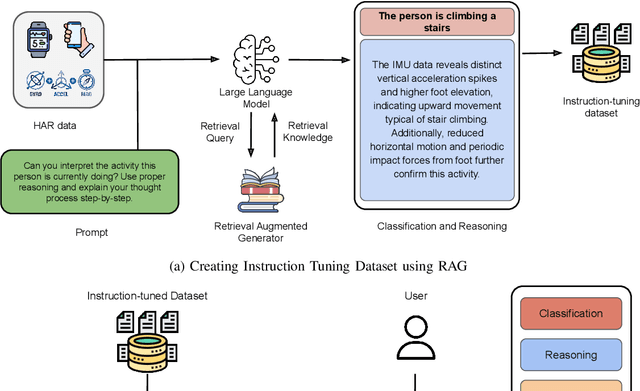
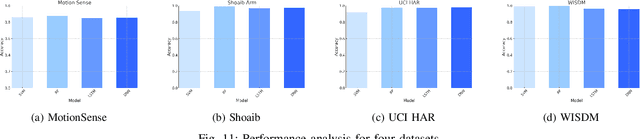
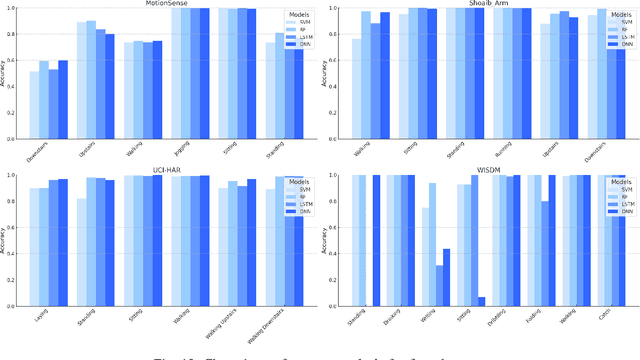
Human Activity Recognition (HAR) has been an active area of research, with applications ranging from healthcare to smart environments. The recent advancements in Large Language Models (LLMs) have opened new possibilities to leverage their capabilities in HAR, enabling not just activity classification but also interpretability and human-like interaction. In this paper, we present a Large Multi-Modal Agent designed for HAR, which integrates the power of LLMs to enhance both performance and user engagement. The proposed framework not only delivers activity classification but also bridges the gap between technical outputs and user-friendly insights through its reasoning and question-answering capabilities. We conduct extensive evaluations using widely adopted HAR datasets, including HHAR, Shoaib, Motionsense to assess the performance of our framework. The results demonstrate that our model achieves high classification accuracy comparable to state-of-the-art methods while significantly improving interpretability through its reasoning and Q&A capabilities.

Human Activity Recognition from Wi-Fi CSI Data Using Principal Component-Based Wavelet CNN
Dec 26, 2022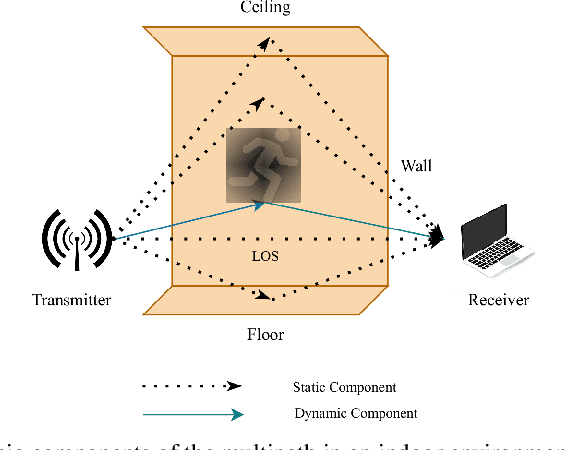
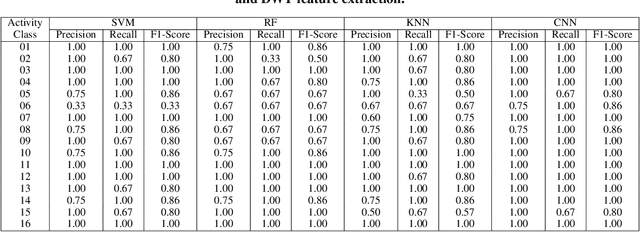

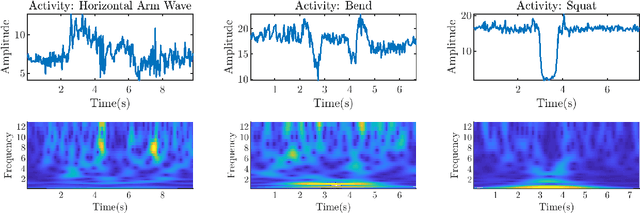
Human Activity Recognition (HAR) is an emerging technology with several applications in surveillance, security, and healthcare sectors. Noninvasive HAR systems based on Wi-Fi Channel State Information (CSI) signals can be developed leveraging the quick growth of ubiquitous Wi-Fi technologies, and the correlation between CSI dynamics and body motions. In this paper, we propose Principal Component-based Wavelet Convolutional Neural Network (or PCWCNN) -- a novel approach that offers robustness and efficiency for practical real-time applications. Our proposed method incorporates two efficient preprocessing algorithms -- the Principal Component Analysis (PCA) and the Discrete Wavelet Transform (DWT). We employ an adaptive activity segmentation algorithm that is accurate and computationally light. Additionally, we used the Wavelet CNN for classification, which is a deep convolutional network analogous to the well-studied ResNet and DenseNet networks. We empirically show that our proposed PCWCNN model performs very well on a real dataset, outperforming existing approaches.