 Add to Chrome
 Add to Firefox
 Add to Edge
How are Prompts Different in Terms of Sensitivity?
Nov 13, 2023
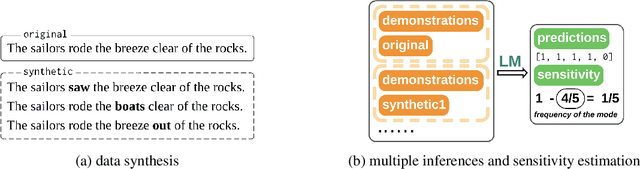


In-context learning (ICL) has become one of the most popular learning paradigms. While there is a growing body of literature focusing on prompt engineering, there is a lack of systematic analysis comparing the effects of prompts across different models and tasks. To address this gap, we present a comprehensive prompt analysis based on the sensitivity of a function. Our analysis reveals that sensitivity is an unsupervised proxy for model performance, as it exhibits a strong negative correlation with accuracy. We use gradient-based saliency scores to empirically demonstrate how different prompts affect the relevance of input tokens to the output, resulting in different levels of sensitivity. Furthermore, we introduce sensitivity-aware decoding which incorporates sensitivity estimation as a penalty term in the standard greedy decoding. We show that this approach is particularly helpful when information in the input is scarce. Our work provides a fresh perspective on the analysis of prompts, and contributes to a better understanding of the mechanism of ICL.

A Template Is All You Meme
Nov 11, 2023Memes are a modern form of communication and meme templates possess a base semantics that is customizable by whomever posts it on social media. Machine learning systems struggle with memes, which is likely due to such systems having insufficient context to understand memes, as there is more to memes than the obvious image and text. Here, to aid understanding of memes, we release a knowledge base of memes and information found on www.knowyourmeme.com, which we call the Know Your Meme Knowledge Base (KYMKB), composed of more than 54,000 images. The KYMKB includes popular meme templates, examples of each template, and detailed information about the template. We hypothesize that meme templates can be used to inject models with the context missing from previous approaches. To test our hypothesis, we create a non-parametric majority-based classifier, which we call Template-Label Counter (TLC). We find TLC more effective than or competitive with fine-tuned baselines. To demonstrate the power of meme templates and the value of both our knowledge base and method, we conduct thorough classification experiments and exploratory data analysis in the context of five meme analysis tasks.
Exploring Jiu-Jitsu Argumentation for Writing Peer Review Rebuttals
Nov 07, 2023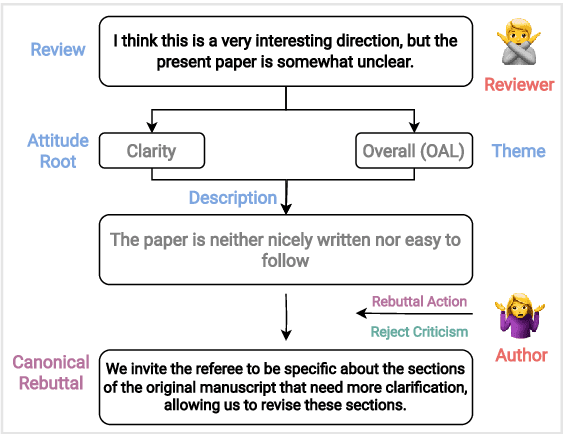
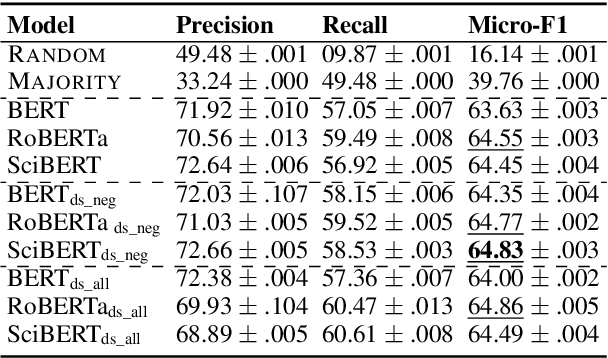
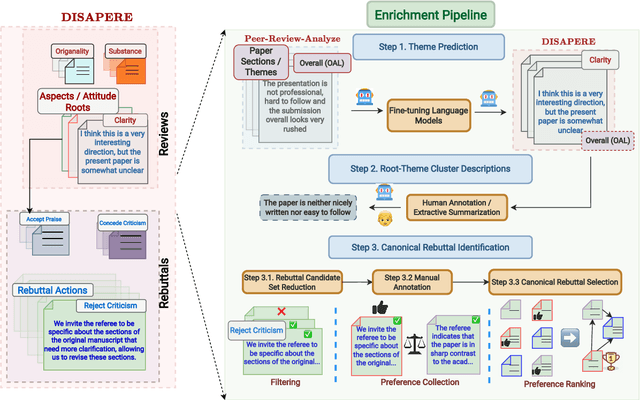
In many domains of argumentation, people's arguments are driven by so-called attitude roots, i.e., underlying beliefs and world views, and their corresponding attitude themes. Given the strength of these latent drivers of arguments, recent work in psychology suggests that instead of directly countering surface-level reasoning (e.g., falsifying given premises), one should follow an argumentation style inspired by the Jiu-Jitsu 'soft' combat system (Hornsey and Fielding, 2017): first, identify an arguer's attitude roots and themes, and then choose a prototypical rebuttal that is aligned with those drivers instead of invalidating those. In this work, we are the first to explore Jiu-Jitsu argumentation for peer review by proposing the novel task of attitude and theme-guided rebuttal generation. To this end, we enrich an existing dataset for discourse structure in peer reviews with attitude roots, attitude themes, and canonical rebuttals. To facilitate this process, we recast established annotation concepts from the domain of peer reviews (e.g., aspects a review sentence is relating to) and train domain-specific models. We then propose strong rebuttal generation strategies, which we benchmark on our novel dataset for the task of end-to-end attitude and theme-guided rebuttal generation and two subtasks.
AdaSent: Efficient Domain-Adapted Sentence Embeddings for Few-Shot Classification
Nov 01, 2023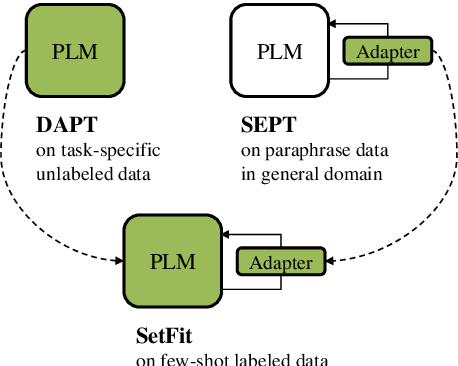

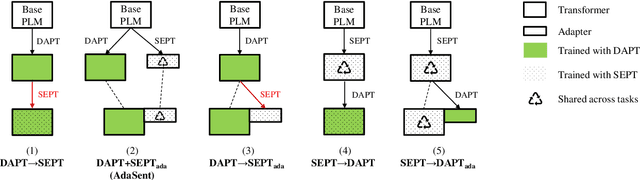
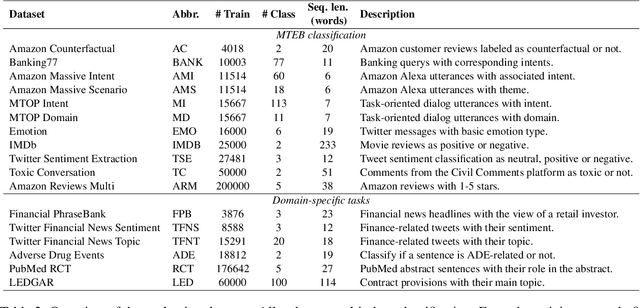
Recent work has found that few-shot sentence classification based on pre-trained Sentence Encoders (SEs) is efficient, robust, and effective. In this work, we investigate strategies for domain-specialization in the context of few-shot sentence classification with SEs. We first establish that unsupervised Domain-Adaptive Pre-Training (DAPT) of a base Pre-trained Language Model (PLM) (i.e., not an SE) substantially improves the accuracy of few-shot sentence classification by up to 8.4 points. However, applying DAPT on SEs, on the one hand, disrupts the effects of their (general-domain) Sentence Embedding Pre-Training (SEPT). On the other hand, applying general-domain SEPT on top of a domain-adapted base PLM (i.e., after DAPT) is effective but inefficient, since the computationally expensive SEPT needs to be executed on top of a DAPT-ed PLM of each domain. As a solution, we propose AdaSent, which decouples SEPT from DAPT by training a SEPT adapter on the base PLM. The adapter can be inserted into DAPT-ed PLMs from any domain. We demonstrate AdaSent's effectiveness in extensive experiments on 17 different few-shot sentence classification datasets. AdaSent matches or surpasses the performance of full SEPT on DAPT-ed PLM, while substantially reducing the training costs. The code for AdaSent is available.
Learning From Free-Text Human Feedback -- Collect New Datasets Or Extend Existing Ones?
Oct 24, 2023Learning from free-text human feedback is essential for dialog systems, but annotated data is scarce and usually covers only a small fraction of error types known in conversational AI. Instead of collecting and annotating new datasets from scratch, recent advances in synthetic dialog generation could be used to augment existing dialog datasets with the necessary annotations. However, to assess the feasibility of such an effort, it is important to know the types and frequency of free-text human feedback included in these datasets. In this work, we investigate this question for a variety of commonly used dialog datasets, including MultiWoZ, SGD, BABI, PersonaChat, Wizards-of-Wikipedia, and the human-bot split of the Self-Feeding Chatbot. Using our observations, we derive new taxonomies for the annotation of free-text human feedback in dialogs and investigate the impact of including such data in response generation for three SOTA language generation models, including GPT-2, LLAMA, and Flan-T5. Our findings provide new insights into the composition of the datasets examined, including error types, user response types, and the relations between them.
Model Merging by Uncertainty-Based Gradient Matching
Oct 19, 2023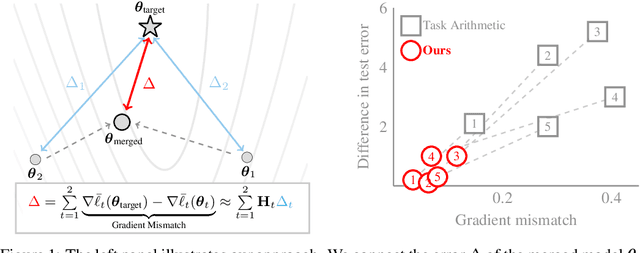
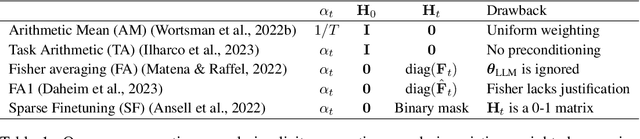
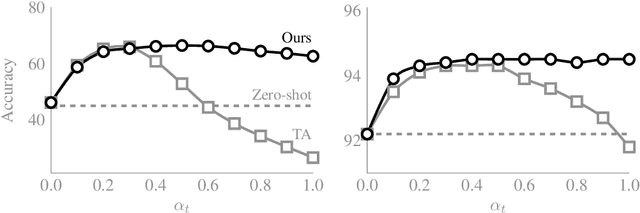

Models trained on different datasets can be merged by a weighted-averaging of their parameters, but why does it work and when can it fail? Here, we connect the inaccuracy of weighted-averaging to mismatches in the gradients and propose a new uncertainty-based scheme to improve the performance by reducing the mismatch. The connection also reveals implicit assumptions in other schemes such as averaging, task arithmetic, and Fisher-weighted averaging. Our new method gives consistent improvements for large language models and vision transformers, both in terms of performance and robustness to hyperparameters.
Measuring Pointwise $\mathcal{V}$-Usable Information In-Context-ly
Oct 18, 2023


In-context learning (ICL) is a new learning paradigm that has gained popularity along with the development of large language models. In this work, we adapt a recently proposed hardness metric, pointwise $\mathcal{V}$-usable information (PVI), to an in-context version (in-context PVI). Compared to the original PVI, in-context PVI is more efficient in that it requires only a few exemplars and does not require fine-tuning. We conducted a comprehensive empirical analysis to evaluate the reliability of in-context PVI. Our findings indicate that in-context PVI estimates exhibit similar characteristics to the original PVI. Specific to the in-context setting, we show that in-context PVI estimates remain consistent across different exemplar selections and numbers of shots. The variance of in-context PVI estimates across different exemplar selections is insignificant, which suggests that in-context PVI are stable. Furthermore, we demonstrate how in-context PVI can be employed to identify challenging instances. Our work highlights the potential of in-context PVI and provides new insights into the capabilities of ICL.
Are Multilingual LLMs Culturally-Diverse Reasoners? An Investigation into Multicultural Proverbs and Sayings
Sep 15, 2023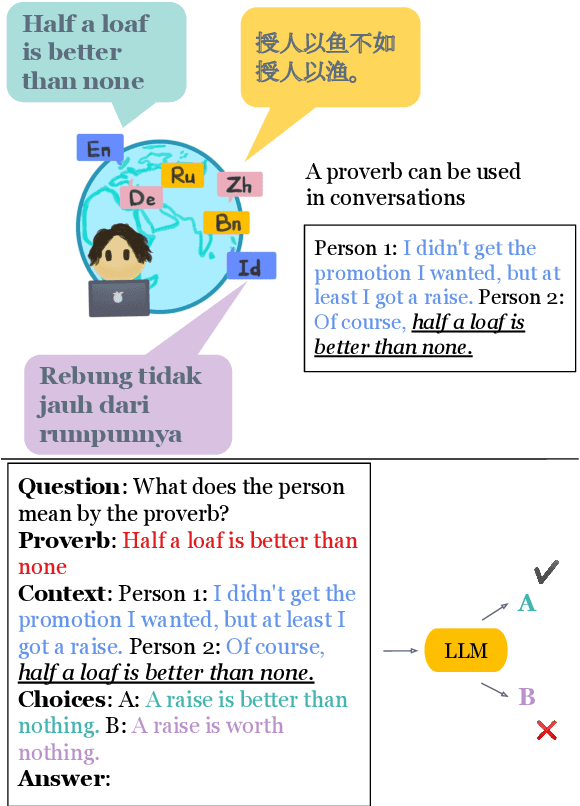
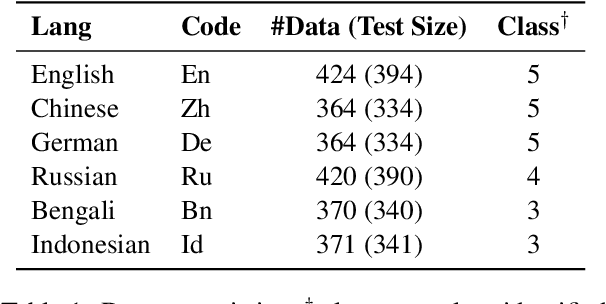
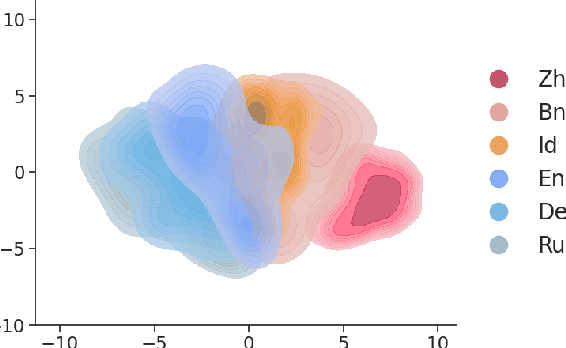
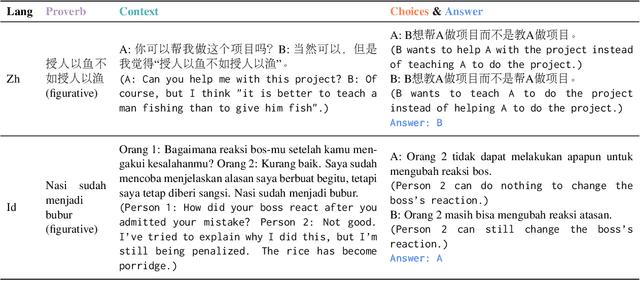
Large language models (LLMs) are highly adept at question answering and reasoning tasks, but when reasoning in situational context, human expectations vary depending on the relevant cultural common ground. As human languages are associated with diverse cultures, LLMs should also be culturally-diverse reasoners. In this paper, we study the ability of a wide range of state-of-the-art multilingual LLMs (mLLMs) to reason with proverbs and sayings in a conversational context. Our experiments reveal that: (1) mLLMs 'knows' limited proverbs and memorizing proverbs does not mean understanding them within a conversational context; (2) mLLMs struggle to reason with figurative proverbs and sayings, and when asked to select the wrong answer (instead of asking it to select the correct answer); and (3) there is a "culture gap" in mLLMs when reasoning about proverbs and sayings translated from other languages. We construct and release our evaluation dataset MAPS (MulticultrAl Proverbs and Sayings) for proverb understanding with conversational context for six different languages.
Bridging Topic, Domain, and Language Shifts: An Evaluation of Comprehensive Out-of-Distribution Scenarios
Sep 15, 2023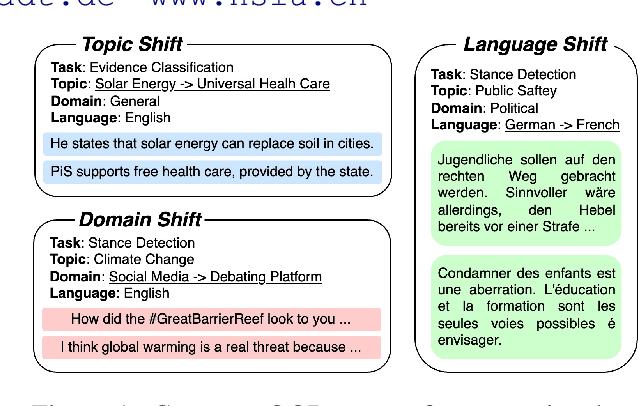
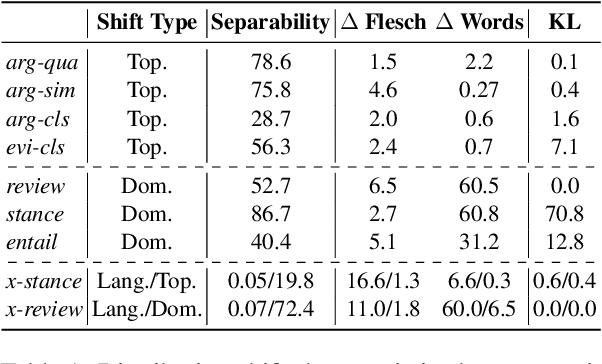
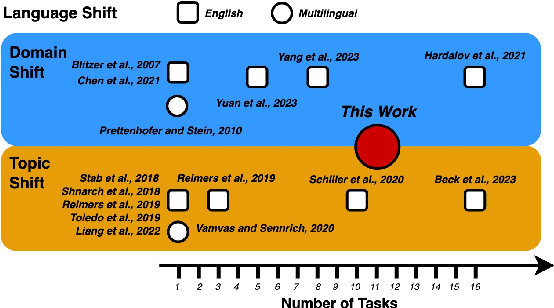
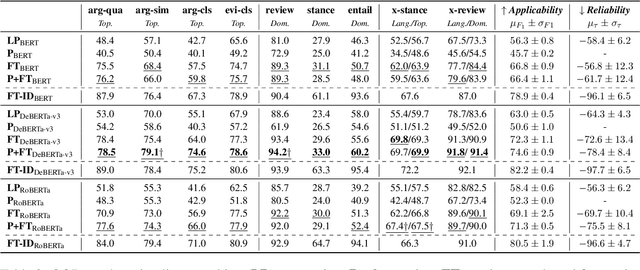
Language models (LMs) excel in in-distribution (ID) scenarios where train and test data are independent and identically distributed. However, their performance often degrades in real-world applications like argument mining. Such degradation happens when new topics emerge, or other text domains and languages become relevant. To assess LMs' generalization abilities in such out-of-distribution (OOD) scenarios, we simulate such distribution shifts by deliberately withholding specific instances for testing, as from the social media domain or the topic Solar Energy. Unlike prior studies focusing on specific shifts and metrics in isolation, we comprehensively analyze OOD generalization. We define three metrics to pinpoint generalization flaws and propose eleven classification tasks covering topic, domain, and language shifts. Overall, we find superior performance of prompt-based fine-tuning, notably when train and test splits primarily differ semantically. Simultaneously, in-context learning is more effective than prompt-based or vanilla fine-tuning for tasks when training data embodies heavy discrepancies in label distribution compared to testing data. This reveals a crucial drawback of gradient-based learning: it biases LMs regarding such structural obstacles.
CATfOOD: Counterfactual Augmented Training for Improving Out-of-Domain Performance and Calibration
Sep 15, 2023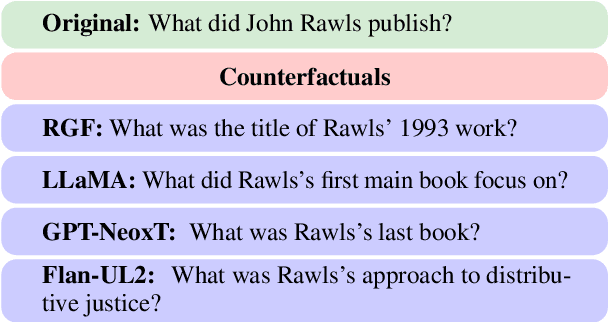
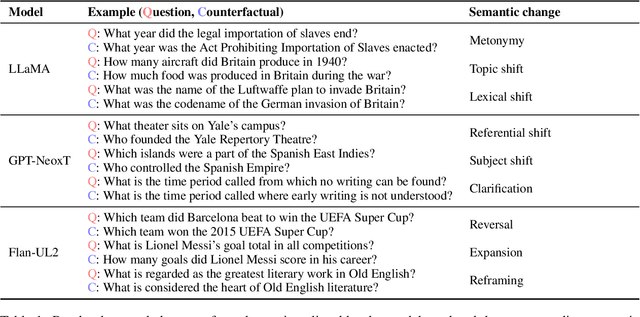

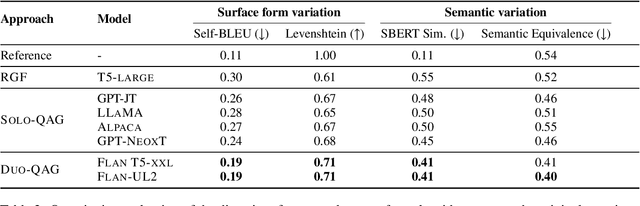
In recent years, large language models (LLMs) have shown remarkable capabilities at scale, particularly at generating text conditioned on a prompt. In our work, we investigate the use of LLMs to augment training data of small language models~(SLMs) with automatically generated counterfactual~(CF) instances -- i.e. minimally altered inputs -- in order to improve out-of-domain~(OOD) performance of SLMs in the extractive question answering~(QA) setup. We show that, across various LLM generators, such data augmentation consistently enhances OOD performance and improves model calibration for both confidence-based and rationale-augmented calibrator models. Furthermore, these performance improvements correlate with higher diversity of CF instances in terms of their surface form and semantic content. Finally, we show that CF augmented models which are easier to calibrate also exhibit much lower entropy when assigning importance, indicating that rationale-augmented calibrators prefer concise explanations.