 Add to Chrome
 Add to Firefox
 Add to Edge
LLMs on Tabular Data with Limited Semantics: Evidence from Industrial Car Retrofit Prediction
Jun 13, 2026
Industrial retrofit planning depends on structured operational data rather than free text: planners must estimate whether a newly registered prototype will require a retrofit, which retrofit package it will need, and how long the work will take. We study an industrial dataset linking a prototype-registration system (284,271 vehicles) with a retrofit-management system (48,716 cleaned visits), and compare strong tabular machine learning baselines with three LLM-based strategies on row-serialized inputs: embedding features (Amazon Titan), direct prompted classification (Claude Sonnet 4), and an ML+LLM stacking approach. Across binary occurrence prediction, 15-way retrofit-type classification, per-visit duration regression, and an aggregated monthly benchmark, classical tree ensembles remain the strongest standalone models. However, the LLM results reveal a consistent pattern: embeddings remain useful on tables (binary AUC = 0.982), direct prompting collapses once semantic signal is stripped by hashing (binary AUC = 0.500; multiclass weighted F1 = 0.018), and hybrid stacking yields the best manually built multiclass model (weighted F1 = 0.626). On the monthly benchmark, lag-based machine learning outperforms time-series foundation models, though Chronos-small remains competitive in zero-shot forecasting. The results suggest that on privacy-constrained industrial tables, LLMs are more effective as complementary components than as replacements for strong tabular baselines.

A Mathematical Theory of Top-$k$ Sparse Attention via Total Variation Distance
Dec 08, 2025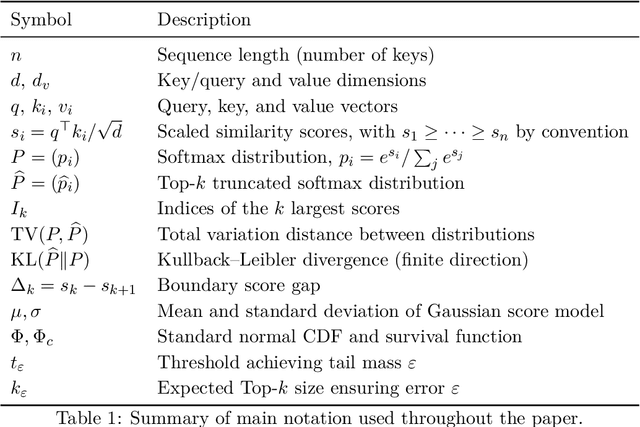
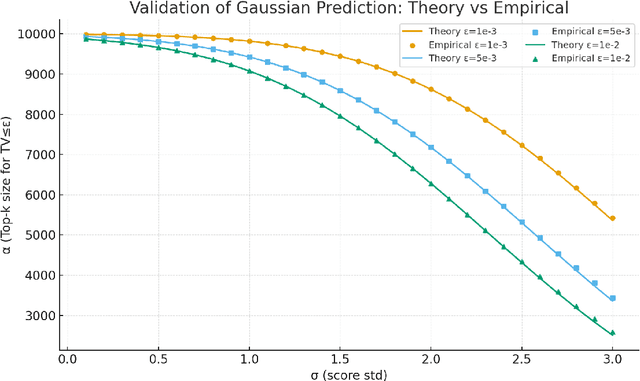
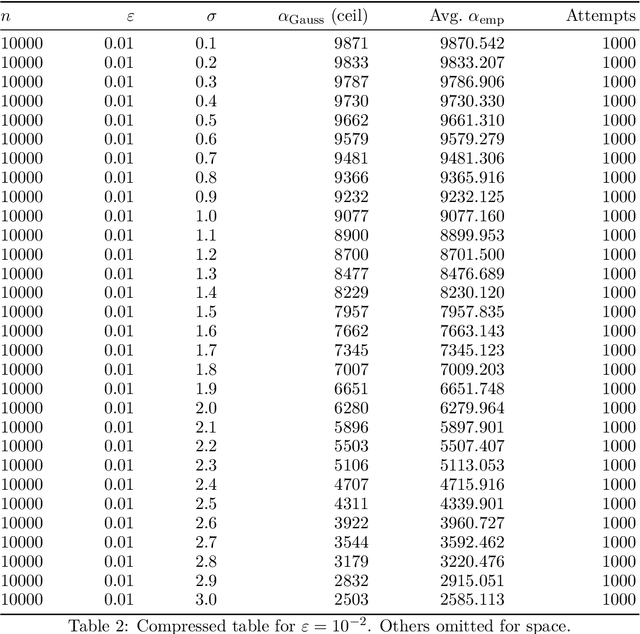
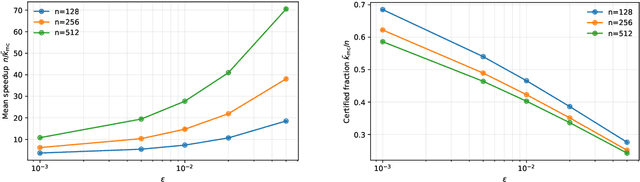
We develop a unified mathematical framework for certified Top-$k$ attention truncation that quantifies approximation error at both the distribution and output levels. For a single attention distribution $P$ and its Top-$k$ truncation $\hat P$, we show that the total-variation distance coincides with the discarded softmax tail mass and satisfies $\mathrm{TV}(P,\hat P)=1-e^{-\mathrm{KL}(\hat P\Vert P)}$, yielding sharp Top-$k$-specific bounds in place of generic inequalities. From this we derive non-asymptotic deterministic bounds -- from a single boundary gap through multi-gap and blockwise variants -- that control $\mathrm{TV}(P,\hat P)$ using only the ordered logits. Using an exact head-tail decomposition, we prove that the output error factorizes as $\|\mathrm{Attn}(q,K,V)-\mathrm{Attn}_k(q,K,V)\|_2=τ\|μ_{\mathrm{tail}}-μ_{\mathrm{head}}\|_2$ with $τ=\mathrm{TV}(P,\hat P)$, yielding a new head-tail diameter bound $\|\mathrm{Attn}(q,K,V)-\mathrm{Attn}_k(q,K,V)\|_2\leτ\,\mathrm{diam}_{H,T}$ and refinements linking the error to $\mathrm{Var}_P(V)$. Under an i.i.d. Gaussian score model $s_i\sim\mathcal N(μ,σ^2)$ we derive closed-form tail masses and an asymptotic rule for the minimal $k_\varepsilon$ ensuring $\mathrm{TV}(P,\hat P)\le\varepsilon$, namely $k_\varepsilon/n\approxΦ_c(σ+Φ^{-1}(\varepsilon))$. Experiments on bert-base-uncased and synthetic logits confirm the predicted scaling of $k_\varepsilon/n$ and show that certified Top-$k$ can reduce scored keys by 2-4$\times$ on average while meeting the prescribed total-variation budget.