 Add to Chrome
 Add to Firefox
 Add to Edge
LLMs on Tabular Data with Limited Semantics: Evidence from Industrial Car Retrofit Prediction
Jun 13, 2026
Industrial retrofit planning depends on structured operational data rather than free text: planners must estimate whether a newly registered prototype will require a retrofit, which retrofit package it will need, and how long the work will take. We study an industrial dataset linking a prototype-registration system (284,271 vehicles) with a retrofit-management system (48,716 cleaned visits), and compare strong tabular machine learning baselines with three LLM-based strategies on row-serialized inputs: embedding features (Amazon Titan), direct prompted classification (Claude Sonnet 4), and an ML+LLM stacking approach. Across binary occurrence prediction, 15-way retrofit-type classification, per-visit duration regression, and an aggregated monthly benchmark, classical tree ensembles remain the strongest standalone models. However, the LLM results reveal a consistent pattern: embeddings remain useful on tables (binary AUC = 0.982), direct prompting collapses once semantic signal is stripped by hashing (binary AUC = 0.500; multiclass weighted F1 = 0.018), and hybrid stacking yields the best manually built multiclass model (weighted F1 = 0.626). On the monthly benchmark, lag-based machine learning outperforms time-series foundation models, though Chronos-small remains competitive in zero-shot forecasting. The results suggest that on privacy-constrained industrial tables, LLMs are more effective as complementary components than as replacements for strong tabular baselines.

Efficient Traffic Prediction at Scale: A Systematic Study of STGCN Architectural Depth
Jun 08, 2026Spatio-temporal graph neural networks (STGNNs) have become the dominant approach for traffic prediction, yet their computational requirements pose challenges for practical deployment in intelligent transportation systems (ITS). While recent work has proposed efficient alternatives to STGNNs, a fundamental question remains unexplored: are these architectures themselves over-parameterised? We examine this question using the Spatio-Temporal Graph Convolutional Network (STGCN), one of the most widely adopted models in this domain. Through systematic experiments across four diverse traffic datasets, we compare 1-block, 2-block (standard), and 3-block STGCN variants. Our findings reveal that the single-block architecture achieves optimal performance for short-term prediction (10 mins) on three of four datasets, while incurring only marginal degradation ($\leq$1.8% relative error) at longer horizons. Crucially, the 2-block variant incurs 61% higher CPU inference latency and 37% lower throughput relative to 1-block -- substantial overhead for resource-constrained ITS deployment. The 3-block architecture offers no favourable tradeoff, more than doubling computational cost for $<$0.5% relative improvement. These results suggest that the default 2-block STGCN may be over-parameterised for many applications, with implications for both practitioners deploying traffic prediction systems and researchers benchmarking efficiency-focused methods.
Graph neural network surrogate for strategic transport planning
Aug 14, 2024As the complexities of urban environments continue to grow, the modelling of transportation systems become increasingly challenging. This paper explores the application of advanced Graph Neural Network (GNN) architectures as surrogate models for strategic transport planning. Building upon a prior work that laid the foundation with graph convolution networks (GCN), our study delves into the comparative analysis of established GCN with the more expressive Graph Attention Network (GAT). Additionally, we propose a novel GAT variant (namely GATv3) to address over-smoothing issues in graph-based models. Our investigation also includes the exploration of a hybrid model combining both GCN and GAT architectures, aiming to investigate the performance of the mixture. The three models are applied to various experiments to understand their limits. We analyse hierarchical regression setups, combining classification and regression tasks, and introduce fine-grained classification with a proposal of a method to convert outputs to precise values. Results reveal the superior performance of the new GAT in classification tasks. To the best of the authors' knowledge, this is the first GAT model in literature to achieve larger depths. Surprisingly, the fine-grained classification task demonstrates the GCN's unexpected dominance with additional training data. This shows that synthetic data generators can increase the training data, without overfitting issues whilst improving model performance. In conclusion, this research advances GNN based surrogate modelling, providing insights for refining GNN architectures. The findings open avenues for investigating the potential of the newly proposed GAT architecture and the modelling setups for other transportation problems.
Utilizing Import Vector Machines to Identify Dangerous Pro-active Traffic Conditions
Jan 19, 2021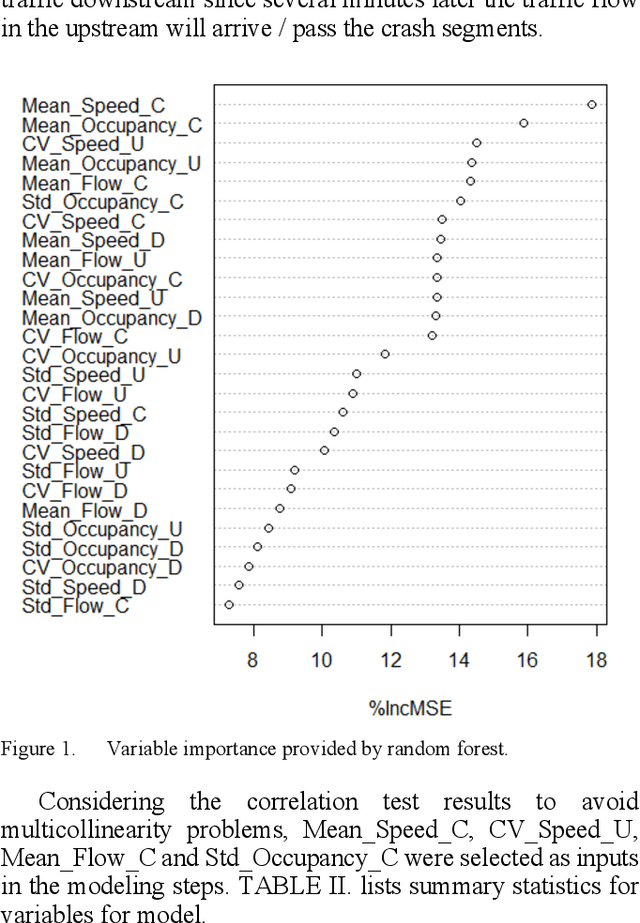
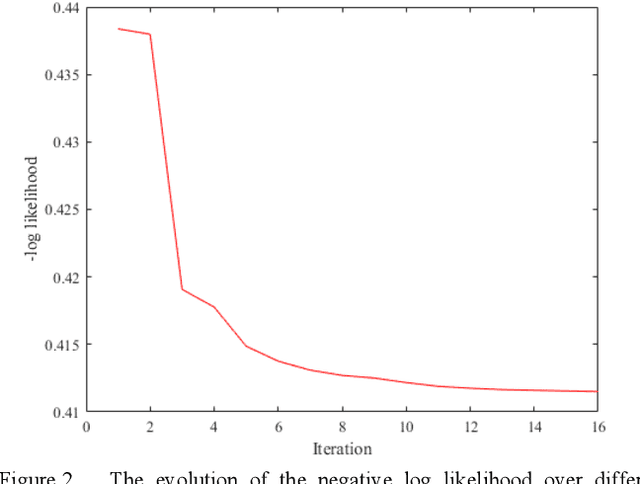
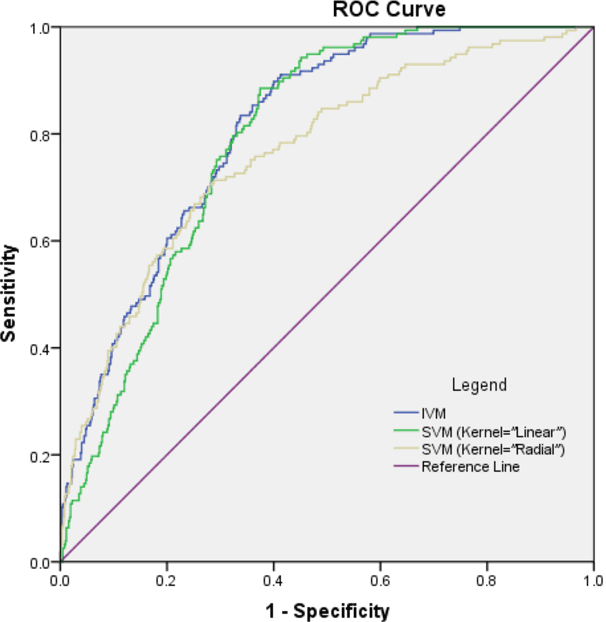
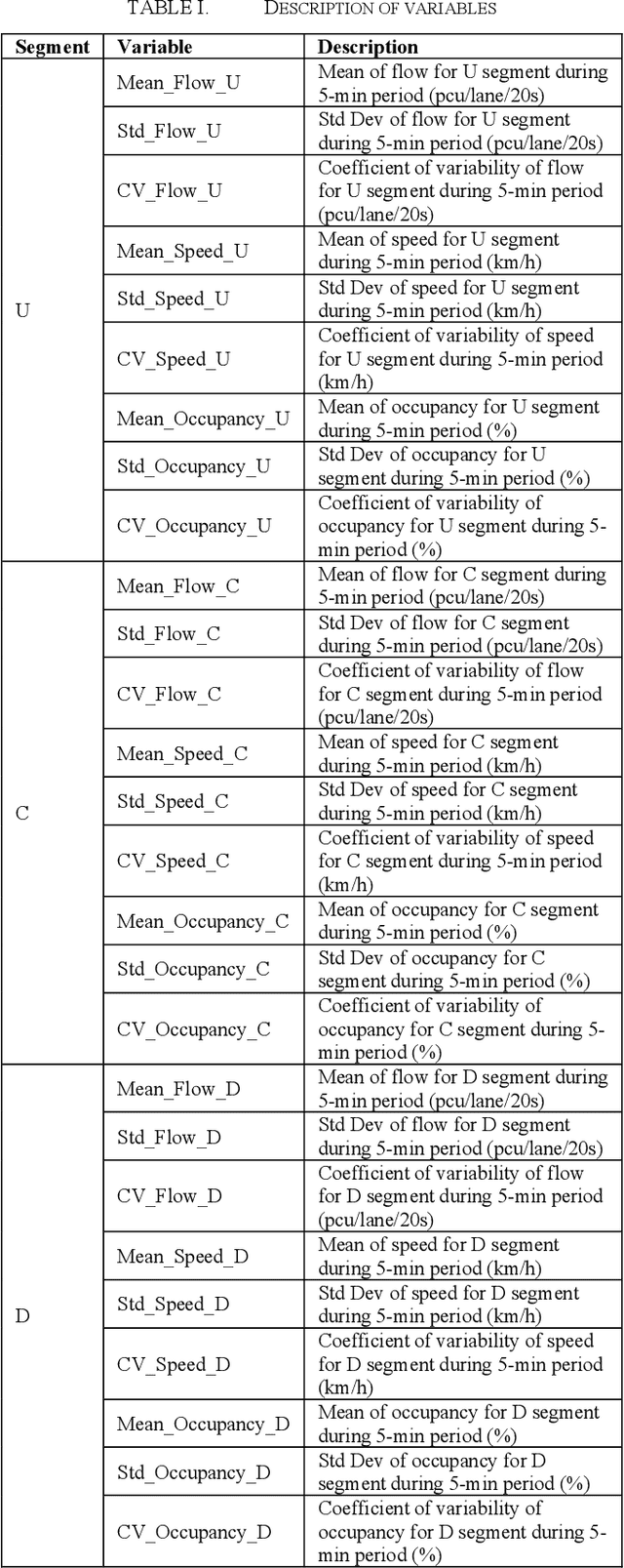
Traffic accidents have been a severe issue in metropolises with the development of traffic flow. This paper explores the theory and application of a recently developed machine learning technique, namely Import Vector Machines (IVMs), in real-time crash risk analysis, which is a hot topic to reduce traffic accidents. Historical crash data and corresponding traffic data from Shanghai Urban Expressway System were employed and matched. Traffic conditions are labelled as dangerous (i.e. probably leading to a crash) and safe (i.e. a normal traffic condition) based on 5-minute measurements of average speed, volume and occupancy. The IVM algorithm is trained to build the classifier and its performance is compared to the popular and successfully applied technique of Support Vector Machines (SVMs). The main findings indicate that IVMs could successfully be employed in real-time identification of dangerous pro-active traffic conditions. Furthermore, similar to the "support points" of the SVM, the IVM model uses only a fraction of the training data to index kernel basis functions, typically a much smaller fraction than the SVM, and its classification rates are similar to those of SVMs. This gives the IVM a computational advantage over the SVM, especially when the size of the training data set is large.
* 6 pages, 3 figures, 2020 IEEE 23rd International Conference on Intelligent Transportation Systems (ITSC)