 Add to Chrome
 Add to Firefox
 Add to Edge
VISion On Request: Enhanced VLLM efficiency with sparse, dynamically selected, vision-language interactions
Mar 24, 2026
Existing approaches for improving the efficiency of Large Vision-Language Models (LVLMs) are largely based on the concept of visual token reduction. This approach, however, creates an information bottleneck that impairs performance, especially on challenging tasks that require fine-grained understanding and reasoning. In this work, we challenge this paradigm by introducing VISion On Request (VISOR), a method that reduces inference cost without discarding visual information. Instead of compressing the image, VISOR improves efficiency by sparsifying the interaction between image and text tokens. Specifically, the language model attends to the full set of high-resolution visual tokens through a small, strategically placed set of attention layers: general visual context is provided by efficient cross-attention between text-image, while a few well-placed and dynamically selected self-attention layers refine the visual representations themselves, enabling complex, high-resolution reasoning when needed. Based on this principle, we first train a single universal network on a range of computational budgets by varying the number of self-attention layers, and then introduce a lightweight policy mechanism that dynamically allocates visual computation based on per-sample complexity. Extensive experiments show that VISOR drastically reduces computational cost while matching or exceeding state-of-the-art results across a diverse suite of benchmarks, and excels in challenging tasks that require detailed visual understanding.

More Images, More Problems? A Controlled Analysis of VLM Failure Modes
Jan 12, 2026Large Vision Language Models (LVLMs) have demonstrated remarkable capabilities, yet their proficiency in understanding and reasoning over multiple images remains largely unexplored. While existing benchmarks have initiated the evaluation of multi-image models, a comprehensive analysis of their core weaknesses and their causes is still lacking. In this work, we introduce MIMIC (Multi-Image Model Insights and Challenges), a new benchmark designed to rigorously evaluate the multi-image capabilities of LVLMs. Using MIMIC, we conduct a series of diagnostic experiments that reveal pervasive issues: LVLMs often fail to aggregate information across images and struggle to track or attend to multiple concepts simultaneously. To address these failures, we propose two novel complementary remedies. On the data side, we present a procedural data-generation strategy that composes single-image annotations into rich, targeted multi-image training examples. On the optimization side, we analyze layer-wise attention patterns and derive an attention-masking scheme tailored for multi-image inputs. Experiments substantially improved cross-image aggregation, while also enhancing performance on existing multi-image benchmarks, outperforming prior state of the art across tasks. Data and code will be made available at https://github.com/anurag-198/MIMIC.
Discriminative Fine-tuning of LVLMs
Dec 05, 2024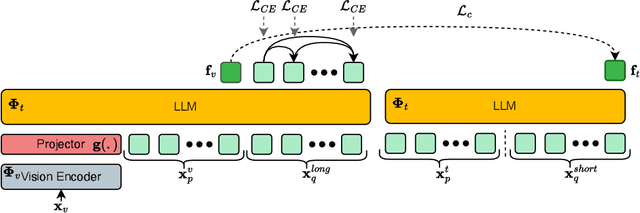
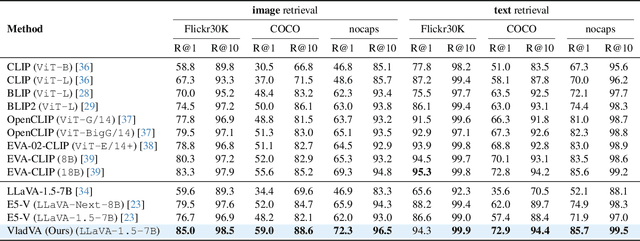


Contrastively-trained Vision-Language Models (VLMs) like CLIP have become the de facto approach for discriminative vision-language representation learning. However, these models have limited language understanding, often exhibiting a "bag of words" behavior. At the same time, Large Vision-Language Models (LVLMs), which combine vision encoders with LLMs, have been shown capable of detailed vision-language reasoning, yet their autoregressive nature renders them less suitable for discriminative tasks. In this work, we propose to combine "the best of both worlds": a new training approach for discriminative fine-tuning of LVLMs that results in strong discriminative and compositional capabilities. Essentially, our approach converts a generative LVLM into a discriminative one, unlocking its capability for powerful image-text discrimination combined with enhanced language understanding. Our contributions include: (1) A carefully designed training/optimization framework that utilizes image-text pairs of variable length and granularity for training the model with both contrastive and next-token prediction losses. This is accompanied by ablation studies that justify the necessity of our framework's components. (2) A parameter-efficient adaptation method using a combination of soft prompting and LoRA adapters. (3) Significant improvements over state-of-the-art CLIP-like models of similar size, including standard image-text retrieval benchmarks and notable gains in compositionality.
Efficient Unsupervised Visual Representation Learning with Explicit Cluster Balancing
Jul 15, 2024
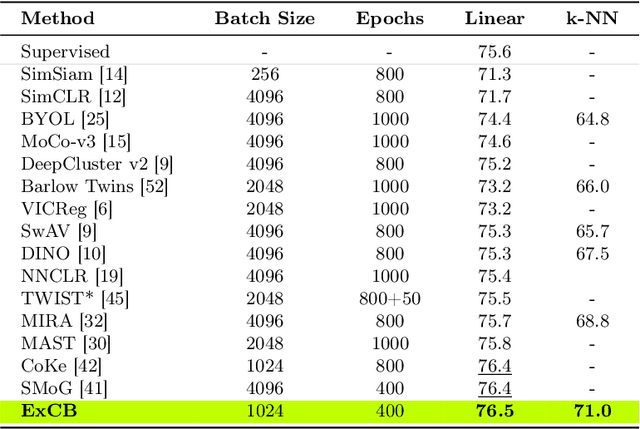


Self-supervised learning has recently emerged as the preeminent pretraining paradigm across and between modalities, with remarkable results. In the image domain specifically, group (or cluster) discrimination has been one of the most successful methods. However, such frameworks need to guard against heavily imbalanced cluster assignments to prevent collapse to trivial solutions. Existing works typically solve this by reweighing cluster assignments to promote balance, or with offline operations (e.g. regular re-clustering) that prevent collapse. However, the former typically requires large batch sizes, which leads to increased resource requirements, and the latter introduces scalability issues with regard to large datasets. In this work, we propose ExCB, a framework that tackles this problem with a novel cluster balancing method. ExCB estimates the relative size of the clusters across batches and balances them by adjusting cluster assignments, proportionately to their relative size and in an online manner. Thereby, it overcomes previous methods' dependence on large batch sizes and is fully online, and therefore scalable to any dataset. We conduct extensive experiments to evaluate our approach and demonstrate that ExCB: a) achieves state-of-the-art results with significantly reduced resource requirements compared to previous works, b) is fully online, and therefore scalable to large datasets, and c) is stable and effective even with very small batch sizes.
SimDETR: Simplifying self-supervised pretraining for DETR
Jul 28, 2023DETR-based object detectors have achieved remarkable performance but are sample-inefficient and exhibit slow convergence. Unsupervised pretraining has been found to be helpful to alleviate these impediments, allowing training with large amounts of unlabeled data to improve the detector's performance. However, existing methods have their own limitations, like keeping the detector's backbone frozen in order to avoid performance degradation and utilizing pretraining objectives misaligned with the downstream task. To overcome these limitations, we propose a simple pretraining framework for DETR-based detectors that consists of three simple yet key ingredients: (i) richer, semantics-based initial proposals derived from high-level feature maps, (ii) discriminative training using object pseudo-labels produced via clustering, (iii) self-training to take advantage of the improved object proposals learned by the detector. We report two main findings: (1) Our pretraining outperforms prior DETR pretraining works on both the full and low data regimes by significant margins. (2) We show we can pretrain DETR from scratch (including the backbone) directly on complex image datasets like COCO, paving the path for unsupervised representation learning directly using DETR.
DivClust: Controlling Diversity in Deep Clustering
Apr 03, 2023Clustering has been a major research topic in the field of machine learning, one to which Deep Learning has recently been applied with significant success. However, an aspect of clustering that is not addressed by existing deep clustering methods, is that of efficiently producing multiple, diverse partitionings for a given dataset. This is particularly important, as a diverse set of base clusterings are necessary for consensus clustering, which has been found to produce better and more robust results than relying on a single clustering. To address this gap, we propose DivClust, a diversity controlling loss that can be incorporated into existing deep clustering frameworks to produce multiple clusterings with the desired degree of diversity. We conduct experiments with multiple datasets and deep clustering frameworks and show that: a) our method effectively controls diversity across frameworks and datasets with very small additional computational cost, b) the sets of clusterings learned by DivClust include solutions that significantly outperform single-clustering baselines, and c) using an off-the-shelf consensus clustering algorithm, DivClust produces consensus clustering solutions that consistently outperform single-clustering baselines, effectively improving the performance of the base deep clustering framework.