 Add to Chrome
 Add to Firefox
 Add to Edge
From Classical to Topological Neural Networks Under Uncertainty
Feb 10, 2026
This chapter explores neural networks, topological data analysis, and topological deep learning techniques, alongside statistical Bayesian methods, for processing images, time series, and graphs to maximize the potential of artificial intelligence in the military domain. Throughout the chapter, we highlight practical applications spanning image, video, audio, and time-series recognition, fraud detection, and link prediction for graphical data, illustrating how topology-aware and uncertainty-aware models can enhance robustness, interpretability, and generalization.

Graph filtering for data reduction and reconstruction
Sep 25, 2018
A novel approach is put forth that utilizes data similarity, quantified on a graph, to improve upon the reconstruction performance of principal component analysis. The tasks of data dimensionality reduction and reconstruction are formulated as graph filtering operations, that enable the exploitation of data node connectivity in a graph via the adjacency matrix. The unknown reducing and reconstruction filters are determined by optimizing a mean-square error cost that entails the data, as well as their graph adjacency matrix. Working in the graph spectral domain enables the derivation of simple gradient descent recursions used to update the matrix filter taps. Numerical tests in real image datasets demonstrate the better reconstruction performance of the novel method over standard principal component analysis.
Decentralized learning for wireless communications and networking
Mar 30, 2015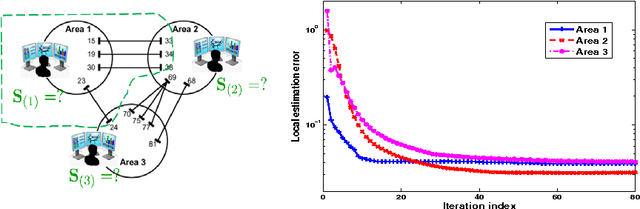
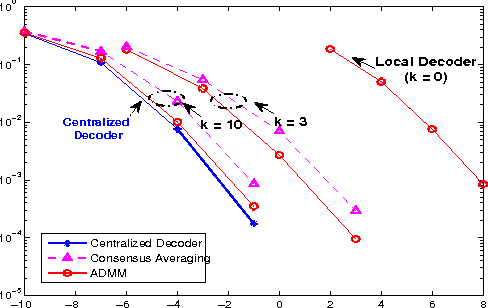
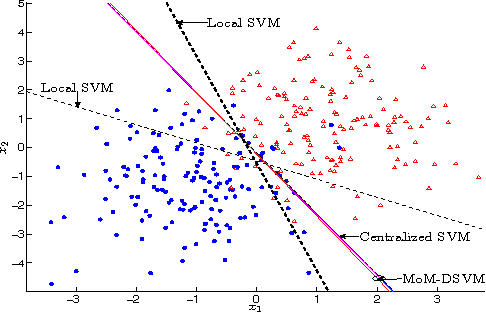
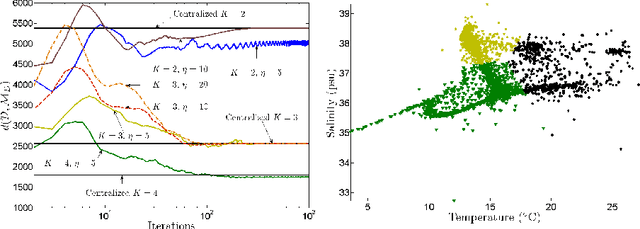
This chapter deals with decentralized learning algorithms for in-network processing of graph-valued data. A generic learning problem is formulated and recast into a separable form, which is iteratively minimized using the alternating-direction method of multipliers (ADMM) so as to gain the desired degree of parallelization. Without exchanging elements from the distributed training sets and keeping inter-node communications at affordable levels, the local (per-node) learners consent to the desired quantity inferred globally, meaning the one obtained if the entire training data set were centrally available. Impact of the decentralized learning framework to contemporary wireless communications and networking tasks is illustrated through case studies including target tracking using wireless sensor networks, unveiling Internet traffic anomalies, power system state estimation, as well as spectrum cartography for wireless cognitive radio networks.