 Add to Chrome
 Add to Firefox
 Add to Edge
Rate-Utility Frontiers for Language Encodings: Comparing Tokens, Bytes, and Pixels Under Controlled Linguistic Content
Jul 17, 2026
Language models encode text as subword tokens, raw bytes, or rendered pixels, but these encodings are usually compared under modeling constraints that expose different amounts of linguistic content to models across different languages. We instead ask what each encoding preserves when both the content and the downstream capacity are controlled. Using verified parallel sentences across thirteen languages and five scripts, we compare tokens, bytes, and pixels through a shared bottleneck whose width is swept to trace rate-utility frontiers. This separates three quantities that are often conflated: the number of input positions an encoding creates, the latent capacity available after encoding, and the task-relevant information that survives compression. We evaluate three utilities: surface form preservation, cross-lingual sentence alignment, and topic classification. No encoding dominates across tasks or capacity regimes. Pixels preserve surface form best, bytes preserve cross-lingual alignment best, especially in same-script multilingual settings, and tokens support topic prediction best. These performances are not explained by sequence length alone. Short inputs can discard useful meaning, while long inputs can preserve information that compresses well. Choosing an encoding is therefore not a fixed preference for tokens, bytes, or pixels, but a rate-utility tradeoff that depends on the task, language mix, capacity regime, and compute budget.

Multilingual Pretraining for Pixel Language Models
May 27, 2025Pixel language models operate directly on images of rendered text, eliminating the need for a fixed vocabulary. While these models have demonstrated strong capabilities for downstream cross-lingual transfer, multilingual pretraining remains underexplored. We introduce PIXEL-M4, a model pretrained on four visually and linguistically diverse languages: English, Hindi, Ukrainian, and Simplified Chinese. Multilingual evaluations on semantic and syntactic tasks show that PIXEL-M4 outperforms an English-only counterpart on non-Latin scripts. Word-level probing analyses confirm that PIXEL-M4 captures rich linguistic features, even in languages not seen during pretraining. Furthermore, an analysis of its hidden representations shows that multilingual pretraining yields a semantic embedding space closely aligned across the languages used for pretraining. This work demonstrates that multilingual pretraining substantially enhances the capability of pixel language models to effectively support a diverse set of languages.
ImageChain: Advancing Sequential Image-to-Text Reasoning in Multimodal Large Language Models
Feb 26, 2025Reasoning over sequences of images remains a challenge for multimodal large language models (MLLMs). While recent models incorporate multi-image data during pre-training, they still struggle to recognize sequential structures, often treating images independently. This work introduces ImageChain, a framework that enhances MLLMs with sequential reasoning capabilities over image data by modeling visual sequences as a multi-turn conversation. In ImageChain, images are interleaved with corresponding textual descriptions to form a controlled dialogue that explicitly captures temporal dependencies and narrative progression. Our method optimizes for the task of next-scene description, where the model generates a context-aware description of an upcoming scene based on preceding visual and textual cues. We demonstrate that our approach improves performance on the next-scene description task -- achieving an average improvement from 3.7% to 19% in SimRate, a metric that quantifies semantic similarity to human-annotated ground truths. Moreover, ImageChain achieves robust zero-shot out-of-domain performance in applications ranging from comics to robotics. Extensive experiments validate that instruction-tuning in a multimodal, multi-turn conversation design is key to bridging the gap between static image understanding and temporally-aware reasoning.
CRAFT Your Dataset: Task-Specific Synthetic Dataset Generation Through Corpus Retrieval and Augmentation
Sep 03, 2024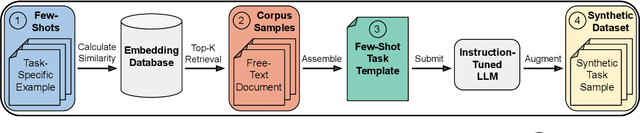
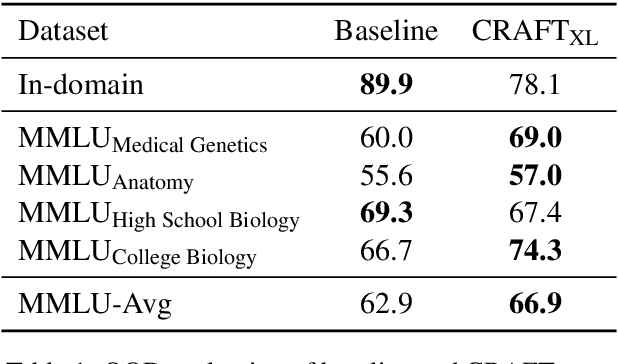
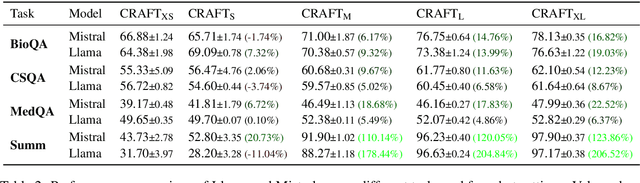
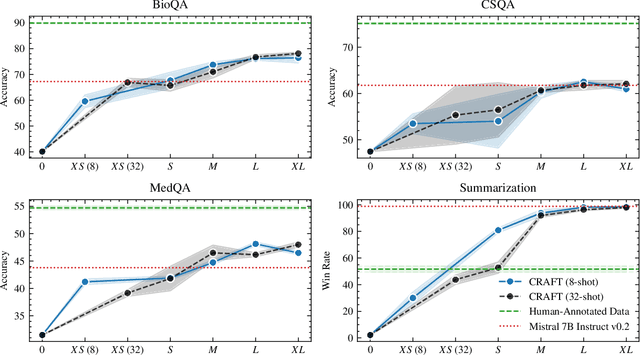
Building high-quality datasets for specialized tasks is a time-consuming and resource-intensive process that often requires specialized domain knowledge. We propose Corpus Retrieval and Augmentation for Fine-Tuning (CRAFT), a method for generating synthetic datasets, given a small number of user-written few-shots that demonstrate the task to be performed. Given the few-shot examples, we use large-scale public web-crawled corpora and similarity-based document retrieval to find other relevant human-written documents. Lastly, instruction-tuned large language models (LLMs) augment the retrieved documents into custom-formatted task samples, which then can be used for fine-tuning. We demonstrate that CRAFT can efficiently generate large-scale task-specific training datasets for four diverse tasks: biology question-answering (QA), medicine QA and commonsense QA as well as summarization. Our experiments show that CRAFT-based models outperform or achieve comparable performance to general LLMs for QA tasks, while CRAFT-based summarization models outperform models trained on human-curated data by 46 preference points.