 Add to Chrome
 Add to Firefox
 Add to Edge
An Efficient Gradient-Based Inference Attack for Federated Learning
Dec 17, 2025
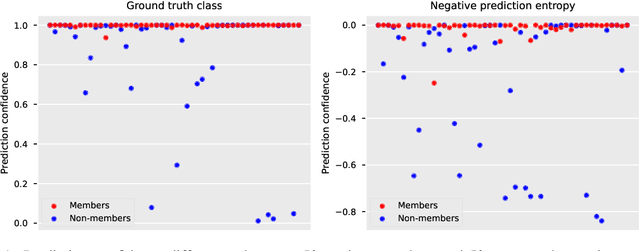
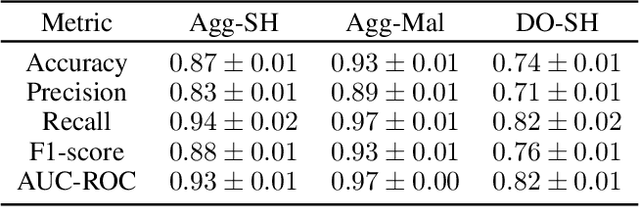
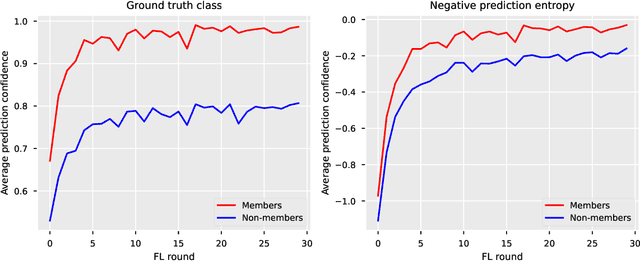
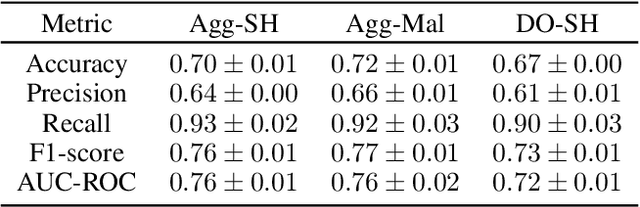
Federated Learning is a machine learning setting that reduces direct data exposure, improving the privacy guarantees of machine learning models. Yet, the exchange of model updates between the participants and the aggregator can still leak sensitive information. In this work, we present a new gradient-based membership inference attack for federated learning scenarios that exploits the temporal evolution of last-layer gradients across multiple federated rounds. Our method uses the shadow technique to learn round-wise gradient patterns of the training records, requiring no access to the private dataset, and is designed to consider both semi-honest and malicious adversaries (aggregators or data owners). Beyond membership inference, we also provide a natural extension of the proposed attack to discrete attribute inference by contrasting gradient responses under alternative attribute hypotheses. The proposed attacks are model-agnostic, and therefore applicable to any gradient-based model and can be applied to both classification and regression settings. We evaluate the attack on CIFAR-100 and Purchase100 datasets for membership inference and on Breast Cancer Wisconsin for attribute inference. Our findings reveal strong attack performance and comparable computational and memory overhead in membership inference when compared to another attack from the literature. The obtained results emphasize that multi-round federated learning can increase the vulnerability to inference attacks, that aggregators pose a more substantial threat than data owners, and that attack performance is strongly influenced by the nature of the training dataset, with richer, high-dimensional data leading to stronger leakage than simpler tabular data.

Cybersecurity threat detection based on a UEBA framework using Deep Autoencoders
May 14, 2025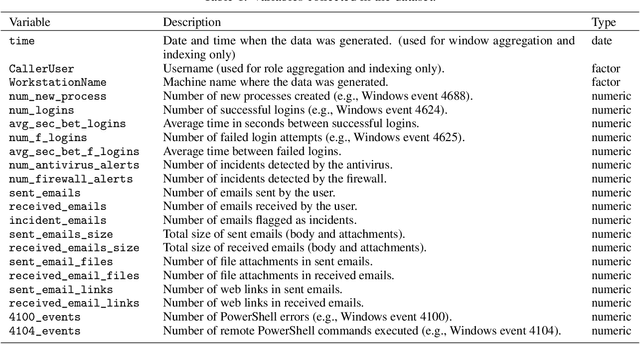
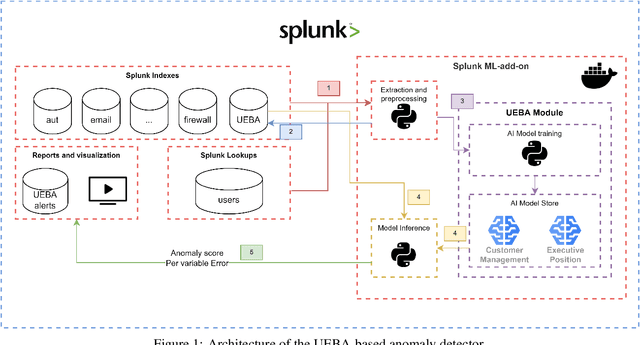
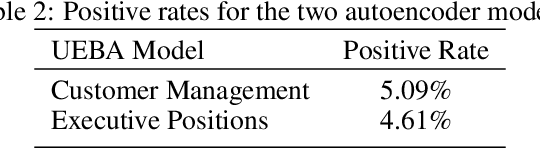
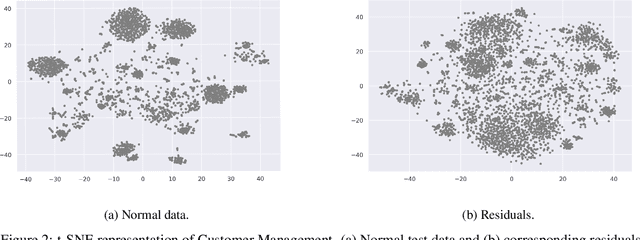
User and Entity Behaviour Analytics (UEBA) is a broad branch of data analytics that attempts to build a normal behavioural profile in order to detect anomalous events. Among the techniques used to detect anomalies, Deep Autoencoders constitute one of the most promising deep learning models on UEBA tasks, allowing explainable detection of security incidents that could lead to the leak of personal data, hijacking of systems, or access to sensitive business information. In this study, we introduce the first implementation of an explainable UEBA-based anomaly detection framework that leverages Deep Autoencoders in combination with Doc2Vec to process both numerical and textual features. Additionally, based on the theoretical foundations of neural networks, we offer a novel proof demonstrating the equivalence of two widely used definitions for fully-connected neural networks. The experimental results demonstrate the proposed framework capability to detect real and synthetic anomalies effectively generated from real attack data, showing that the models provide not only correct identification of anomalies but also explainable results that enable the reconstruction of the possible origin of the anomaly. Our findings suggest that the proposed UEBA framework can be seamlessly integrated into enterprise environments, complementing existing security systems for explainable threat detection.
neuralGAM: An R Package for Fitting Generalized Additive Neural Networks
May 13, 2025Nowadays, Neural Networks are considered one of the most effective methods for various tasks such as anomaly detection, computer-aided disease detection, or natural language processing. However, these networks suffer from the ``black-box'' problem which makes it difficult to understand how they make decisions. In order to solve this issue, an R package called neuralGAM is introduced. This package implements a Neural Network topology based on Generalized Additive Models, allowing to fit an independent Neural Network to estimate the contribution of each feature to the output variable, yielding a highly accurate and interpretable Deep Learning model. The neuralGAM package provides a flexible framework for training Generalized Additive Neural Networks, which does not impose any restrictions on the Neural Network architecture. We illustrate the use of the neuralGAM package in both synthetic and real data examples.