 Add to Chrome
 Add to Firefox
 Add to Edge
Simulating Students' Java Programming Errors with Large Language Models
Jun 12, 2026
Understanding student errors in the programming is a cornerstone of programming education, yet obtaining a representative set of student errors for any newly designed task remains slow and costly, since authentic submissions only accumulate after extensive classroom deployment. This paper explores whether large language models (LLMs) can serve as scalable proxies for students by simulating realistic logical errors in code submissions. Using the CodeWorkout dataset of 74,000+ unique student Java submissions across 37 problems, we evaluate five LLMs under three mainstream prompting strategies: Input-Output (IO), Chain-of-Thought (CoT), and iterative Self-Refine. We assess performance along two key dimensions: diversity (the range of distinct error patterns) and alignment (alignment with authentic student mistakes), and examine how these vary by struggling level of programming tasks. Our quantitative findings reveal that while all models generate diverse errors, their alignment to human submissions diverges: Claude Sonnet 4 achieves the most balanced performance. In addition, we conducted a blinded expert annotation study (N = 401) comparing synthetic and authentic errors. This qualitative analysis confirms that the generated errors are functionally indistinguishable from authentic student errors. Moreover, higher-struggling-level problems elicit more diverse but less student-like errors. These results highlight trade-offs in using LLMs to simulate human learners and suggest design considerations for integrating synthetic errors into teachable agents, intelligent tutoring systems, and large-scale learning analytics.

LLMs in HCI Data Work: Bridging the Gap Between Information Retrieval and Responsible Research Practices
Mar 27, 2024
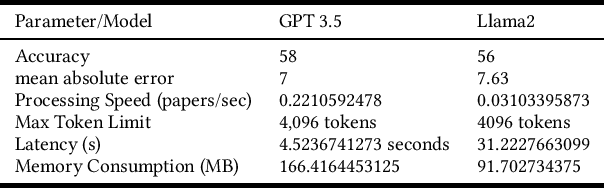
Efficient and accurate information extraction from scientific papers is significant in the rapidly developing human-computer interaction research in the literature review process. Our paper introduces and analyses a new information retrieval system using state-of-the-art Large Language Models (LLMs) in combination with structured text analysis techniques to extract experimental data from HCI literature, emphasizing key elements. Then We analyze the challenges and risks of using LLMs in the world of research. We performed a comprehensive analysis on our conducted dataset, which contained the specified information of 300 CHI 2020-2022 papers, to evaluate the performance of the two large language models, GPT-3.5 (text-davinci-003) and Llama-2-70b, paired with structured text analysis techniques. The GPT-3.5 model gains an accuracy of 58\% and a mean absolute error of 7.00. In contrast, the Llama2 model indicates an accuracy of 56\% with a mean absolute error of 7.63. The ability to answer questions was also included in the system in order to work with streamlined data. By evaluating the risks and opportunities presented by LLMs, our work contributes to the ongoing dialogue on establishing methodological validity and ethical guidelines for LLM use in HCI data work.