 Add to Chrome
 Add to Firefox
 Add to Edge
Multitask learning with semiempirical orbital charges enables sample-efficient MLIPs
May 22, 2026
Machine learning interatomic potentials (MLIPs) require generating computationally expensive, large-scale training datasets to accurately simulate materials and molecules. Incorporating electronic structure information using multitask learning improves sample efficiency, however, training on full Hamiltonian matrices, which scale quadratically with the number of atoms, is intractable for large datasets. In this work, we show that multitask learning utilizing orbitally resolved semiempirical charges significantly improves sample efficiency and accuracy in MLIPs. To efficiently predict orbital charges, we implement a specialized equivariant model, reducing charge prediction error compared to an invariant baseline. By augmenting training with computationally inexpensive GFN1-xTB orbital charges, which scale linearly with the number of atoms, our model achieves a 46\% reduction in energy mean absolute error and requires five times less data to match the performance of energy-only models. Furthermore, our approach outperforms models trained on expensive density functional theory (DFT) atomic charges, capturing orbitally resolved electronic complexity and forcing the network to learn a physically accurate latent space that spontaneously clusters metals by shared chemical properties. Because orbital charges are only required during training, this approach preserves inference efficiency, providing a scalable recipe for developing accurate, data-efficient foundation models for complex chemical systems.

Efficient Biological Data Acquisition through Inference Set Design
Oct 25, 2024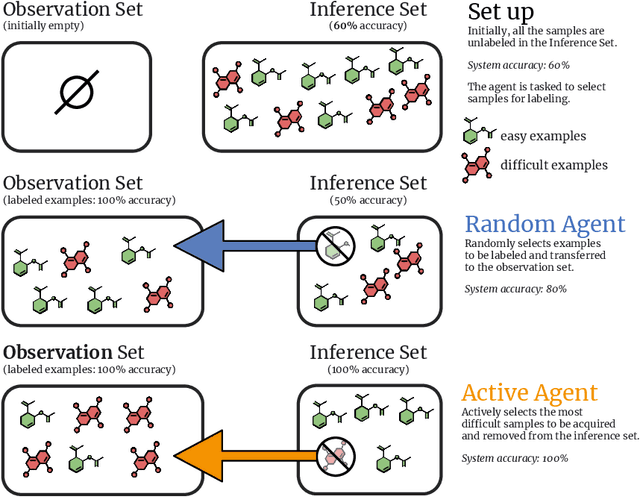
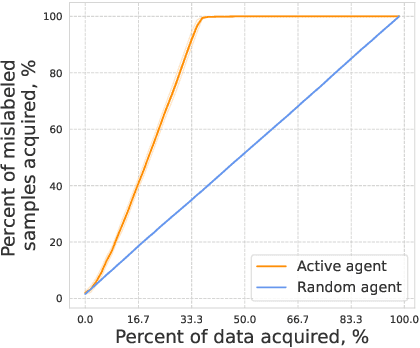
In drug discovery, highly automated high-throughput laboratories are used to screen a large number of compounds in search of effective drugs. These experiments are expensive, so we might hope to reduce their cost by experimenting on a subset of the compounds, and predicting the outcomes of the remaining experiments. In this work, we model this scenario as a sequential subset selection problem: we aim to select the smallest set of candidates in order to achieve some desired level of accuracy for the system as a whole. Our key observation is that, if there is heterogeneity in the difficulty of the prediction problem across the input space, selectively obtaining the labels for the hardest examples in the acquisition pool will leave only the relatively easy examples to remain in the inference set, leading to better overall system performance. We call this mechanism inference set design, and propose the use of an uncertainty-based active learning solution to prune out these challenging examples. Our algorithm includes an explicit stopping criterion that stops running the experiments when it is sufficiently confident that the system has reached the target performance. Our empirical studies on image and molecular datasets, as well as a real-world large-scale biological assay, show that deploying active learning for inference set design leads to significant reduction in experimental cost while obtaining high system performance.