 Add to Chrome
 Add to Firefox
 Add to Edge
Architectural Backdoors in Vision-Language Model Supply Chains via Representation Steering
Jul 28, 2026
Vision--Language Models (VLMs) are increasingly deployed through a model supply chain in which pretrained checkpoints, architecture definitions, text encoders, and exported computation graphs are distributed by third parties and reused across downstream services. This reuse model creates a security-critical trust boundary: VLM deployments inherit not only learned parameters but also executable behavior encoded in shared model artifacts. In this paper, we show that a malicious provider can exploit this trust boundary by embedding architectural backdoors into VLM supply chains through representation steering. Our attack introduces dormant steering logic into the model architecture through a trigger-gated additive modification of an intermediate representation, without poisoning training data, controlling downstream fine-tuning, or modifying prompts at deployment time. When the trigger is absent, the modification reduces to zero and the model follows its normal computation, preserving clean utility. When the trigger is present, a steering direction shifts the internal representation toward an attacker-defined objective. We evaluate the attack across multiple VLM families and downstream tasks, including visual question answering, text-to-image generation, retrieval, and semantic response biasing. The results show that the proposed architectural steering backdoor compromises integrity, safety enforcement, and ranking fairness while preserving normal behavior on clean inputs. We further show that shared VLM artifacts can carry dormant steering logic against downstream services, and we propose an auditing defense that inspects the executable logic distributed with model artifacts rather than only their learned weights.

Harnessing Hyperbolic Geometry for Harmful Prompt Detection and Sanitization
Apr 07, 2026Vision-Language Models (VLMs) have become essential for tasks such as image synthesis, captioning, and retrieval by aligning textual and visual information in a shared embedding space. Yet, this flexibility also makes them vulnerable to malicious prompts designed to produce unsafe content, raising critical safety concerns. Existing defenses either rely on blacklist filters, which are easily circumvented, or on heavy classifier-based systems, both of which are costly and fragile under embedding-level attacks. We address these challenges with two complementary components: Hyperbolic Prompt Espial (HyPE) and Hyperbolic Prompt Sanitization (HyPS). HyPE is a lightweight anomaly detector that leverages the structured geometry of hyperbolic space to model benign prompts and detect harmful ones as outliers. HyPS builds on this detection by applying explainable attribution methods to identify and selectively modify harmful words, neutralizing unsafe intent while preserving the original semantics of user prompts. Through extensive experiments across multiple datasets and adversarial scenarios, we prove that our framework consistently outperforms prior defenses in both detection accuracy and robustness. Together, HyPE and HyPS offer an efficient, interpretable, and resilient approach to safeguarding VLMs against malicious prompt misuse.
Robust image classification with multi-modal large language models
Dec 13, 2024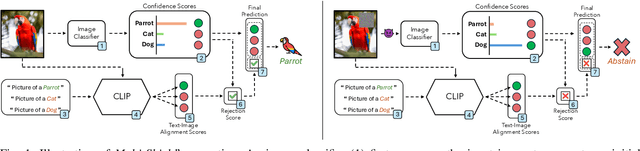
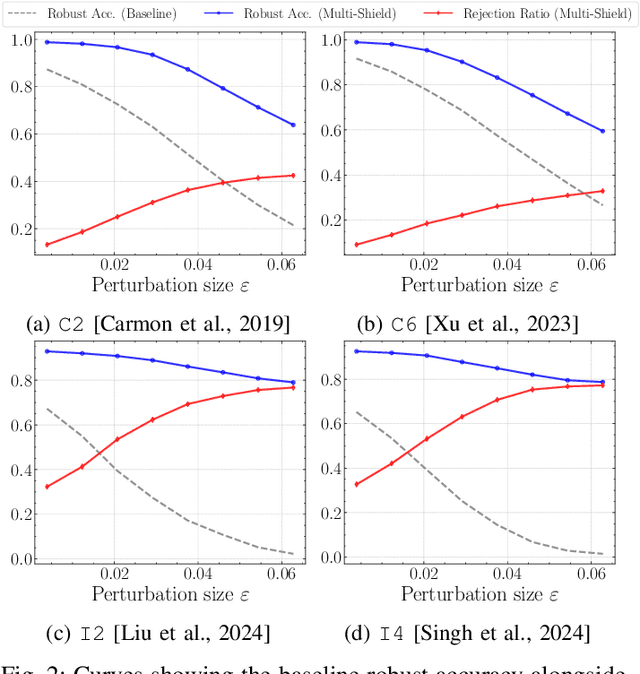
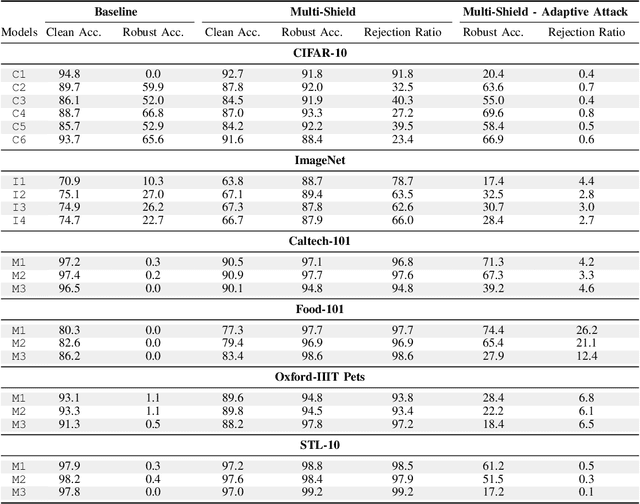
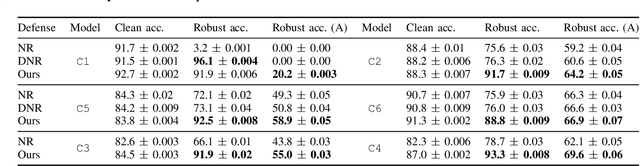
Deep Neural Networks are vulnerable to adversarial examples, i.e., carefully crafted input samples that can cause models to make incorrect predictions with high confidence. To mitigate these vulnerabilities, adversarial training and detection-based defenses have been proposed to strengthen models in advance. However, most of these approaches focus on a single data modality, overlooking the relationships between visual patterns and textual descriptions of the input. In this paper, we propose a novel defense, Multi-Shield, designed to combine and complement these defenses with multi-modal information to further enhance their robustness. Multi-Shield leverages multi-modal large language models to detect adversarial examples and abstain from uncertain classifications when there is no alignment between textual and visual representations of the input. Extensive evaluations on CIFAR-10 and ImageNet datasets, using robust and non-robust image classification models, demonstrate that Multi-Shield can be easily integrated to detect and reject adversarial examples, outperforming the original defenses.