 Add to Chrome
 Add to Firefox
 Add to Edge
FLASH-MAXSIM: IO-Aware Fused Kernels for Late-Interaction Scoring
May 28, 2026
Late-interaction retrieval (ColBERT, ColPali) scores a query against a document with the MaxSim operator: for every query token, the maximum similarity over the document tokens, summed over query tokens. The standard implementation materializes the full query-token x document-token similarity tensor in GPU memory; for visual ColPali at 10K documents this tensor alone is 21 GB in FP16, created only to be reduced to one score per document and discarded. It exhausts a 40 GB GPU and bounds the achievable batch size in both inference and training. We present Flash-MaxSim, an IO-aware fused GPU kernel that computes exactly the same scores without ever materializing the tensor, by streaming query and document tiles through on-chip SRAM and folding the row-maximum reduction into the same pass. We extend the IO-aware principle through the training backward pass, an inverse-grid CSR construction that reuses the forward argmax for an atomic-free, destination-owned gradient reduction, and through INT8xINT8 quantization and variable-length (padding-free) scoring. Flash-MaxSim is up to 3.9x faster on an A100 (4.7x on an H100) than naive PyTorch at matched precision, uses up to 16x less inference memory and ~28x less training memory, unlocks corpus and batch sizes that exhaust PyTorch entirely, preserves the exact ranking (100% top-20 agreement with an FP32 reference)

VAREX: A Benchmark for Multi-Modal Structured Extraction from Documents
Mar 16, 2026We introduce VAREX (VARied-schema EXtraction), a benchmark for evaluating multimodal foundation models on structured data extraction from government forms. VAREX employs a Reverse Annotation pipeline that programmatically fills PDF templates with synthetic values, producing deterministic ground truth validated through three-phase quality assurance. The benchmark comprises 1,777 documents with 1,771 unique schemas across three structural categories, each provided in four input modalities: plain text, layout-preserving text (whitespace-aligned to approximate column positions), document image, or both text and image combined. Unlike existing benchmarks that evaluate from a single input representation, VAREX provides four controlled modalities per document, enabling systematic ablation of how input format affects extraction accuracy -- a capability absent from prior benchmarks. We evaluate 20 models from frontier proprietary models to small open models, with particular attention to models <=4B parameters suitable for cost-sensitive and latency-constrained deployment. Results reveal that (1) below 4B parameters, structured output compliance -- not extraction capability -- is a dominant bottleneck; in particular, schema echo (models producing schema-conforming structure instead of extracted values) depresses scores by 45-65 pp (percentage points) in affected models; (2) extraction-specific fine-tuning at 2B yields +81 pp gains, demonstrating that the instruction-following deficit is addressable without scale; (3) layout-preserving text provides the largest accuracy gain (+3-18 pp), exceeding pixel-level visual cues; and (4) the benchmark most effectively discriminates models in the 60-95% accuracy band. Dataset and evaluation code are publicly available.
Col-Bandit: Zero-Shot Query-Time Pruning for Late-Interaction Retrieval
Feb 02, 2026Multi-vector late-interaction retrievers such as ColBERT achieve state-of-the-art retrieval quality, but their query-time cost is dominated by exhaustively computing token-level MaxSim interactions for every candidate document. While approximating late interaction with single-vector representations reduces cost, it often incurs substantial accuracy loss. We introduce Col-Bandit, a query-time pruning algorithm that reduces this computational burden by casting reranking as a finite-population Top-$K$ identification problem. Col-Bandit maintains uncertainty-aware bounds over partially observed document scores and adaptively reveals only the (document, query token) MaxSim entries needed to determine the top results under statistical decision bounds with a tunable relaxation. Unlike coarse-grained approaches that prune entire documents or tokens offline, Col-Bandit sparsifies the interaction matrix on the fly. It operates as a zero-shot, drop-in layer over standard multi-vector systems, requiring no index modifications, offline preprocessing, or model retraining. Experiments on textual (BEIR) and multimodal (REAL-MM-RAG) benchmarks show that Col-Bandit preserves ranking fidelity while reducing MaxSim FLOPs by up to 5$\times$, indicating that dense late-interaction scoring contains substantial redundancy that can be identified and pruned efficiently at query time.
KVP10k : A Comprehensive Dataset for Key-Value Pair Extraction in Business Documents
May 01, 2024
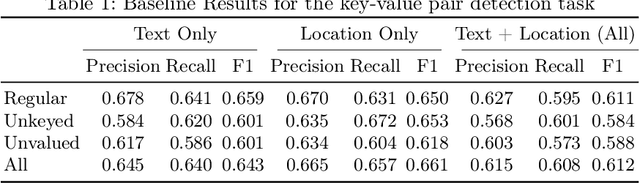

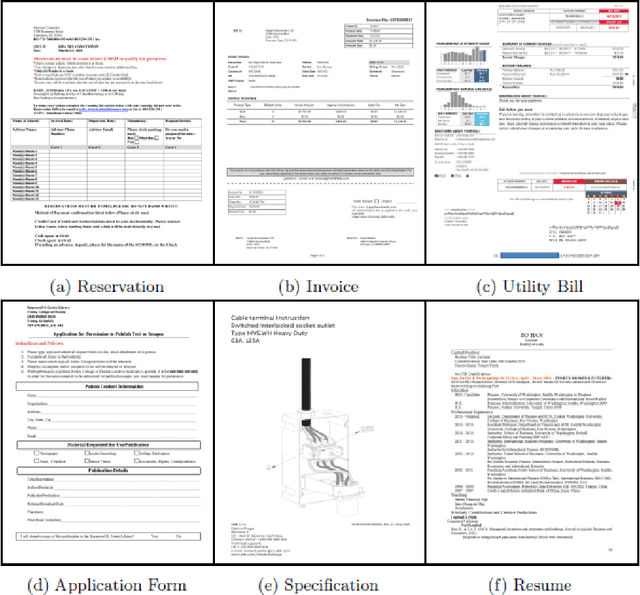
In recent years, the challenge of extracting information from business documents has emerged as a critical task, finding applications across numerous domains. This effort has attracted substantial interest from both industry and academy, highlighting its significance in the current technological landscape. Most datasets in this area are primarily focused on Key Information Extraction (KIE), where the extraction process revolves around extracting information using a specific, predefined set of keys. Unlike most existing datasets and benchmarks, our focus is on discovering key-value pairs (KVPs) without relying on predefined keys, navigating through an array of diverse templates and complex layouts. This task presents unique challenges, primarily due to the absence of comprehensive datasets and benchmarks tailored for non-predetermined KVP extraction. To address this gap, we introduce KVP10k , a new dataset and benchmark specifically designed for KVP extraction. The dataset contains 10707 richly annotated images. In our benchmark, we also introduce a new challenging task that combines elements of KIE as well as KVP in a single task. KVP10k sets itself apart with its extensive diversity in data and richly detailed annotations, paving the way for advancements in the field of information extraction from complex business documents.