 Add to Chrome
 Add to Firefox
 Add to Edge
Stabilizing Direct Training of Spiking Neural Networks: Membrane Potential Initialization and Threshold-robust Surrogate Gradient
Nov 11, 2025
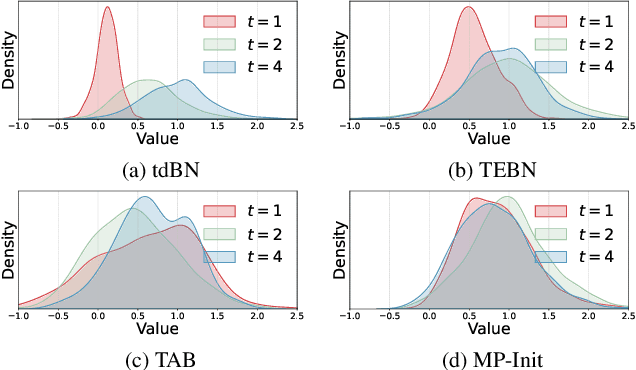
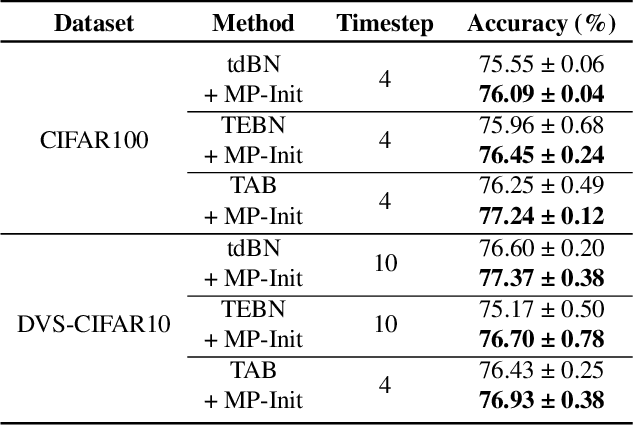
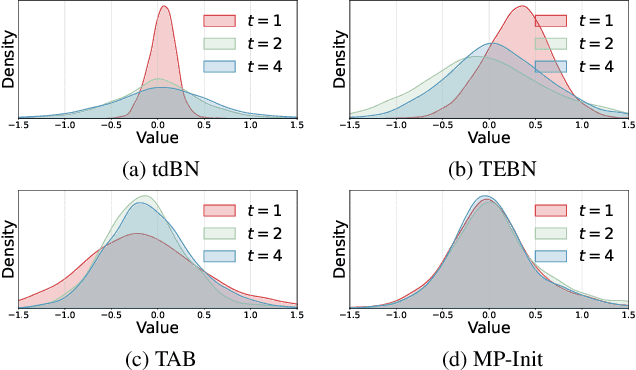
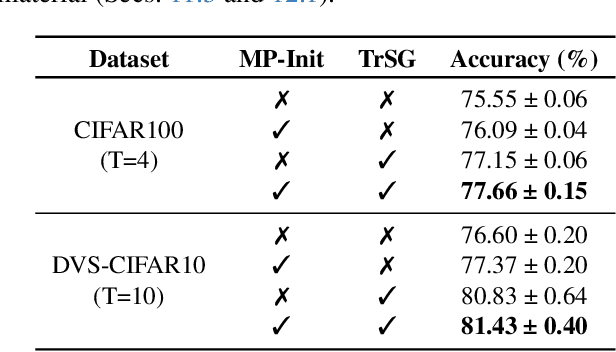
Recent advancements in the direct training of Spiking Neural Networks (SNNs) have demonstrated high-quality outputs even at early timesteps, paving the way for novel energy-efficient AI paradigms. However, the inherent non-linearity and temporal dependencies in SNNs introduce persistent challenges, such as temporal covariate shift (TCS) and unstable gradient flow with learnable neuron thresholds. In this paper, we present two key innovations: MP-Init (Membrane Potential Initialization) and TrSG (Threshold-robust Surrogate Gradient). MP-Init addresses TCS by aligning the initial membrane potential with its stationary distribution, while TrSG stabilizes gradient flow with respect to threshold voltage during training. Extensive experiments validate our approach, achieving state-of-the-art accuracy on both static and dynamic image datasets. The code is available at: https://github.com/kookhh0827/SNN-MP-Init-TRSG

Grouped Speculative Decoding for Autoregressive Image Generation
Aug 11, 2025Recently, autoregressive (AR) image models have demonstrated remarkable generative capabilities, positioning themselves as a compelling alternative to diffusion models. However, their sequential nature leads to long inference times, limiting their practical scalability. In this work, we introduce Grouped Speculative Decoding (GSD), a novel, training-free acceleration method for AR image models. While recent studies have explored Speculative Decoding (SD) as a means to speed up AR image generation, existing approaches either provide only modest acceleration or require additional training. Our in-depth analysis reveals a fundamental difference between language and image tokens: image tokens exhibit inherent redundancy and diversity, meaning multiple tokens can convey valid semantics. However, traditional SD methods are designed to accept only a single most-likely token, which fails to leverage this difference, leading to excessive false-negative rejections. To address this, we propose a new SD strategy that evaluates clusters of visually valid tokens rather than relying on a single target token. Additionally, we observe that static clustering based on embedding distance is ineffective, which motivates our dynamic GSD approach. Extensive experiments show that GSD accelerates AR image models by an average of 3.7x while preserving image quality-all without requiring any additional training. The source code is available at https://github.com/junhyukso/GSD