 Add to Chrome
 Add to Firefox
 Add to Edge
DIG to Heal: Scaling General-purpose Agent Collaboration via Explainable Dynamic Decision Paths
Feb 27, 2026
The increasingly popular agentic AI paradigm promises to harness the power of multiple, general-purpose large language model (LLM) agents to collaboratively complete complex tasks. While many agentic AI systems utilize predefined workflows or agent roles in order to reduce complexity, ideally these agents would be truly autonomous, able to achieve emergent collaboration even as the number of collaborating agents increases. Yet in practice, such unstructured interactions can lead to redundant work and cascading failures that are difficult to interpret or correct. In this work, we study multi-agent systems composed of general-purpose LLM agents that operate without predefined roles, control flow, or communication constraints, relying instead on emergent collaboration to solve problems. We introduce the Dynamic Interaction Graph (DIG), which captures emergent collaboration as a time-evolving causal network of agent activations and interactions. DIG makes emergent collaboration observable and explainable for the first time, enabling real-time identification, explanation, and correction of collaboration-induced error patterns directly from agents' collaboration paths. Thus, DIG fills a critical gap in understanding how general LLM agents solve problems together in truly agentic multi-agent systems. The project webpage can be found at: https://happyeureka.github.io/dig.

Shared Disk KV Cache Management for Efficient Multi-Instance Inference in RAG-Powered LLMs
Apr 16, 2025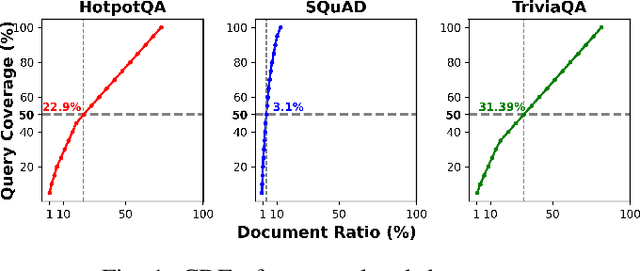
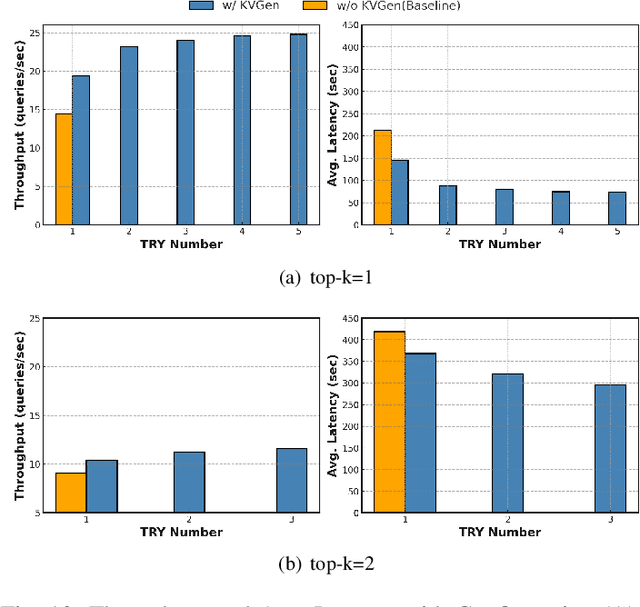
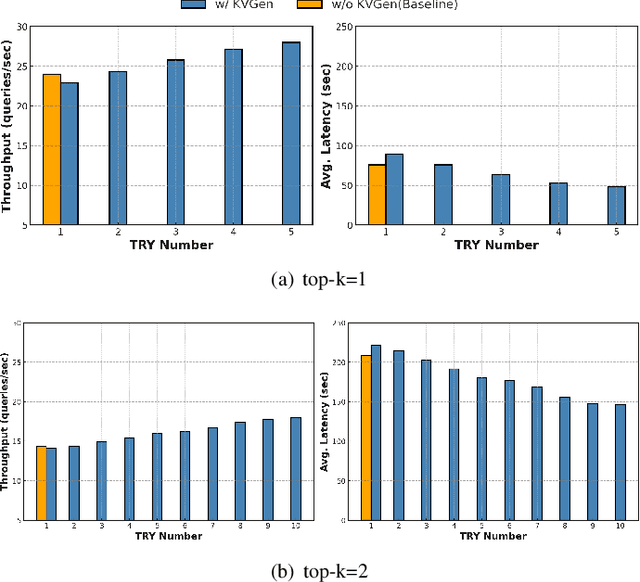
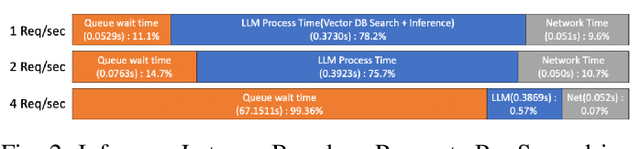
Recent large language models (LLMs) face increasing inference latency as input context length and model size continue to grow. In particular, the retrieval-augmented generation (RAG) technique, which enhances LLM responses by incorporating external knowledge, exacerbates this issue by significantly increasing the number of input tokens. This expansion in token length leads to a substantial rise in computational overhead, particularly during the prefill stage, resulting in prolonged time-to-first-token (TTFT). To address this issue, this paper proposes a method to reduce TTFT by leveraging a disk-based key-value (KV) cache to lessen the computational burden during the prefill stage. We also introduce a disk-based shared KV cache management system, called Shared RAG-DCache, for multi-instance LLM RAG service environments. This system, together with an optimal system configuration, improves both throughput and latency under given resource constraints. Shared RAG-DCache exploits the locality of documents related to user queries in RAG, as well as the queueing delay in LLM inference services. It proactively generates and stores disk KV caches for query-related documents and shares them across multiple LLM instances to enhance inference performance. In experiments on a single host equipped with 2 GPUs and 1 CPU, Shared RAG-DCache achieved a 15~71% increase in throughput and up to a 12~65% reduction in latency, depending on the resource configuration.