 Add to Chrome
 Add to Firefox
 Add to Edge
Cross-Modal Consistency-Guided Active Learning for Affective BCI Systems
Nov 19, 2025
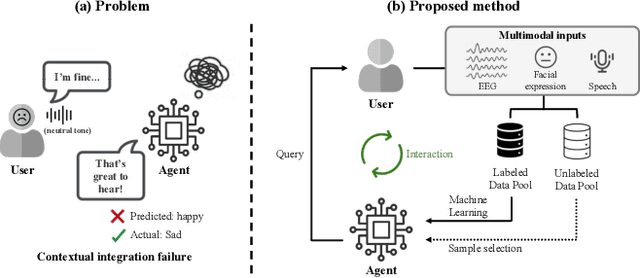
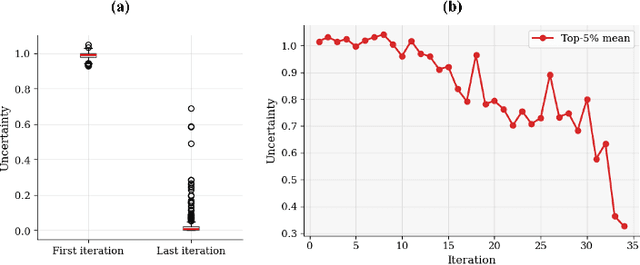
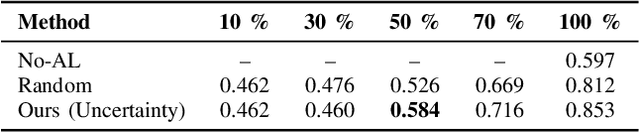
Deep learning models perform best with abundant, high-quality labels, yet such conditions are rarely achievable in EEG-based emotion recognition. Electroencephalogram (EEG) signals are easily corrupted by artifacts and individual variability, while emotional labels often stem from subjective and inconsistent reports-making robust affective decoding particularly difficult. We propose an uncertainty-aware active learning framework that enhances robustness to label noise by jointly leveraging model uncertainty and cross-modal consistency. Instead of relying solely on EEG-based uncertainty estimates, the method evaluates cross-modal alignment to determine whether uncertainty originates from cognitive ambiguity or sensor noise. A representation alignment module embeds EEG and face features into a shared latent space, enforcing semantic coherence between modalities. Residual discrepancies are treated as noise-induced inconsistencies, and these samples are selectively queried for oracle feedback during active learning. This feedback-driven process guides the network toward reliable, informative samples and reduces the impact of noisy labels. Experiments on the ASCERTAIN dataset examine the efficiency and robustness of ours, highlighting its potential as a data-efficient and noise-tolerant approach for EEG-based affective decoding in brain-computer interface systems.

Uncertainty-Aware Cross-Modal Knowledge Distillation with Prototype Learning for Multimodal Brain-Computer Interfaces
Jul 17, 2025Electroencephalography (EEG) is a fundamental modality for cognitive state monitoring in brain-computer interfaces (BCIs). However, it is highly susceptible to intrinsic signal errors and human-induced labeling errors, which lead to label noise and ultimately degrade model performance. To enhance EEG learning, multimodal knowledge distillation (KD) has been explored to transfer knowledge from visual models with rich representations to EEG-based models. Nevertheless, KD faces two key challenges: modality gap and soft label misalignment. The former arises from the heterogeneous nature of EEG and visual feature spaces, while the latter stems from label inconsistencies that create discrepancies between ground truth labels and distillation targets. This paper addresses semantic uncertainty caused by ambiguous features and weakly defined labels. We propose a novel cross-modal knowledge distillation framework that mitigates both modality and label inconsistencies. It aligns feature semantics through a prototype-based similarity module and introduces a task-specific distillation head to resolve label-induced inconsistency in supervision. Experimental results demonstrate that our approach improves EEG-based emotion regression and classification performance, outperforming both unimodal and multimodal baselines on a public multimodal dataset. These findings highlight the potential of our framework for BCI applications.