 Add to Chrome
 Add to Firefox
 Add to Edge
SLIM: Semantic-based Low-bitrate Image compression for Machines by leveraging diffusion
Dec 23, 2025
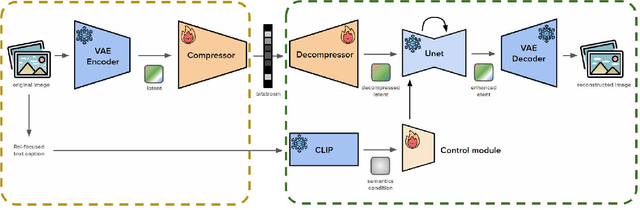
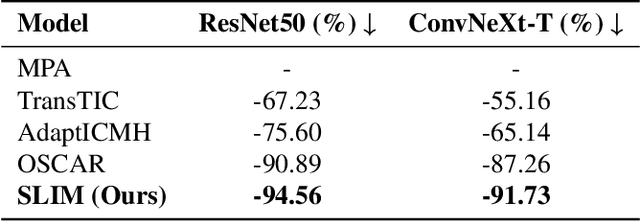
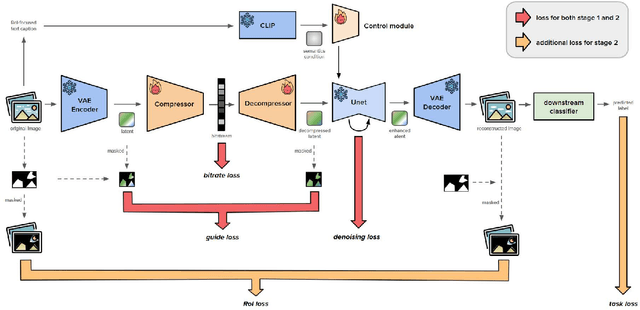
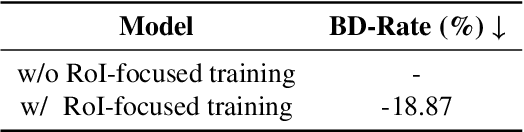
In recent years, the demand of image compression models for machine vision has increased dramatically. However, the training frameworks of image compression still focus on the vision of human, maintaining the excessive perceptual details, thus have limitations in optimally reducing the bits per pixel in the case of performing machine vision tasks. In this paper, we propose Semantic-based Low-bitrate Image compression for Machines by leveraging diffusion, termed SLIM. This is a new effective training framework of image compression for machine vision, using a pretrained latent diffusion model.The compressor model of our method focuses only on the Region-of-Interest (RoI) areas for machine vision in the image latent, to compress it compactly. Then the pretrained Unet model enhances the decompressed latent, utilizing a RoI-focused text caption which containing semantic information of the image. Therefore, SLIM is able to focus on RoI areas of the image without any guide mask at the inference stage, achieving low bitrate when compressing. And SLIM is also able to enhance a decompressed latent by denoising steps, so the final reconstructed image from the enhanced latent can be optimized for the machine vision task while still containing perceptual details for human vision. Experimental results show that SLIM achieves a higher classification accuracy in the same bits per pixel condition, compared to conventional image compression models for machines.

LLMail-Inject: A Dataset from a Realistic Adaptive Prompt Injection Challenge
Jun 11, 2025Indirect Prompt Injection attacks exploit the inherent limitation of Large Language Models (LLMs) to distinguish between instructions and data in their inputs. Despite numerous defense proposals, the systematic evaluation against adaptive adversaries remains limited, even when successful attacks can have wide security and privacy implications, and many real-world LLM-based applications remain vulnerable. We present the results of LLMail-Inject, a public challenge simulating a realistic scenario in which participants adaptively attempted to inject malicious instructions into emails in order to trigger unauthorized tool calls in an LLM-based email assistant. The challenge spanned multiple defense strategies, LLM architectures, and retrieval configurations, resulting in a dataset of 208,095 unique attack submissions from 839 participants. We release the challenge code, the full dataset of submissions, and our analysis demonstrating how this data can provide new insights into the instruction-data separation problem. We hope this will serve as a foundation for future research towards practical structural solutions to prompt injection.