 Add to Chrome
 Add to Firefox
 Add to Edge
Detecting the Undetectable: Enhancing Unsupervised time series Anomaly Detection via Active Learning
Jul 01, 2026
Despite the increasing sophistication of industrial AI systems, the ability to reliably detect subtle and noisy anomalies in complex time series data remains a critical yet unresolved challenge. In large-scale industrial applications, labeling time series data is often prohibitively expensive and time-consuming, making unsupervised learning a practical and widely adopted approach. However, existing unsupervised methods frequently struggle to distinguish near-normal anomalies from normal patterns and are vulnerable to noise contamination within normal samples. To address these limitations, we propose a novel framework that leverages active learning to iteratively enhance the performance of unsupervised models. Our framework's core contributions are (1) a masked time-series reconstruction feedback strategy that forces the model to learn robust temporal dependencies, and (2) a minimax learning strategy that promotes robustness by differentially treating normal and abnormal samples. This process encourages the model to better capture the dynamics of subtle and noisy patterns. The proposed framework is evaluated across 28 test cases involving four multivariate time-series datasets and seven unsupervised backbone models. Experimental results demonstrate a 12.39% improvement in AUC compared to the original models, confirming that our method can be readily integrated into existing unsupervised reconstruction-based anomaly detection systems to significantly enhance their performance.

Detecting Time Series Anomalies Like an Expert: A Multi-Agent LLM Framework with Specialized Analyzers
May 07, 2026Recent studies have explored large language models for time-series anomaly detection, yet existing approaches often rely on a single general-purpose model to directly infer anomaly indices or intervals, limiting controllability, interpretability, and reliability for complex anomaly patterns. We propose SAGE (Specialized Analyzer Group for Expert-like Detection), a multi-agent framework for structured anomaly diagnosis in univariate time series. It decomposes anomaly analysis into four specialized Analyzers for point, structural, seasonal, and pattern anomalies. Each Analyzer applies family-specific numerical tools and diagnostic visualizations to generate evidence, while an evidence-grounded Detector consolidates the evidence into confidence-scored anomaly records with intervals and candidate types. A Supervisor then converts these structured records into analyst-facing diagnostic reports. SAGE further constructs synthetic in-context examples from normal-reference training segments, without using real anomalous segments or anomaly-type labels as in-context examples. Across three benchmarks, SAGE achieves the best average performance among strong ML/DL and language-model-based baselines. Ablation studies and human evaluation further show that the proposed framework improves detection reliability and the practical usefulness of diagnostic outputs.
Forecasting Anomaly Precursors via Uncertainty-Aware Time-Series Ensembles
Feb 19, 2026Detecting anomalies in time-series data is critical in domains such as industrial operations, finance, and cybersecurity, where early identification of abnormal patterns is essential for ensuring system reliability and enabling preventive maintenance. However, most existing methods are reactive: they detect anomalies only after they occur and lack the capability to provide proactive early warning signals. In this paper, we propose FATE (Forecasting Anomalies with Time-series Ensembles), a novel unsupervised framework for detecting Precursors-of-Anomaly (PoA) by quantifying predictive uncertainty from a diverse ensemble of time-series forecasting models. Unlike prior approaches that rely on reconstruction errors or require ground-truth labels, FATE anticipates future values and leverages ensemble disagreement to signal early signs of potential anomalies without access to target values at inference time. To rigorously evaluate PoA detection, we introduce Precursor Time-series Aware Precision and Recall (PTaPR), a new metric that extends the traditional Time-series Aware Precision and Recall (TaPR) by jointly assessing segment-level accuracy, within-segment coverage, and temporal promptness of early predictions. This enables a more holistic assessment of early warning capabilities that existing metrics overlook. Experiments on five real-world benchmark datasets show that FATE achieves an average improvement of 19.9 percentage points in PTaPR AUC and 20.02 percentage points in early detection F1 score, outperforming baselines while requiring no anomaly labels. These results demonstrate the effectiveness and practicality of FATE for real-time unsupervised early warning in complex time-series environments.
COMET: Codebook-based Online-adaptive Multi-scale Embedding for Time-series Anomaly Detection
Feb 03, 2026Time series anomaly detection is a critical task across various industrial domains. However, capturing temporal dependencies and multivariate correlations within patch-level representation learning remains underexplored, and reliance on single-scale patterns limits the detection of anomalies across different temporal ranges. Furthermore, focusing on normal data representations makes models vulnerable to distribution shifts at inference time. To address these limitations, we propose Codebook-based Online-adaptive Multi-scale Embedding for Time-series anomaly detection (COMET), which consists of three key components: (1) Multi-scale Patch Encoding captures temporal dependencies and inter-variable correlations across multiple patch scales. (2) Vector-Quantized Coreset learns representative normal patterns via codebook and detects anomalies with a dual-score combining quantization error and memory distance. (3) Online Codebook Adaptation generates pseudo-labels based on codebook entries and dynamically adapts the model at inference through contrastive learning. Experiments on five benchmark datasets demonstrate that COMET achieves the best performance in 36 out of 45 evaluation metrics, validating its effectiveness across diverse environments.
RAPID: Training-free Retrieval-based Log Anomaly Detection with PLM considering Token-level information
Nov 09, 2023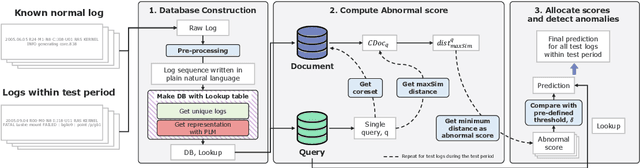
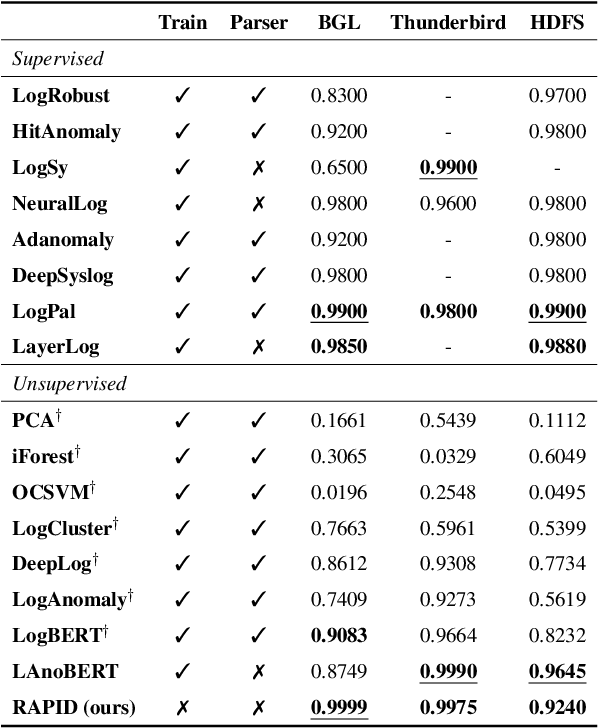
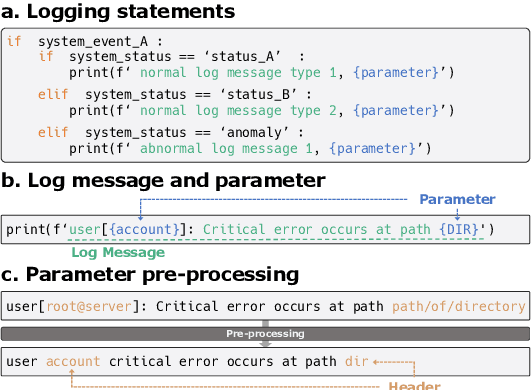
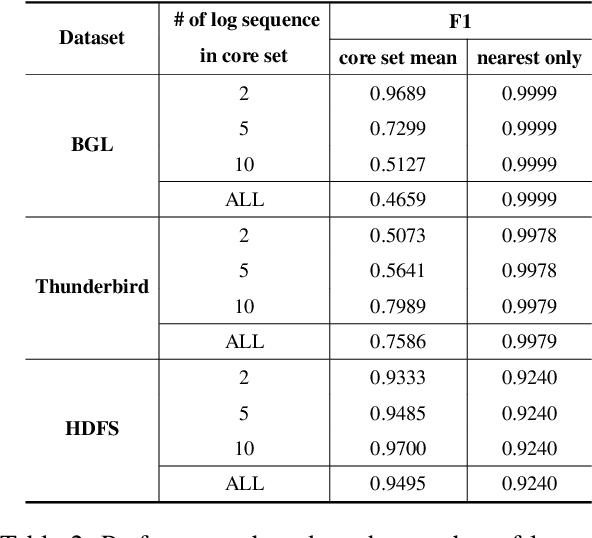
As the IT industry advances, system log data becomes increasingly crucial. Many computer systems rely on log texts for management due to restricted access to source code. The need for log anomaly detection is growing, especially in real-world applications, but identifying anomalies in rapidly accumulating logs remains a challenging task. Traditional deep learning-based anomaly detection models require dataset-specific training, leading to corresponding delays. Notably, most methods only focus on sequence-level log information, which makes the detection of subtle anomalies harder, and often involve inference processes that are difficult to utilize in real-time. We introduce RAPID, a model that capitalizes on the inherent features of log data to enable anomaly detection without training delays, ensuring real-time capability. RAPID treats logs as natural language, extracting representations using pre-trained language models. Given that logs can be categorized based on system context, we implement a retrieval-based technique to contrast test logs with the most similar normal logs. This strategy not only obviates the need for log-specific training but also adeptly incorporates token-level information, ensuring refined and robust detection, particularly for unseen logs. We also propose the core set technique, which can reduce the computational cost needed for comparison. Experimental results show that even without training on log data, RAPID demonstrates competitive performance compared to prior models and achieves the best performance on certain datasets. Through various research questions, we verified its capability for real-time detection without delay.