 Add to Chrome
 Add to Firefox
 Add to Edge
HSDF-Lane: Height-Aligned Signed Distance Field with Semantic Lane Prior for 3D Lane Detection
Jun 30, 2026
Monocular 3D lane detection plays a critical role in autonomous driving, yet recovering reliable 3D geometry from a single image remains challenging due to inherent depth ambiguity. Prior methods project image features into Bird's-Eye-View (BEV) space under a flat-ground assumption, causing geometric distortion on real-world roads. Recent methods instead predict explicit height maps to capture non-planar surfaces, but still rely on sparse anchor-based regression and exploit the recovered geometry merely for spatial transformation rather than semantic understanding. To overcome these limitations, we propose HSDF-Lane, which implicitly models the road surface as a Height-aligned Signed Distance Field (HSDF) over a densely sampled 3D feature volume. Through differentiable rendering, the HSDF jointly produces an accurate height map and surface-aligned features. We further introduce Lane-aware Semantic Positional Encoding (LSPE), which injects a lane-existence prior derived from the surface-aligned features into the transformer queries, coupling geometric structure with semantic guidance. Extensive experiments on the OpenLane benchmark show that HSDF-Lane achieves state-of-the-art performance in both 3D lane detection and height map estimation.

HEAT: Heterogeneous End-to-End Autonomous Driving via Trajectory-Guided World Models
May 19, 2026End-to-end autonomous driving has emerged as a compelling alternative to traditional modular pipelines by directly mapping raw sensor data to driving actions. While recent approaches achieve strong performance on single-domain datasets, their performance degrades significantly when trained jointly across multiple heterogeneous domains. In practice, however, autonomous systems must operate across diverse environments with heterogeneous distributions, including different cities, sensor configurations, and traffic patterns, without domain-specific retraining. This gap highlights a key challenge in multi-domain learning: domain-specific variations across heterogeneous domains introduce conflicting learning signals, driving models toward compromised solutions that are suboptimal across domains. To address this, we propose a trajectory-driven learning paradigm that organizes training around planning trajectories, enabling the model to capture domain-invariant representations of driving intent. Furthermore, we incorporate a world model that predicts future latent features conditioned on ego actions, improving feature consistency and mitigating domain-induced biases. We evaluate our approach on three benchmarks, nuScenes, NAVSIM, and the Waymo end-to-end dataset, and show substantial improvements over existing methods across all domains. Our results demonstrate that a single unified model can be trained on heterogeneous datasets while maintaining strong performance within each domain, highlighting a step toward scalable real-world deployment. We will make our code publicly available.
ProgRAG: Hallucination-Resistant Progressive Retrieval and Reasoning over Knowledge Graphs
Nov 13, 2025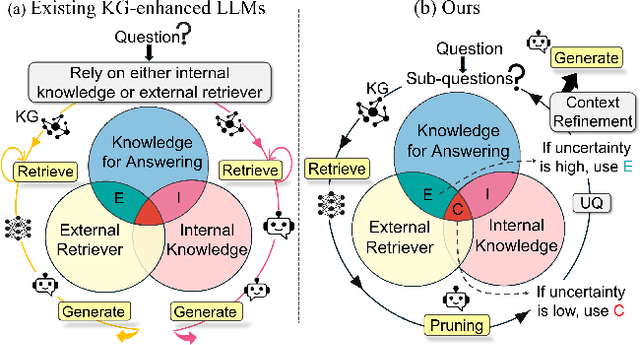
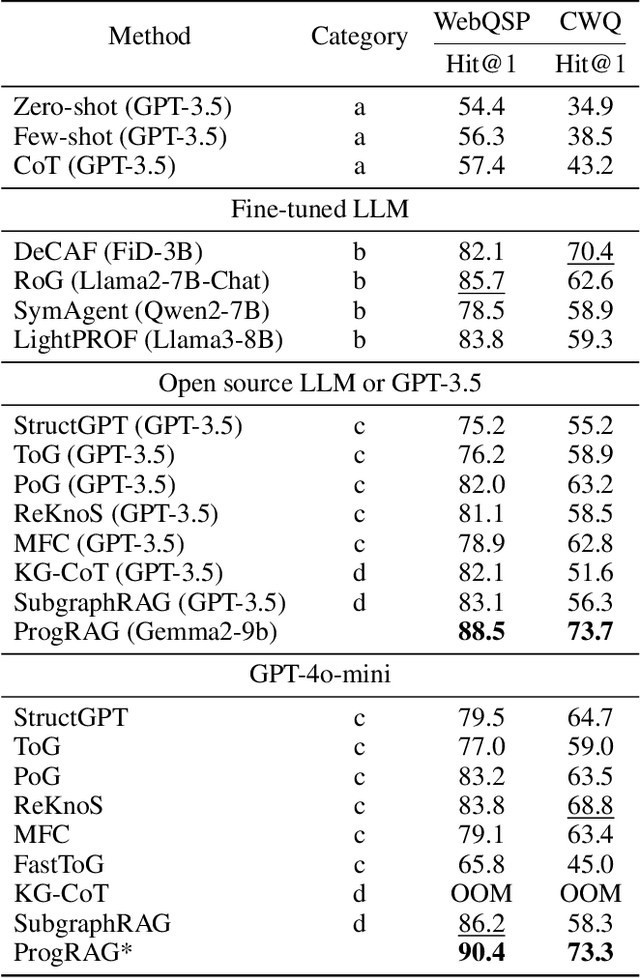
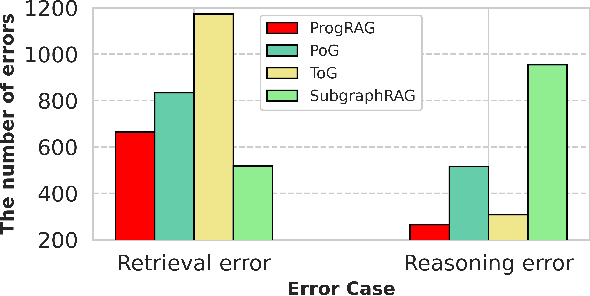
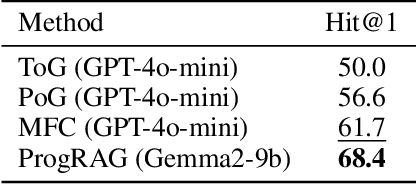
Large Language Models (LLMs) demonstrate strong reasoning capabilities but struggle with hallucinations and limited transparency. Recently, KG-enhanced LLMs that integrate knowledge graphs (KGs) have been shown to improve reasoning performance, particularly for complex, knowledge-intensive tasks. However, these methods still face significant challenges, including inaccurate retrieval and reasoning failures, often exacerbated by long input contexts that obscure relevant information or by context constructions that struggle to capture the richer logical directions required by different question types. Furthermore, many of these approaches rely on LLMs to directly retrieve evidence from KGs, and to self-assess the sufficiency of this evidence, which often results in premature or incorrect reasoning. To address the retrieval and reasoning failures, we propose ProgRAG, a multi-hop knowledge graph question answering (KGQA) framework that decomposes complex questions into sub-questions, and progressively extends partial reasoning paths by answering each sub-question. At each step, external retrievers gather candidate evidence, which is then refined through uncertainty-aware pruning by the LLM. Finally, the context for LLM reasoning is optimized by organizing and rearranging the partial reasoning paths obtained from the sub-question answers. Experiments on three well-known datasets demonstrate that ProgRAG outperforms existing baselines in multi-hop KGQA, offering improved reliability and reasoning quality.
Subgraph-Aware Training of Text-based Methods for Knowledge Graph Completion
Jul 19, 2024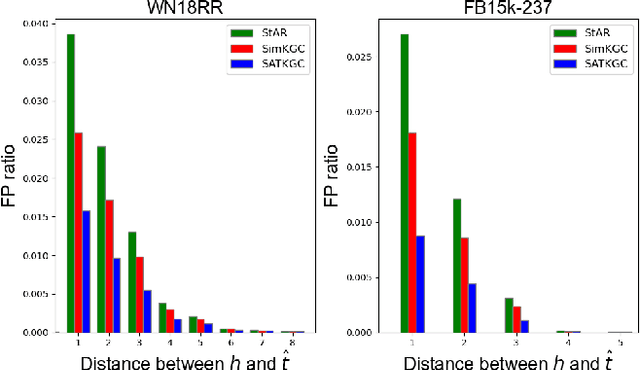
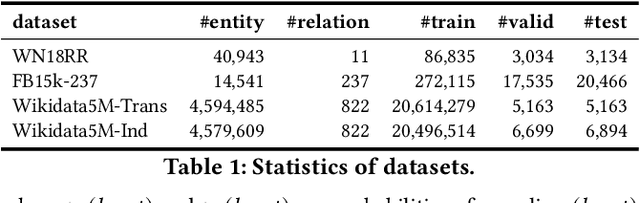
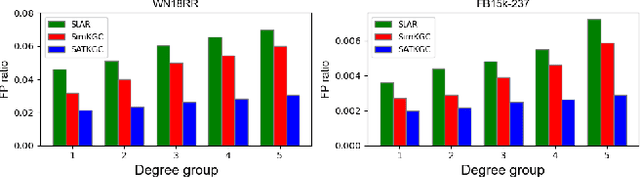
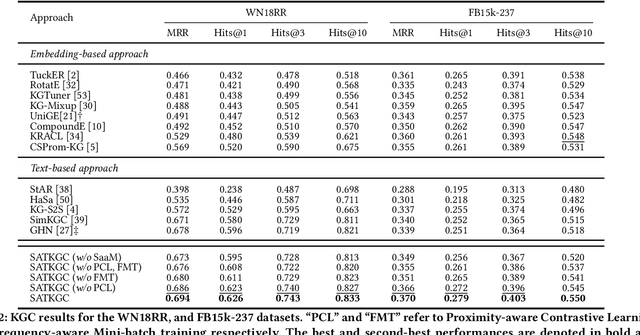
Fine-tuning pre-trained language models (PLMs) has recently shown a potential to improve knowledge graph completion (KGC). However, most PLM-based methods encode only textual information, neglecting various topological structures of knowledge graphs (KGs). In this paper, we empirically validate the significant relations between the structural properties of KGs and the performance of the PLM-based methods. To leverage the structural knowledge, we propose a Subgraph-Aware Training framework for KGC (SATKGC) that combines (i) subgraph-aware mini-batching to encourage hard negative sampling, and (ii) a new contrastive learning method to focus more on harder entities and harder negative triples in terms of the structural properties. To the best of our knowledge, this is the first study to comprehensively incorporate the structural inductive bias of the subgraphs into fine-tuning PLMs. Extensive experiments on four KGC benchmarks demonstrate the superiority of SATKGC. Our code is available.