 Add to Chrome
 Add to Firefox
 Add to Edge
Cooperative Retrieval-Augmented Generation for Question Answering: Mutual Information Exchange and Ranking by Contrasting Layers
Dec 17, 2025
Since large language models (LLMs) have a tendency to generate factually inaccurate output, retrieval-augmented generation (RAG) has gained significant attention as a key means to mitigate this downside of harnessing only LLMs. However, existing RAG methods for simple and multi-hop question answering (QA) are still prone to incorrect retrievals and hallucinations. To address these limitations, we propose CoopRAG, a novel RAG framework for the question answering task in which a retriever and an LLM work cooperatively with each other by exchanging informative knowledge, and the earlier and later layers of the retriever model work cooperatively with each other to accurately rank the retrieved documents relevant to a given query. In this framework, we (i) unroll a question into sub-questions and a reasoning chain in which uncertain positions are masked, (ii) retrieve the documents relevant to the question augmented with the sub-questions and the reasoning chain, (iii) rerank the documents by contrasting layers of the retriever, and (iv) reconstruct the reasoning chain by filling the masked positions via the LLM. Our experiments demonstrate that CoopRAG consistently outperforms state-of-the-art QA methods on three multi-hop QA datasets as well as a simple QA dataset in terms of both the retrieval and QA performances. Our code is available.

Subgraph-Aware Training of Text-based Methods for Knowledge Graph Completion
Jul 19, 2024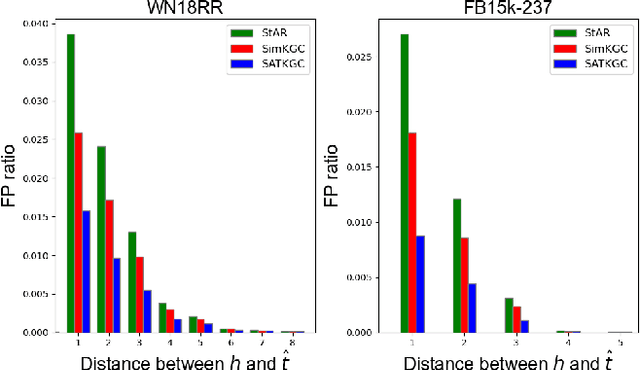
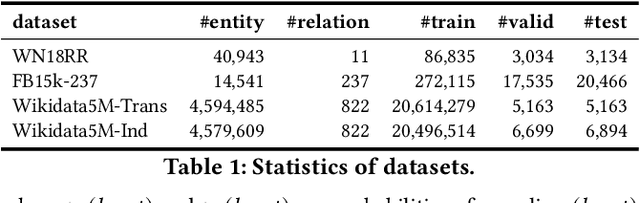
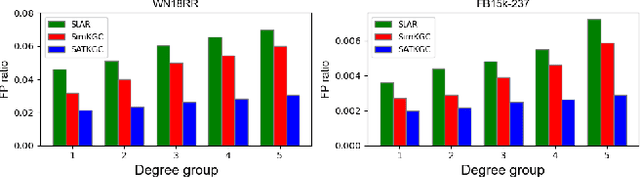
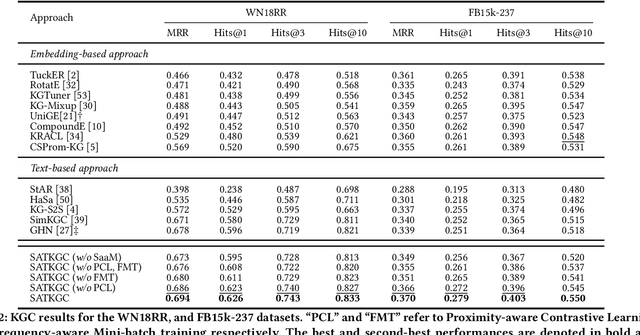
Fine-tuning pre-trained language models (PLMs) has recently shown a potential to improve knowledge graph completion (KGC). However, most PLM-based methods encode only textual information, neglecting various topological structures of knowledge graphs (KGs). In this paper, we empirically validate the significant relations between the structural properties of KGs and the performance of the PLM-based methods. To leverage the structural knowledge, we propose a Subgraph-Aware Training framework for KGC (SATKGC) that combines (i) subgraph-aware mini-batching to encourage hard negative sampling, and (ii) a new contrastive learning method to focus more on harder entities and harder negative triples in terms of the structural properties. To the best of our knowledge, this is the first study to comprehensively incorporate the structural inductive bias of the subgraphs into fine-tuning PLMs. Extensive experiments on four KGC benchmarks demonstrate the superiority of SATKGC. Our code is available.