 Add to Chrome
 Add to Firefox
 Add to Edge
KG2Cypher: Data-Centric Pipeline for Building Enterprise Text-to-Cypher Systems
Jun 26, 2026
Enterprise Knowledge Graphs (KGs) are increasingly used for internal search, analytics, and question answering, but building natural-language interfaces for private enterprise graphs remains costly. We present KG2Cypher, a data-centric pipeline for building enterprise text-to-Cypher systems from existing KGs. KG2Cypher first constructs an executable Cypher query from observed graph facts and then uses LLMs to generate its associated natural-language question. The resulting Text-Cypher pairs are validated with an LLM judge and human validation, and are converted into candidate-aware SFT data. The trained generator is served with class-conditioned schema prompting, entity retrieval, and LoRA-based inference. We evaluate KG2Cypher in Korean enterprise settings, where short search-style queries and schema paraphrases make language grounding difficult. LoRA SFT improves execution-result F1 from 0.806 to 0.950 on broadcast-program queries and from 0.70 to 0.92 on company queries. In an 11-class setting, KG2Cypher achieves 95.2% exact match, 99.9% execution rate, and 0.964 execution-result F1.

Hybrid GCN-GRU Model for Anomaly Detection in Cryptocurrency Transactions
Sep 09, 2025Blockchain transaction networks are complex, with evolving temporal patterns and inter-node relationships. To detect illicit activities, we propose a hybrid GCN-GRU model that captures both structural and sequential features. Using real Bitcoin transaction data (2020-2024), our model achieved 0.9470 Accuracy and 0.9807 AUC-ROC, outperforming all baselines.
UACANet: Uncertainty Augmented Context Attention for Polyp Segmentation
Jul 22, 2021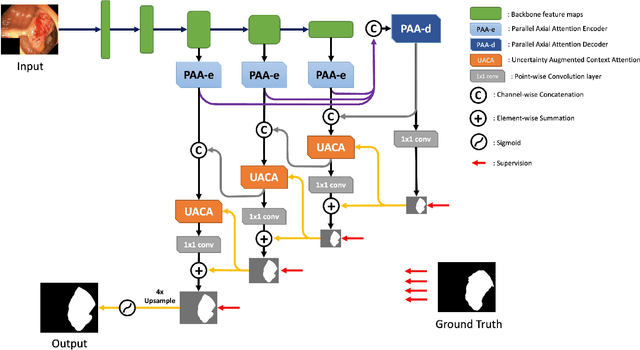
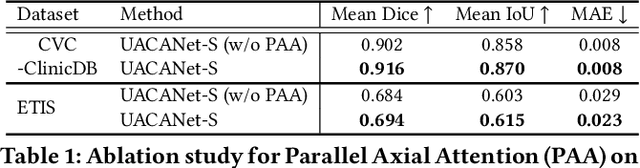
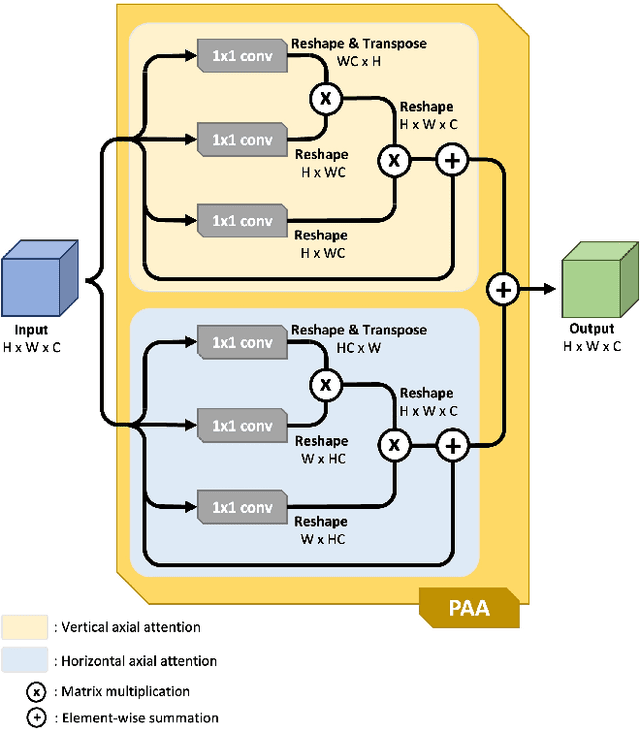
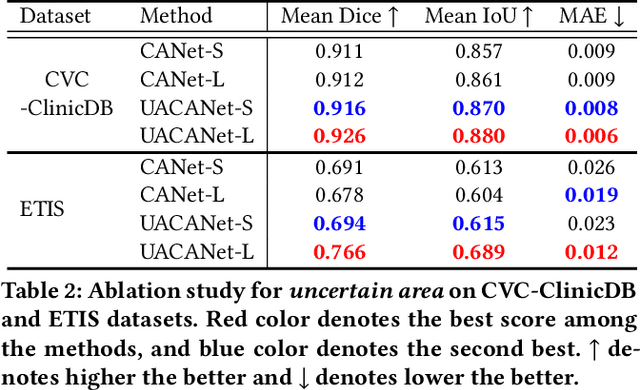
We propose Uncertainty Augmented Context Attention network (UACANet) for polyp segmentation which consider a uncertain area of the saliency map. We construct a modified version of U-Net shape network with additional encoder and decoder and compute a saliency map in each bottom-up stream prediction module and propagate to the next prediction module. In each prediction module, previously predicted saliency map is utilized to compute foreground, background and uncertain area map and we aggregate the feature map with three area maps for each representation. Then we compute the relation between each representation and each pixel in the feature map. We conduct experiments on five popular polyp segmentation benchmarks, Kvasir, CVC-ClinicDB, ETIS, CVC-ColonDB and CVC-300, and achieve state-of-the-art performance. Especially, we achieve 76.6% mean Dice on ETIS dataset which is 13.8% improvement compared to the previous state-of-the-art method. Source code is publicly available at https://github.com/plemeri/UACANet