 Add to Chrome
 Add to Firefox
 Add to Edge
Self-Supervised Super-Resolution for Sentinel-5P Hyperspectral Images
Apr 19, 2026
Sentinel-5P (S5P) plays a critical role in atmospheric monitoring; however, its spatial resolution limits fine-scale analysis. Existing super-resolution (SR) approaches rely on supervised learning with synthetic low-resolution (LR) data, since true high-resolution (HR) data do not exist, limiting their applicability to real observations. We propose a self-supervised hyperspectral SR framework for S5P that enables training without HR ground truth. The method combines Stein's Unbiased Risk Estimator (SURE) with an equivariant imaging constraint, incorporating the S5P degradation operator and noise statistics derived from signal-to-noise ratio (SNR) metadata. We also introduce depthwise separable convolution U-Net architectures designed for efficiency and spectral fidelity. The framework is evaluated in two settings: (i) LR-HR, where synthetic LR data are used for direct comparison with supervised learning, and (ii) GT-SHR, where super-resolved images surpass the native spatial resolution without HR reference. Results across multiple bands show that self-supervised models achieve performance comparable to supervised methods while maintaining strong consistency. Qualitative analysis shows improved spatial detail over bicubic interpolation, and validation with EMIT data confirms that reconstructed structures are physically meaningful. Code is available at https://github.com/hyamomar/Sentinel-5P-Super-Resolution/tree/main/self_supervised

AI for Mycetoma Diagnosis in Histopathological Images: The MICCAI 2024 Challenge
Dec 25, 2025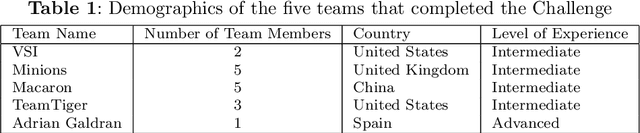
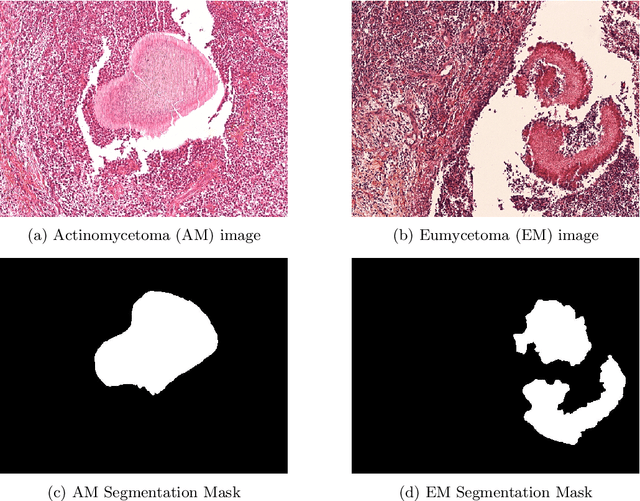
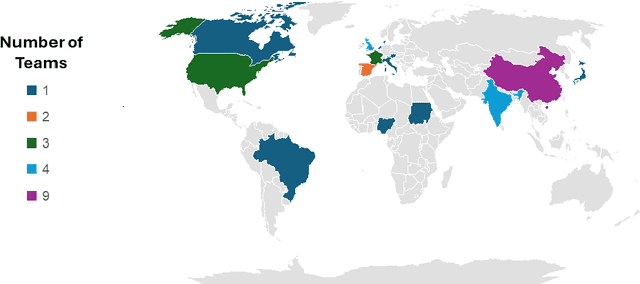
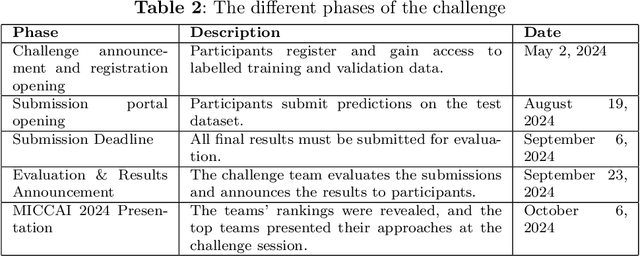
Mycetoma is a neglected tropical disease caused by fungi or bacteria leading to severe tissue damage and disabilities. It affects poor and rural communities and presents medical challenges and socioeconomic burdens on patients and healthcare systems in endemic regions worldwide. Mycetoma diagnosis is a major challenge in mycetoma management, particularly in low-resource settings where expert pathologists are limited. To address this challenge, this paper presents an overview of the Mycetoma MicroImage: Detect and Classify Challenge (mAIcetoma) which was organized to advance mycetoma diagnosis through AI solutions. mAIcetoma focused on developing automated models for segmenting mycetoma grains and classifying mycetoma types from histopathological images. The challenge attracted the attention of several teams worldwide to participate and five finalist teams fulfilled the challenge objectives. The teams proposed various deep learning architectures for the ultimate goal of this challenge. Mycetoma database (MyData) was provided to participants as a standardized dataset to run the proposed models. Those models were evaluated using evaluation metrics. Results showed that all the models achieved high segmentation accuracy, emphasizing the necessitate of grain detection as a critical step in mycetoma diagnosis. In addition, the top-performing models show a significant performance in classifying mycetoma types.
Depth Separable architecture for Sentinel-5P Super-Resolution
Jan 28, 2025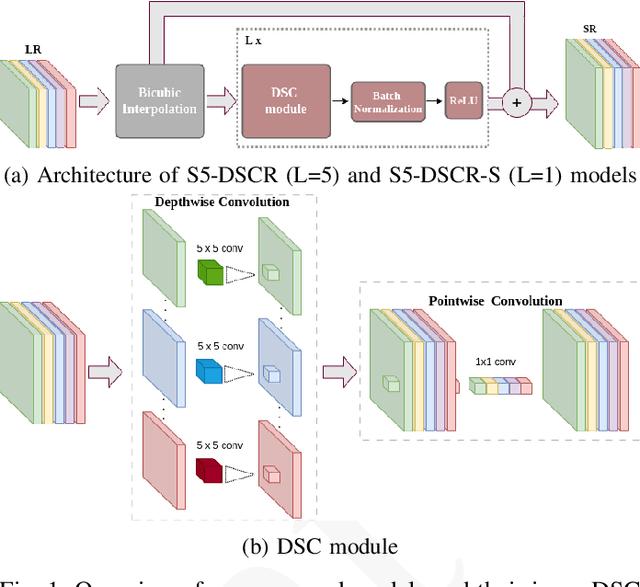
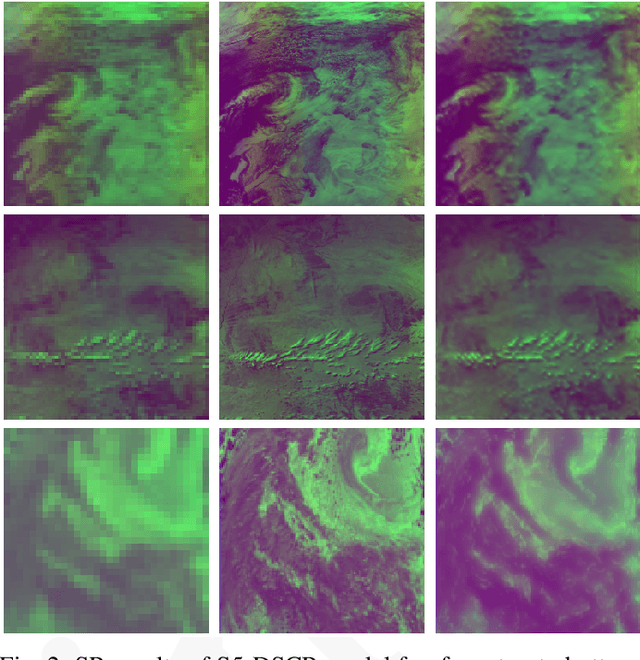
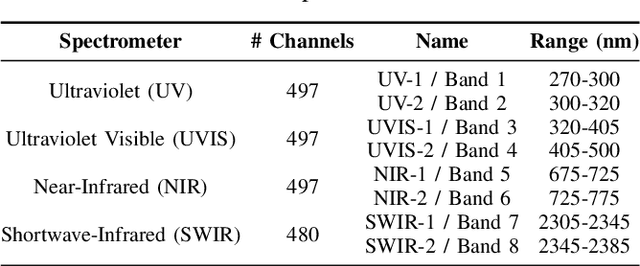
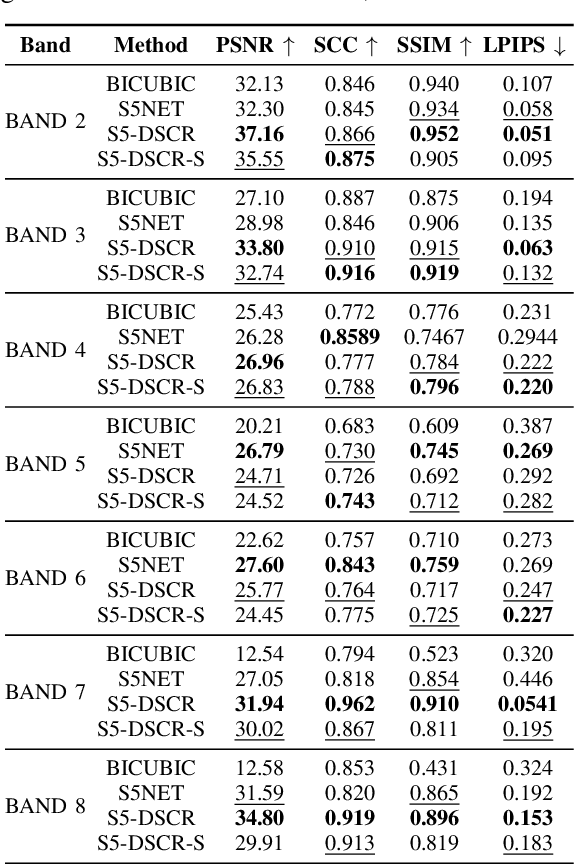
Sentinel-5P (S5P) satellite provides atmospheric measurements for air quality and climate monitoring. While the S5P satellite offers rich spectral resolution, it inherits physical limitations that restricts its spatial resolution. Super-resolution (SR) techniques can overcome these limitations and enhance the spatial resolution of S5P data. In this work, we introduce a novel SR model specifically designed for S5P data that have eight spectral bands with around 500 channels for each band. Our proposed S5-DSCR model relies on Depth Separable Convolution (DSC) architecture to effectively perform spatial SR by exploiting cross-channel correlations. Quantitative evaluation demonstrates that our model outperforms existing methods for the majority of the spectral bands. This work highlights the potential of leveraging DSC architecture to address the challenges of hyperspectral SR. Our model allows for capturing fine details necessary for precise analysis and paves the way for advancements in air quality monitoring as well as remote sensing applications.