 Add to Chrome
 Add to Firefox
 Add to Edge
Self-Supervised Super-Resolution for Sentinel-5P Hyperspectral Images
Apr 19, 2026
Sentinel-5P (S5P) plays a critical role in atmospheric monitoring; however, its spatial resolution limits fine-scale analysis. Existing super-resolution (SR) approaches rely on supervised learning with synthetic low-resolution (LR) data, since true high-resolution (HR) data do not exist, limiting their applicability to real observations. We propose a self-supervised hyperspectral SR framework for S5P that enables training without HR ground truth. The method combines Stein's Unbiased Risk Estimator (SURE) with an equivariant imaging constraint, incorporating the S5P degradation operator and noise statistics derived from signal-to-noise ratio (SNR) metadata. We also introduce depthwise separable convolution U-Net architectures designed for efficiency and spectral fidelity. The framework is evaluated in two settings: (i) LR-HR, where synthetic LR data are used for direct comparison with supervised learning, and (ii) GT-SHR, where super-resolved images surpass the native spatial resolution without HR reference. Results across multiple bands show that self-supervised models achieve performance comparable to supervised methods while maintaining strong consistency. Qualitative analysis shows improved spatial detail over bicubic interpolation, and validation with EMIT data confirms that reconstructed structures are physically meaningful. Code is available at https://github.com/hyamomar/Sentinel-5P-Super-Resolution/tree/main/self_supervised

Depth Separable architecture for Sentinel-5P Super-Resolution
Jan 28, 2025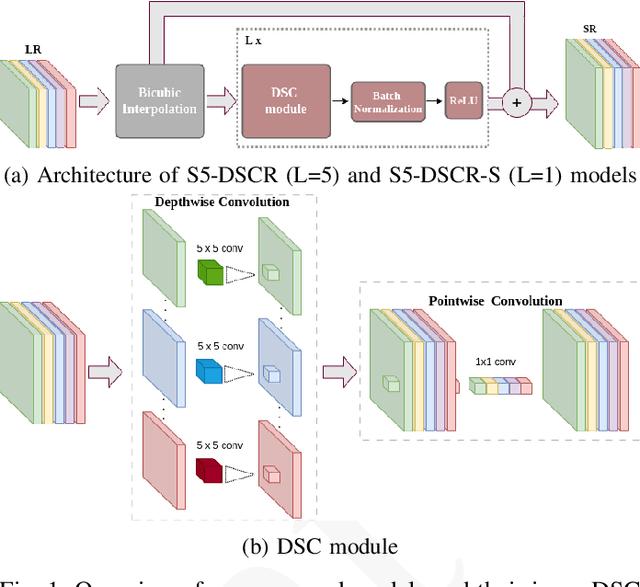
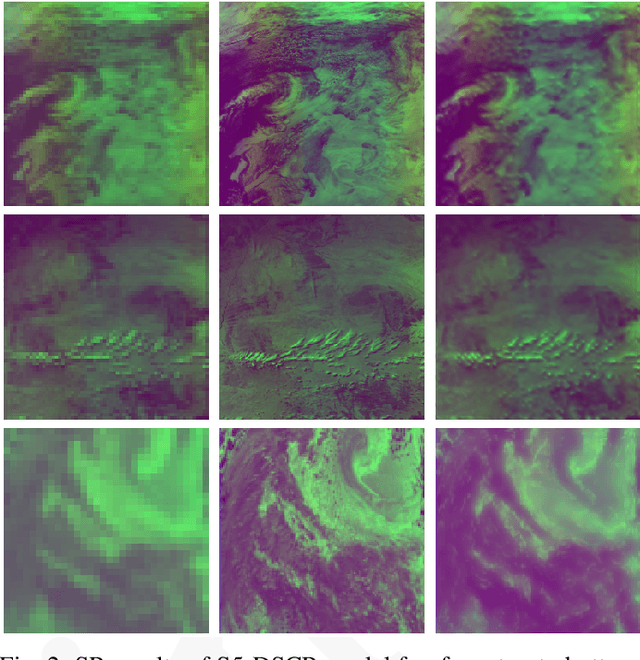
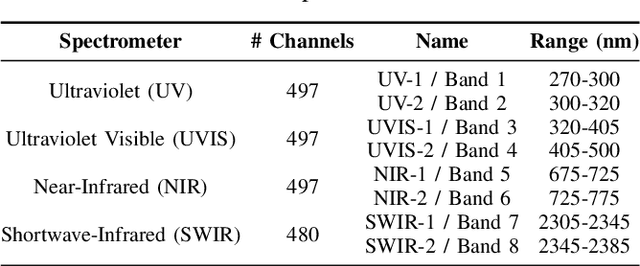
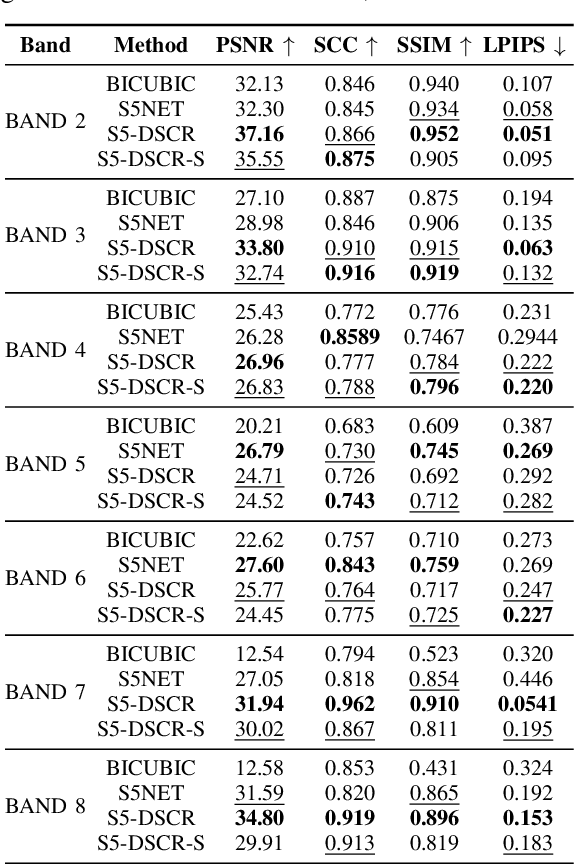
Sentinel-5P (S5P) satellite provides atmospheric measurements for air quality and climate monitoring. While the S5P satellite offers rich spectral resolution, it inherits physical limitations that restricts its spatial resolution. Super-resolution (SR) techniques can overcome these limitations and enhance the spatial resolution of S5P data. In this work, we introduce a novel SR model specifically designed for S5P data that have eight spectral bands with around 500 channels for each band. Our proposed S5-DSCR model relies on Depth Separable Convolution (DSC) architecture to effectively perform spatial SR by exploiting cross-channel correlations. Quantitative evaluation demonstrates that our model outperforms existing methods for the majority of the spectral bands. This work highlights the potential of leveraging DSC architecture to address the challenges of hyperspectral SR. Our model allows for capturing fine details necessary for precise analysis and paves the way for advancements in air quality monitoring as well as remote sensing applications.
An active curve approach for tomographic reconstruction of binary radially symmetric objects
Jul 10, 2006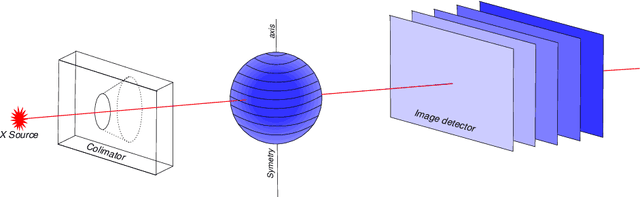


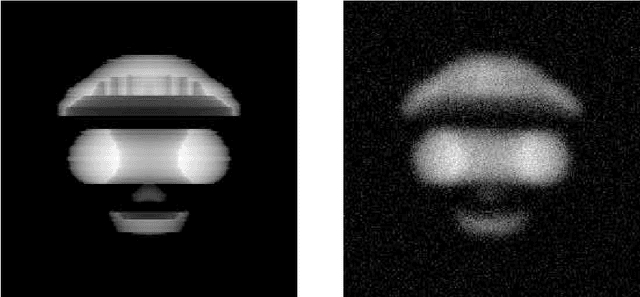
This paper deals with a method of tomographic reconstruction of radially symmetric objects from a single radiograph, in order to study the behavior of shocked material. The usual tomographic reconstruction algorithms such as generalized inverse or filtered back-projection cannot be applied here because data are very noisy and the inverse problem associated to single view tomographic reconstruction is highly unstable. In order to improve the reconstruction, we propose here to add some a priori assumptions on the looked after object. One of these assumptions is that the object is binary and consequently, the object may be described by the curves that separate the two materials. We present a model that lives in BV space and leads to a non local Hamilton-Jacobi equation, via a level set strategy. Numerical experiments are performed (using level sets methods) on synthetic objects.