 Add to Chrome
 Add to Firefox
 Add to Edge
AI for Mycetoma Diagnosis in Histopathological Images: The MICCAI 2024 Challenge
Dec 25, 2025
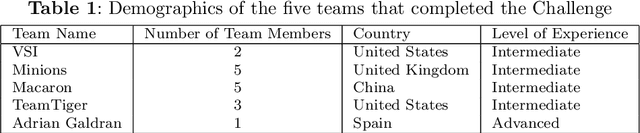
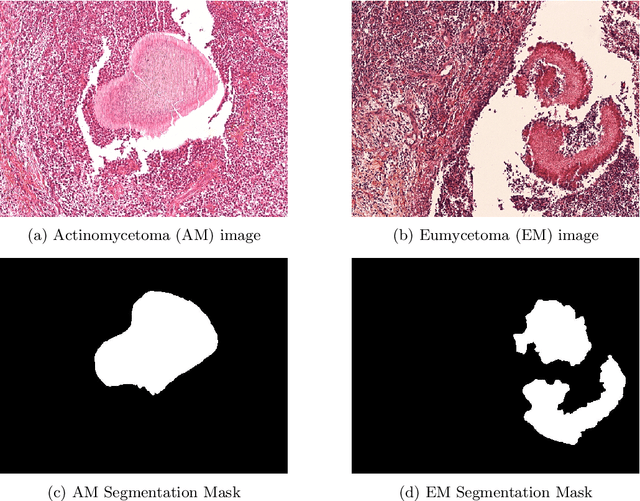
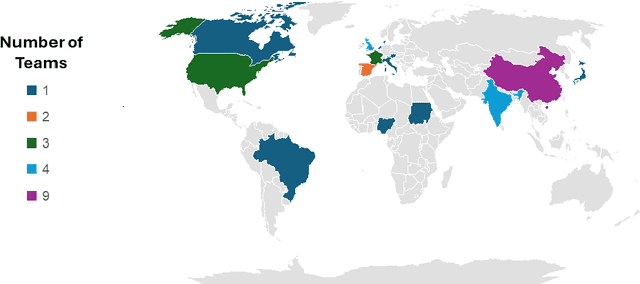
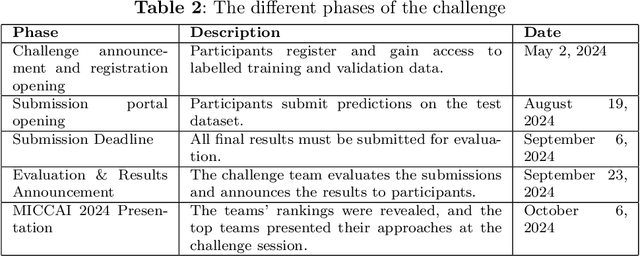
Mycetoma is a neglected tropical disease caused by fungi or bacteria leading to severe tissue damage and disabilities. It affects poor and rural communities and presents medical challenges and socioeconomic burdens on patients and healthcare systems in endemic regions worldwide. Mycetoma diagnosis is a major challenge in mycetoma management, particularly in low-resource settings where expert pathologists are limited. To address this challenge, this paper presents an overview of the Mycetoma MicroImage: Detect and Classify Challenge (mAIcetoma) which was organized to advance mycetoma diagnosis through AI solutions. mAIcetoma focused on developing automated models for segmenting mycetoma grains and classifying mycetoma types from histopathological images. The challenge attracted the attention of several teams worldwide to participate and five finalist teams fulfilled the challenge objectives. The teams proposed various deep learning architectures for the ultimate goal of this challenge. Mycetoma database (MyData) was provided to participants as a standardized dataset to run the proposed models. Those models were evaluated using evaluation metrics. Results showed that all the models achieved high segmentation accuracy, emphasizing the necessitate of grain detection as a critical step in mycetoma diagnosis. In addition, the top-performing models show a significant performance in classifying mycetoma types.

Interpretable Prediction of Lymph Node Metastasis in Rectal Cancer MRI Using Variational Autoencoders
Jul 15, 2025Effective treatment for rectal cancer relies on accurate lymph node metastasis (LNM) staging. However, radiological criteria based on lymph node (LN) size, shape and texture morphology have limited diagnostic accuracy. In this work, we investigate applying a Variational Autoencoder (VAE) as a feature encoder model to replace the large pre-trained Convolutional Neural Network (CNN) used in existing approaches. The motivation for using a VAE is that the generative model aims to reconstruct the images, so it directly encodes visual features and meaningful patterns across the data. This leads to a disentangled and structured latent space which can be more interpretable than a CNN. Models are deployed on an in-house MRI dataset with 168 patients who did not undergo neo-adjuvant treatment. The post-operative pathological N stage was used as the ground truth to evaluate model predictions. Our proposed model 'VAE-MLP' achieved state-of-the-art performance on the MRI dataset, with cross-validated metrics of AUC 0.86 +/- 0.05, Sensitivity 0.79 +/- 0.06, and Specificity 0.85 +/- 0.05. Code is available at: https://github.com/benkeel/Lymph_Node_Classification_MIUA.
* Published in Medical Image Understanding and Analysis (MIUA) 2025
Variational Autoencoders for Feature Exploration and Malignancy Prediction of Lung Lesions
Nov 27, 2023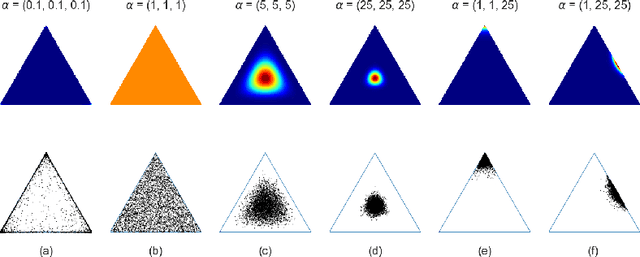
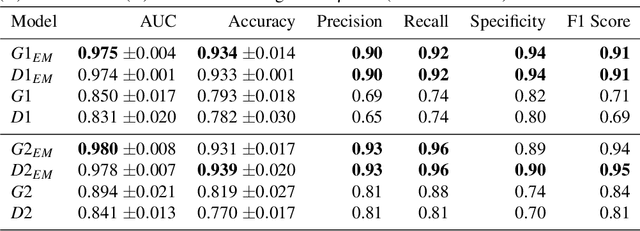
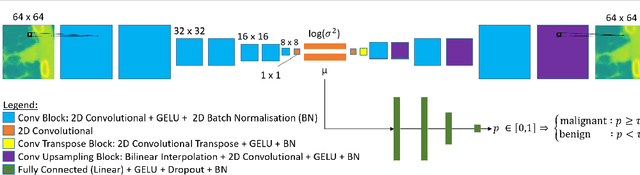
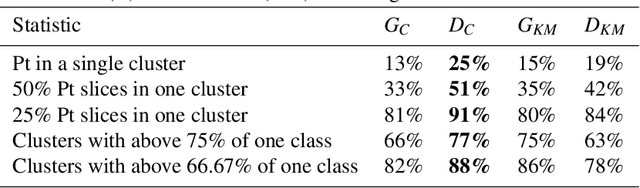
Lung cancer is responsible for 21% of cancer deaths in the UK and five-year survival rates are heavily influenced by the stage the cancer was identified at. Recent studies have demonstrated the capability of AI methods for accurate and early diagnosis of lung cancer from routine scans. However, this evidence has not translated into clinical practice with one barrier being a lack of interpretable models. This study investigates the application Variational Autoencoders (VAEs), a type of generative AI model, to lung cancer lesions. Proposed models were trained on lesions extracted from 3D CT scans in the LIDC-IDRI public dataset. Latent vector representations of 2D slices produced by the VAEs were explored through clustering to justify their quality and used in an MLP classifier model for lung cancer diagnosis, the best model achieved state-of-the-art metrics of AUC 0.98 and 93.1% accuracy. Cluster analysis shows the VAE latent space separates the dataset of malignant and benign lesions based on meaningful feature components including tumour size, shape, patient and malignancy class. We also include a comparative analysis of the standard Gaussian VAE (GVAE) and the more recent Dirichlet VAE (DirVAE), which replaces the prior with a Dirichlet distribution to encourage a more explainable latent space with disentangled feature representation. Finally, we demonstrate the potential for latent space traversals corresponding to clinically meaningful feature changes.