 Add to Chrome
 Add to Firefox
 Add to Edge
ZeSTA: Zero-Shot TTS Augmentation with Domain-Conditioned Training for Data-Efficient Personalized Speech Synthesis
Mar 04, 2026
We investigate the use of zero-shot text-to-speech (ZS-TTS) as a data augmentation source for low-resource personalized speech synthesis. While synthetic augmentation can provide linguistically rich and phonetically diverse speech, naively mixing large amounts of synthetic speech with limited real recordings often leads to speaker similarity degradation during fine-tuning. To address this issue, we propose ZeSTA, a simple domain-conditioned training framework that distinguishes real and synthetic speech via a lightweight domain embedding, combined with real-data oversampling to stabilize adaptation under extremely limited target data, without modifying the base architecture. Experiments on LibriTTS and an in-house dataset with two ZS-TTS sources demonstrate that our approach improves speaker similarity over naive synthetic augmentation while preserving intelligibility and perceptual quality.

Exploring Fine-Tuning of Large Audio Language Models for Spoken Language Understanding under Limited Speech data
Sep 18, 2025Large Audio Language Models (LALMs) have emerged as powerful tools for speech-related tasks but remain underexplored for fine-tuning, especially with limited speech data. To bridge this gap, we systematically examine how different fine-tuning schemes including text-only, direct mixing, and curriculum learning affect spoken language understanding (SLU), focusing on scenarios where text-label pairs are abundant while paired speech-label data are limited. Results show that LALMs already achieve competitive performance with text-only fine-tuning, highlighting their strong generalization ability. Adding even small amounts of speech data (2-5%) yields substantial further gains, with curriculum learning particularly effective under scarce data. In cross-lingual SLU, combining source-language speech data with target-language text and minimal target-language speech data enables effective adaptation. Overall, this study provides practical insights into the LALM fine-tuning under realistic data constraints.
DESAMO: A Device for Elder-Friendly Smart Homes Powered by Embedded LLM with Audio Modality
Aug 26, 2025We present DESAMO, an on-device smart home system for elder-friendly use powered by Audio LLM, that supports natural and private interactions. While conventional voice assistants rely on ASR-based pipelines or ASR-LLM cascades, often struggling with the unclear speech common among elderly users and unable to handle non-speech audio, DESAMO leverages an Audio LLM to process raw audio input directly, enabling a robust understanding of user intent and critical events, such as falls or calls for help.
CUE-M: Contextual Understanding and Enhanced Search with Multimodal Large Language Model
Nov 19, 2024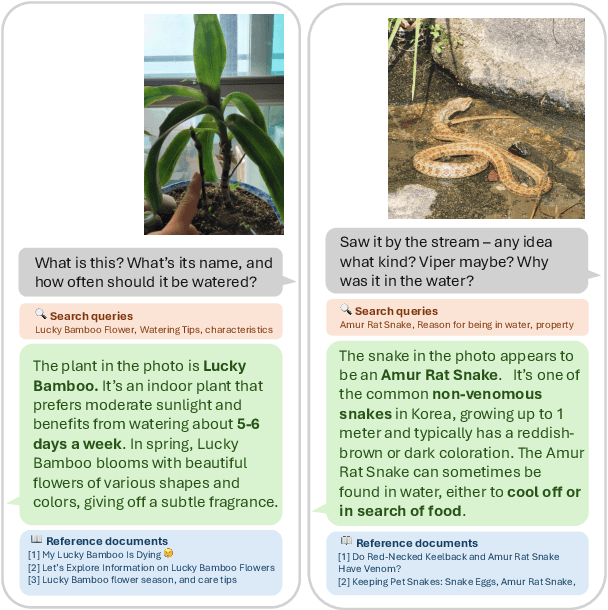
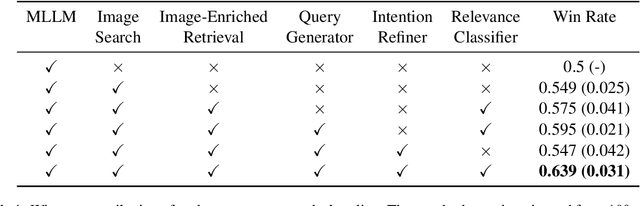
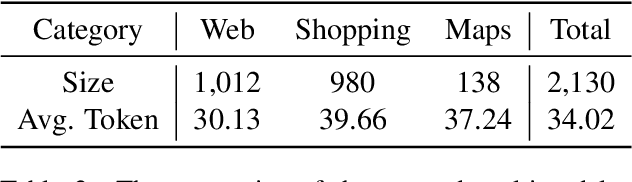
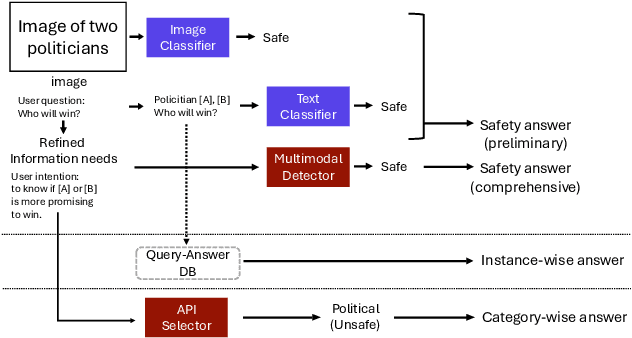
The integration of Retrieval-Augmented Generation (RAG) with Multimodal Large Language Models (MLLMs) has expanded the scope of multimodal query resolution. However, current systems struggle with intent understanding, information retrieval, and safety filtering, limiting their effectiveness. This paper introduces Contextual Understanding and Enhanced Search with MLLM (CUE-M), a novel multimodal search pipeline that addresses these challenges through a multi-stage framework comprising image context enrichment, intent refinement, contextual query generation, external API integration, and relevance-based filtering. CUE-M incorporates a robust safety framework combining image-based, text-based, and multimodal classifiers, dynamically adapting to instance- and category-specific risks. Evaluations on a multimodal Q&A dataset and a public safety benchmark demonstrate that CUE-M outperforms baselines in accuracy, knowledge integration, and safety, advancing the capabilities of multimodal retrieval systems.