 Add to Chrome
 Add to Firefox
 Add to Edge
DeepTokenEEG Enhancing Mild Cognitive Impairment and Alzheimers Classification via Tokenized EEG Features
May 14, 2026
The detection of Alzheimers disease (AD) is considered crucial, as timely intervention can improve patient outcomes. Electroencephalogram (EEG)-based diagnosis has been recognized as a non-invasive, accessible, and cost-effective approach for AD detection; however, it faces challenges related to data availability, accuracy of modern deep learning methods, and the time-consuming nature of expert-based interpretation. In this study, a novel lightweight and high-performance model, DeepTokenEEG, was designed for the diagnosis of AD and the classification of EEG signals from AD patients, individuals with other neurological conditions, and healthy subjects. Unlike traditional heavy-weight models, DeepTokenEEG ultilizes spatial and temporal tokenizer that effectively captures AD-related biomarkers in both temporal and frequency domain with only 0.29 million paramaters. Trained in a combined dataset of 274 subjects, including 180 AD cases, and 94 healthy controls, the proposed method achieves a maximum recorded accuracy of 100% on specific frequency bands, representing an improvement of 1.41-15.35% over state-of-the-art methods on the same dataset. These results indicate the potential of DeepTokenEEG for early detection and screening of AD, with promising applicability for deployment due to its compact size.

Enhancing Alzheimer's Detection through Late Fusion of Multi-Modal EEG Features
Dec 17, 2025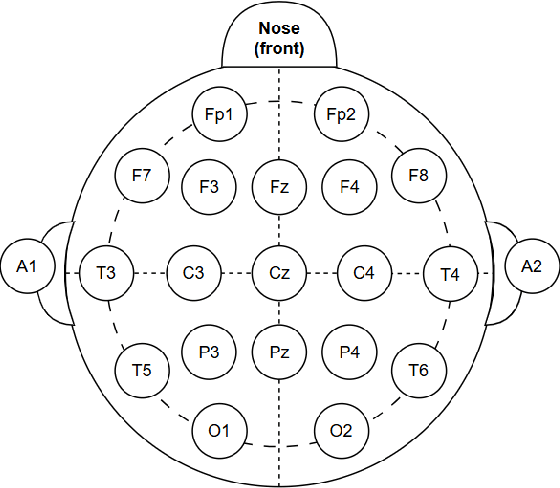
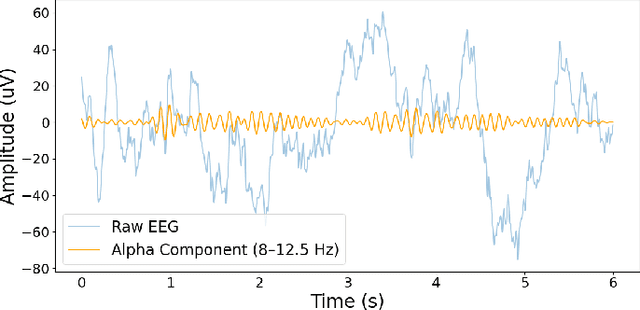
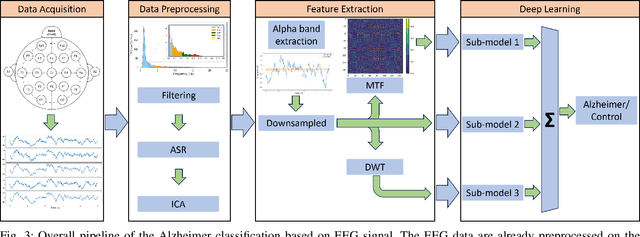
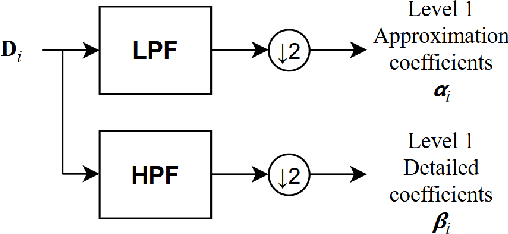
Alzheimer s disease (AD) is a progressive neurodegenerative disorder characterized by cognitive decline, where early detection is essential for timely intervention and improved patient outcomes. Traditional diagnostic methods are time-consuming and require expert interpretation, thus, automated approaches are highly desirable. This study presents a novel deep learning framework for AD diagnosis using Electroencephalograph (EEG) signals, integrating multiple feature extraction techniques including alpha-wave analysis, Discrete Wavelet Transform (DWT), and Markov Transition Fields (MTF). A late-fusion strategy is employed to combine predictions from separate neural networks trained on these diverse representations, capturing both temporal and frequency-domain patterns in the EEG data. The proposed model attains a classification accuracy of 87.23%, with a precision of 87.95%, a recall of 86.91%, and an F1 score of 87.42% when evaluated on a publicly available dataset, demonstrating its potential for reliable, scalable, and early AD screening. Rigorous preprocessing and targeted frequency band selection, particularly in the alpha range due to its cognitive relevance, further enhance performance. This work highlights the promise of deep learning in supporting physicians with efficient and accessible tools for early AD diagnosis.
Investigation of Using Non-Contact Electrodes for Fetal ECG Monitoring
Oct 01, 2025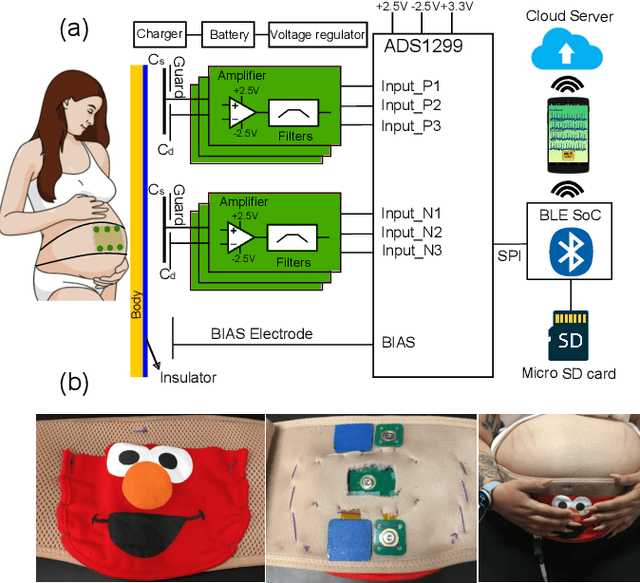
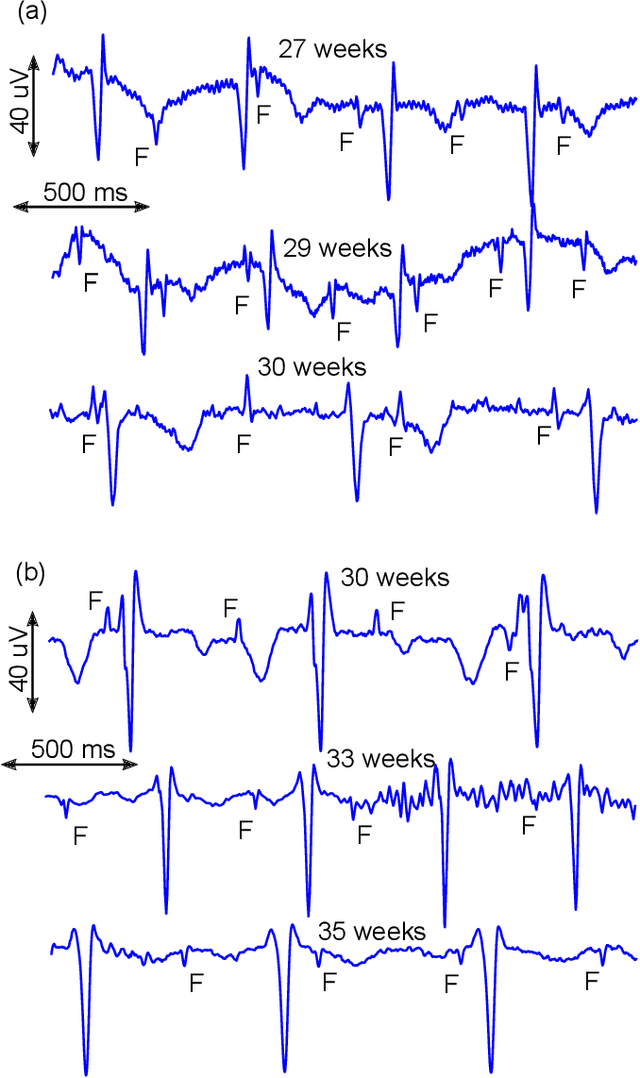
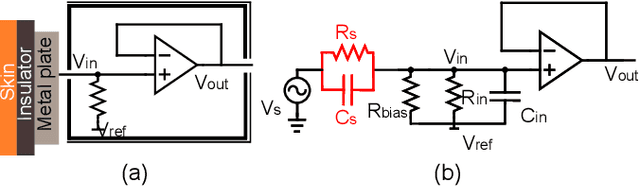
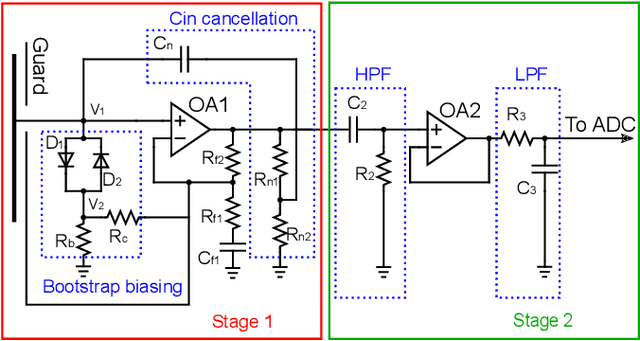
Regular physiological monitoring of maternal and fetal parameters is indispensable for ensuring safe outcomes during pregnancy and parturition. Fetal electrocardiogram (fECG) assessment is crucial to detect fetal distress and developmental anomalies. Given challenges of prenatal care due to the lack of medical professionals and the limit of accessibility, especially in remote and resource-poor areas, we develop a fECG monitoring system using novel non-contact electrodes (NCE) to record the fetal/maternal ECG (f/mECG) signals through clothes, thereby improving the comfort during measurement. The system is designed to be incorporated inside a maternity belt with data acquisition, data transmission module as well as novel NCEs. Thorough characterizations were carried out to evaluate the novel NCE against traditional wet electrodes (i.e., Ag/AgCl electrodes), showing comparable performance. A successful {preliminary pilot feasibility study} conducted with pregnant women (n = 10) between 25 and 32 weeks of gestation demonstrates the system's performance, usability and safety.