 Add to Chrome
 Add to Firefox
 Add to Edge
Task-Anchored Representation Shaping for Pre-Trained Model-Based Continual Learning
Aug 17, 2026
Pre-trained models (PTMs) provide a strong foundation for continual learning by offering stable representations that facilitate lightweight adaptation to new tasks. However, adapting well to each task does not ensure reliable inference over all learned tasks. Since task boundaries are often artificial and semantically entangled, an input from an unknown task can remain ambiguous even with strong PTM features, making cross-task prediction a key bottleneck. We propose Task-Anchored Inference Latent Shaping (TAILS), a lightweight post-PTM module that can be integrated into diverse continual learners and optimized through a decoupled step. TAILS uses fixed task anchors as persistent references to accumulated knowledge. It interprets each sample's feature representation relative to these references, then composes relevant evidence across tasks into latent recall. Rather than selecting a task-specific path or adjusting classifier outputs, TAILS uses latent recall to directly correct the feature representation before prediction. It therefore resolves cross-task ambiguity at the representation level, while leaving the original PTM, method-specific modules, and classifier unchanged. Extensive experiments across multiple PTM-based continual learning paradigms show that TAILS can improve classification and task-inference performance with modest parameter overhead and negligible inference cost.

Beyond Routing Saturation: A Long-Horizon Class-Incremental Perspective on Expert Routing in Multimodal Continual Instruction Tuning
Aug 02, 2026Multimodal Continual Instruction Tuning (MCIT) enables multimodal large language models to acquire new tasks sequentially while retaining previously learned capabilities. Many recent methods maintain task-specific LoRA experts and route each input to one or more experts at inference. Yet the task-identification problem underlying expert routing remains under-explored. We show that routing is nearly saturated on widely used MCIT benchmarks. Textual fingerprints that leak task identity and short 4--10-task sequences with few competing experts jointly obscure the long-horizon routing problem. To expose this challenge, we introduce FLEX (Fingerprint-reduced Long-horizon Expert eXamination), a 34-task long-horizon MCIT benchmark with weakened textual fingerprints. FLEX groups tasks with similar instruction and answer formats but diverse visual and knowledge domains, normalizes their outer templates, and evaluates routing over a substantially larger expert pool. Crucially, we formulate progressive-LoRA routing as soft task-as-class Multimodal Class-Incremental Learning (MCIL): each task defines an incremental routing class, whose complete score distribution supplies the LoRA mixture weights, with hard routing as a discrete special case. FLEX exposes this expanding task-identification challenge, while the MCIL formulation provides a principled interface for transferring CIL methods to expert routing. We instantiate PureLoRA as a controlled baseline and adapt four CIL methods to four MCIT frameworks without modifying their LoRA experts or generation pipelines. Our plug-in routers improve strict LoRA matching by up to 16.3 percentage points and overall MacroScore by up to 4.6 points. Code is available at: https://github.com/RINC-CL/FLEX
Beyond Point-wise Neural Collapse: A Topology-Aware Hierarchical Classifier for Class-Incremental Learning
May 12, 2026The Nearest Class Mean (NCM) classifier is widely favored in Class-Incremental Learning (CIL) for its superior resistance to catastrophic forgetting compared to Fully Connected layers. While Neural Collapse (NC) theory supports NCM's optimality by assuming features collapse into single points, non-linear feature drift and insufficient training in CIL often prevent this ideal state. Consequently, classes manifest as complex manifolds rather than collapsed points, rendering the single-point NCM suboptimal. To address this, we propose Hierarchical-Cluster SOINN (HC-SOINN), a novel classifier that captures the topological structure of these manifolds via a ``local-to-global'' representation. Furthermore, we introduce Structure-Topology Alignment via Residuals (STAR) method, which employs a fine-grained pointwise trajectory tracking mechanism to actively deform the learned topology, allowing it to adapt precisely to complex non-linear feature drift. Theoretical analysis and Procrustes distance experiments validate our framework's resilience to manifold deformations. We integrated HC-SOINN into seven state-of-the-art methods by replacing their original classifiers, achieving consistent improvements that highlight the effectiveness and robustness of our approach. Code is available at https://github.com/yhyet/HC_SOINN.
Embedding Space Allocation with Angle-Norm Joint Classifiers for Few-Shot Class-Incremental Learning
Nov 14, 2024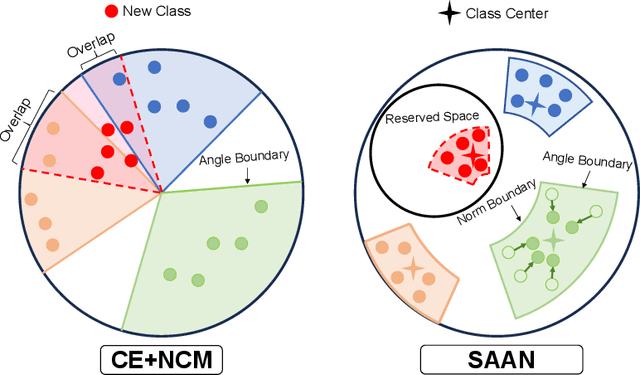
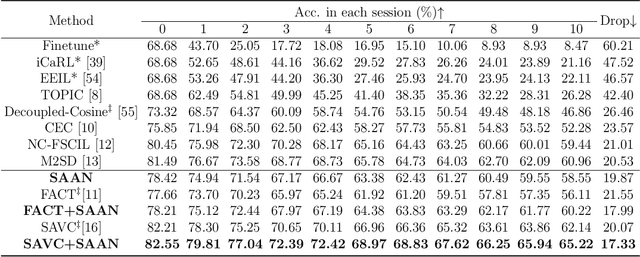
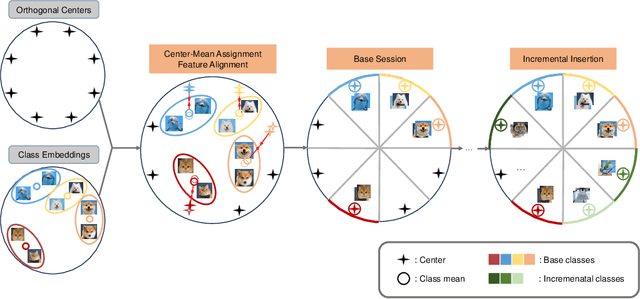
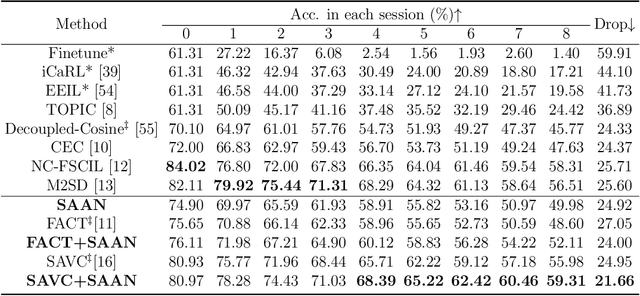
Few-shot class-incremental learning (FSCIL) aims to continually learn new classes from only a few samples without forgetting previous ones, requiring intelligent agents to adapt to dynamic environments. FSCIL combines the characteristics and challenges of class-incremental learning and few-shot learning: (i) Current classes occupy the entire feature space, which is detrimental to learning new classes. (ii) The small number of samples in incremental rounds is insufficient for fully training. In existing mainstream virtual class methods, for addressing the challenge (i), they attempt to use virtual classes as placeholders. However, new classes may not necessarily align with the virtual classes. For the challenge (ii), they replace trainable fully connected layers with Nearest Class Mean (NCM) classifiers based on cosine similarity, but NCM classifiers do not account for sample imbalance issues. To address these issues in previous methods, we propose the class-center guided embedding Space Allocation with Angle-Norm joint classifiers (SAAN) learning framework, which provides balanced space for all classes and leverages norm differences caused by sample imbalance to enhance classification criteria. Specifically, for challenge (i), SAAN divides the feature space into multiple subspaces and allocates a dedicated subspace for each session by guiding samples with the pre-set category centers. For challenge (ii), SAAN establishes a norm distribution for each class and generates angle-norm joint logits. Experiments demonstrate that SAAN can achieve state-of-the-art performance and it can be directly embedded into other SOTA methods as a plug-in, further enhancing their performance.