 Add to Chrome
 Add to Firefox
 Add to Edge
ArtisanCAD: An Industrial-Level CAD Agent with Expert-Grounded Knowledge Distillation
Jul 08, 2026
Computer-aided design (CAD) for industrial components requires long-horizon procedural modeling, robust feature dependencies, editable parametric geometry, and production-grade B-Rep execution. Existing text-to-CAD methods have made promising progress in generating CAD programs from natural-language descriptions, but they still struggle when user prompts are ambiguous, underspecified, or only describe high-level design intent. They also rarely exploit expert procedural knowledge naturally available in industrial workflows, such as CATIA operation recordings, macro logs, drawing notes, and engineering descriptions. We present ArtisanCAD, a skill-guided industrial CAD agent with expert-grounded knowledge distillation. The core of ArtisanCAD is CAD intermediate representation (CAD-IR), an executable procedural representation that encodes parameters, ordered operations, MCP tool bindings, dependencies, generated entities, and verification rules. CAD-IR plays two key roles: it first serves as the carrier for distilling expert CAD procedures into reusable parameterized skills; then it provides a procedural scaffold that turns vague or intermediate-level prompts into complete executable CAD operations. ArtisanCAD retrieves expert-derived skills, instantiates and revises CAD-IR, executes the resulting procedure through a dedicated CATIA-MCP backend, and uses multi-view visual feedback for iterative refinement, and finally generates production-ready B-Rep models. On the Text2CAD benchmark, CAD-IR improves generation from intermediate prompts by reducing mean Chamfer Distance from $14.83$ to $9.88$, showing its ability to bridge ambiguous textual intent and executable CAD construction. On four complex automotive components, CAD-IR enables expert CATIA recordings to be distilled into reusable skills, allowing ArtisanCAD to generate editable CATIA-native B-Rep models for new variant requests.

A Geometry-Aware Triplane Field Network for Vehicle Aerodynamic Prediction
Jun 05, 2026High-fidelity computational fluid dynamics (CFD) is crucial to vehicle aerodynamic analysis, but its cost still constrains early-stage design exploration. Machine-learning-based surface-field prediction offers a faster alternative if the model can efficiently capture both global flow context and local geometric detail. This work proposes a machine-learning-based method, named the geometry-aware triplane field network (GTF-Net), for vehicle aerodynamic pressure and wall shear stress prediction. GTF-Net constructs triplane features directly from sampled surface points through a shared multilayer perceptron (MLP) and smooth bilinear rasterization. The planes are then processed by a dual-stream backbone that combines adaptive Fourier neural operator (AFNO) spectral mixing with convolutional neural network (CNN) refinement, so long-range aerodynamic coupling and local geometry-induced variations are modeled in the same representation. At query stage, sampled triplane features are combined with vehicle-aligned directional coordinates, normal-projection features, and a voxel-based curvature proxy. GTF-Net is compared with Transolver, geometry-informed neural operator (GINO), and TripNet, a triplane-based surrogate model. GTF-Net improves the relative L2 error from the strongest baseline value of 0.157 to 0.145 for pressure prediction and from 0.237 to 0.226 for wall shear stress prediction. Ablation results show that AFNO mixing, local CNN refinement, and query-side geometric encoding each contribute to accuracy, supporting the proposed mechanism of combining structured triplane representation with explicit aerodynamic geometry cues.
Implicit factorized transformer approach to fast prediction of turbulent channel flows
Dec 25, 2024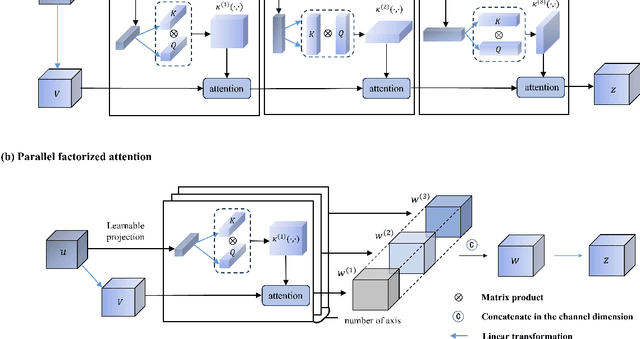

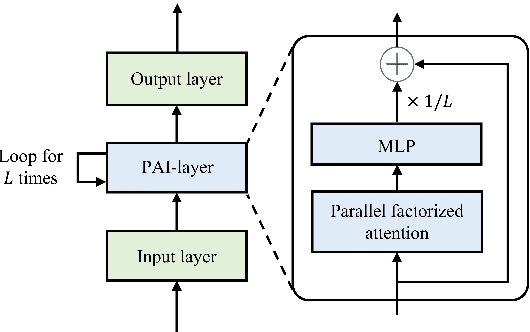

Transformer neural operators have recently become an effective approach for surrogate modeling of nonlinear systems governed by partial differential equations (PDEs). In this paper, we introduce a modified implicit factorized transformer (IFactFormer-m) model which replaces the original chained factorized attention with parallel factorized attention. The IFactFormer-m model successfully performs long-term predictions for turbulent channel flow, whereas the original IFactFormer (IFactFormer-o), Fourier neural operator (FNO), and implicit Fourier neural operator (IFNO) exhibit a poor performance. Turbulent channel flows are simulated by direct numerical simulation using fine grids at friction Reynolds numbers $\text{Re}_{\tau}\approx 180,395,590$, and filtered to coarse grids for training neural operator. The neural operator takes the current flow field as input and predicts the flow field at the next time step, and long-term prediction is achieved in the posterior through an autoregressive approach. The prediction results show that IFactFormer-m, compared to other neural operators and the traditional large eddy simulation (LES) methods including dynamic Smagorinsky model (DSM) and the wall-adapted local eddy-viscosity (WALE) model, reduces prediction errors in the short term, and achieves stable and accurate long-term prediction of various statistical properties and flow structures, including the energy spectrum, mean streamwise velocity, root mean square (rms) values of fluctuating velocities, Reynolds shear stress, and spatial structures of instantaneous velocity. Moreover, the trained IFactFormer-m is much faster than traditional LES methods.
Parameter Identification for Partial Differential Equations with Spatiotemporal Varying Coefficients
Jun 30, 2023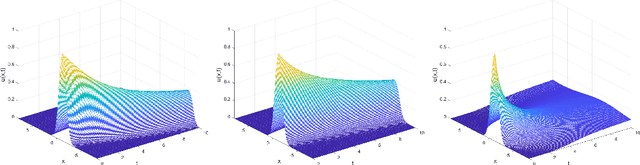
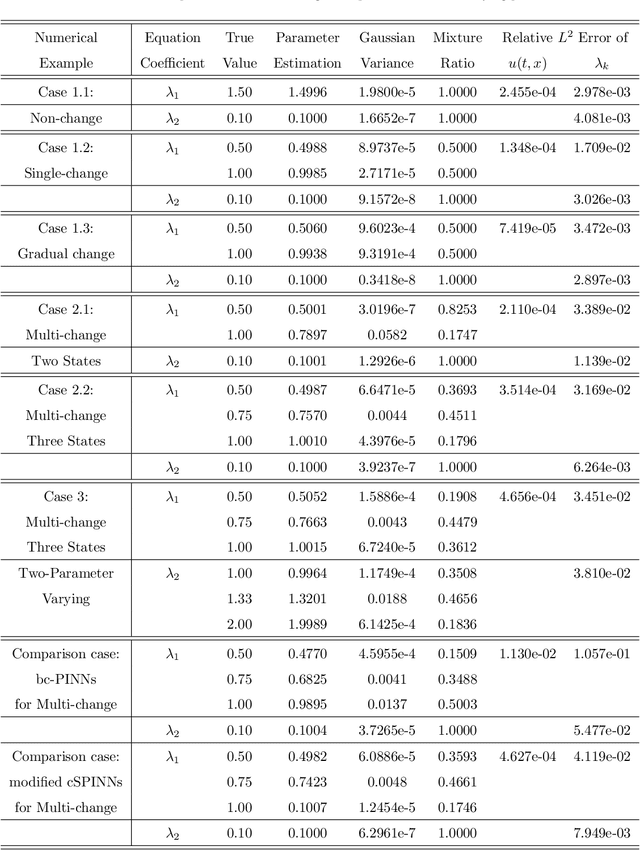

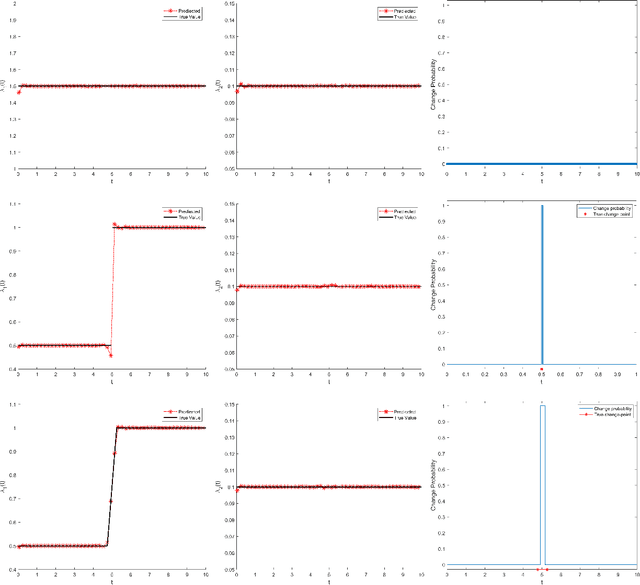
To comprehend complex systems with multiple states, it is imperative to reveal the identity of these states by system outputs. Nevertheless, the mathematical models describing these systems often exhibit nonlinearity so that render the resolution of the parameter inverse problem from the observed spatiotemporal data a challenging endeavor. Starting from the observed data obtained from such systems, we propose a novel framework that facilitates the investigation of parameter identification for multi-state systems governed by spatiotemporal varying parametric partial differential equations. Our framework consists of two integral components: a constrained self-adaptive physics-informed neural network, encompassing a sub-network, as our methodology for parameter identification, and a finite mixture model approach to detect regions of probable parameter variations. Through our scheme, we can precisely ascertain the unknown varying parameters of the complex multi-state system, thereby accomplishing the inversion of the varying parameters. Furthermore, we have showcased the efficacy of our framework on two numerical cases: the 1D Burgers' equation with time-varying parameters and the 2D wave equation with a space-varying parameter.
Automatic Depression Detection: An Emotional Audio-Textual Corpus and a GRU/BiLSTM-based Model
Feb 15, 2022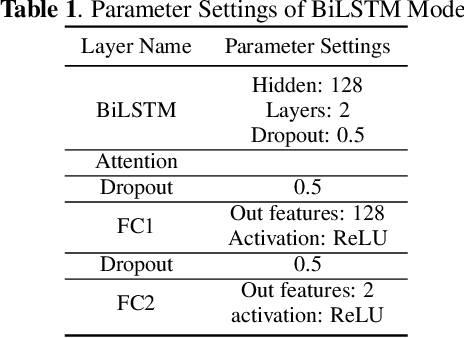
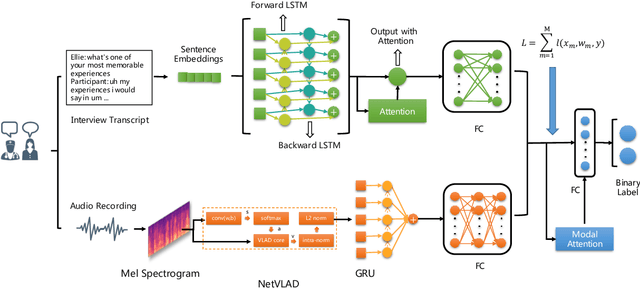

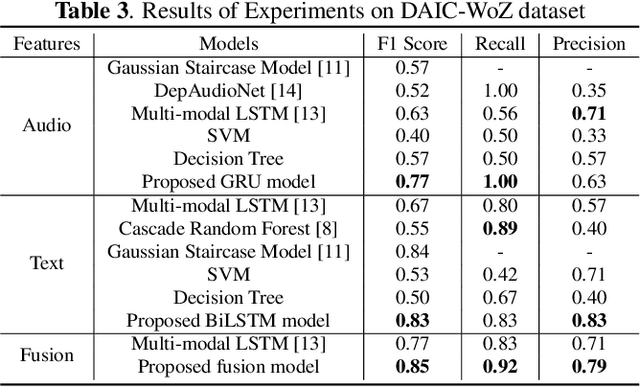
Depression is a global mental health problem, the worst case of which can lead to suicide. An automatic depression detection system provides great help in facilitating depression self-assessment and improving diagnostic accuracy. In this work, we propose a novel depression detection approach utilizing speech characteristics and linguistic contents from participants' interviews. In addition, we establish an Emotional Audio-Textual Depression Corpus (EATD-Corpus) which contains audios and extracted transcripts of responses from depressed and non-depressed volunteers. To the best of our knowledge, EATD-Corpus is the first and only public depression dataset that contains audio and text data in Chinese. Evaluated on two depression datasets, the proposed method achieves the state-of-the-art performances. The outperforming results demonstrate the effectiveness and generalization ability of the proposed method. The source code and EATD-Corpus are available at https://github.com/speechandlanguageprocessing/ICASSP2022-Depression.