 Add to Chrome
 Add to Firefox
 Add to Edge
ALICE: Learning a General-Purpose Pathology Foundation Model from Vision, Vision-Language, and Slide-Level Experts
Jul 10, 2026
Foundation models are reshaping computational pathology, yet their capabilities remain shaped by pretraining objectives, data sources, and spatial scales, fragmenting complementary expertise across separate backbones. Here we present ALICE, a unified foundation model trained through multi-stage agglomerative distillation that sequentially distills eight vision-only, vision-language, and slide-level teacher models into dedicated modules of a single backbone. ALICE is pretrained on 24,985,184 tile-level pathology images and 155,604 high-resolution images, and evaluated across 21 task scenarios, 96 downstream tasks, and 48 data sources, spanning region-of-interest tissue analysis, vision-language multimodal evaluation, and whole-slide clinical assessment. In all three evaluation settings, ALICE achieved the best average rank among task-matched pathology foundation models. These results demonstrate that agglomerative distillation can consolidate complementary capabilities from specialized models into a unified backbone for broad computational pathology applications. The model is available at https://github.com/WonderLandxD/ALICE.

Dynamic Hypergraph Representation for Bone Metastasis Cancer Analysis
Jan 28, 2025Bone metastasis analysis is a significant challenge in pathology and plays a critical role in determining patient quality of life and treatment strategies. The microenvironment and specific tissue structures are essential for pathologists to predict the primary bone cancer origins and primary bone cancer subtyping. By digitizing bone tissue sections into whole slide images (WSIs) and leveraging deep learning to model slide embeddings, this analysis can be enhanced. However, tumor metastasis involves complex multivariate interactions with diverse bone tissue structures, which traditional WSI analysis methods such as multiple instance learning (MIL) fail to capture. Moreover, graph neural networks (GNNs), limited to modeling pairwise relationships, are hard to represent high-order biological associations. To address these challenges, we propose a dynamic hypergraph neural network (DyHG) that overcomes the edge construction limitations of traditional graph representations by connecting multiple nodes via hyperedges. A low-rank strategy is used to reduce the complexity of parameters in learning hypergraph structures, while a Gumbel-Softmax-based sampling strategy optimizes the patch distribution across hyperedges. An MIL aggregator is then used to derive a graph-level embedding for comprehensive WSI analysis. To evaluate the effectiveness of DyHG, we construct two large-scale datasets for primary bone cancer origins and subtyping classification based on real-world bone metastasis scenarios. Extensive experiments demonstrate that DyHG significantly outperforms state-of-the-art (SOTA) baselines, showcasing its ability to model complex biological interactions and improve the accuracy of bone metastasis analysis.
Diagnostic Text-guided Representation Learning in Hierarchical Classification for Pathological Whole Slide Image
Nov 16, 2024
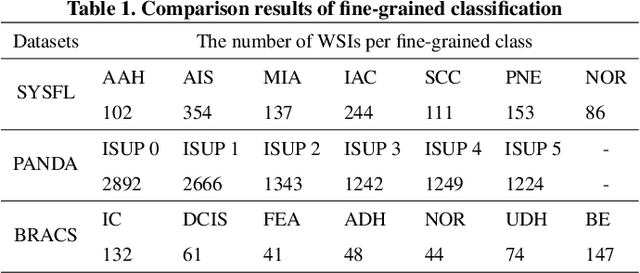

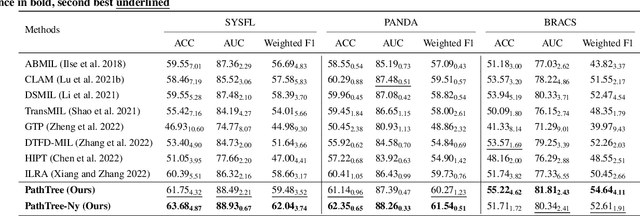
With the development of digital imaging in medical microscopy, artificial intelligent-based analysis of pathological whole slide images (WSIs) provides a powerful tool for cancer diagnosis. Limited by the expensive cost of pixel-level annotation, current research primarily focuses on representation learning with slide-level labels, showing success in various downstream tasks. However, given the diversity of lesion types and the complex relationships between each other, these techniques still deserve further exploration in addressing advanced pathology tasks. To this end, we introduce the concept of hierarchical pathological image classification and propose a representation learning called PathTree. PathTree considers the multi-classification of diseases as a binary tree structure. Each category is represented as a professional pathological text description, which messages information with a tree-like encoder. The interactive text features are then used to guide the aggregation of hierarchical multiple representations. PathTree uses slide-text similarity to obtain probability scores and introduces two extra tree specific losses to further constrain the association between texts and slides. Through extensive experiments on three challenging hierarchical classification datasets: in-house cryosectioned lung tissue lesion identification, public prostate cancer grade assessment, and public breast cancer subtyping, our proposed PathTree is consistently competitive compared to the state-of-the-art methods and provides a new perspective on the deep learning-assisted solution for more complex WSI classification.