 Add to Chrome
 Add to Firefox
 Add to Edge
AdaSplash-2: Faster Differentiable Sparse Attention
Apr 16, 2026
Sparse attention has been proposed as a way to alleviate the quadratic cost of transformers, a central bottleneck in long-context training. A promising line of work is $α$-entmax attention, a differentiable sparse alternative to softmax that enables input-dependent sparsity yet has lagged behind softmax due to the computational overhead necessary to compute the normalizer $τ$. In this paper, we introduce AdaSplash-2, which addresses this limitation through a novel histogram-based initialization that reduces the number of iterations needed to compute $τ$ to typically 1--2. The key idea is to compute a coarse histogram of attention scores on the fly and store it in on-chip SRAM, yielding a more accurate initialization that enables fast forward and backward computation. Combined with a sparsity-aware GPU implementation that skips zero blocks with low overhead, AdaSplash-2 matches or improves per-step training time relative to FlashAttention-2 when block sparsity is moderate-to-high (e.g., $>$60\%), which often occurs at long-context lengths. On downstream tasks, models trained with our efficient $α$-entmax attention match softmax baselines at short-context lengths and achieve substantial gains in long-context settings.

LaTIM: Measuring Latent Token-to-Token Interactions in Mamba Models
Feb 21, 2025State space models (SSMs), such as Mamba, have emerged as an efficient alternative to transformers for long-context sequence modeling. However, despite their growing adoption, SSMs lack the interpretability tools that have been crucial for understanding and improving attention-based architectures. While recent efforts provide insights into Mamba's internal mechanisms, they do not explicitly decompose token-wise contributions, leaving gaps in understanding how Mamba selectively processes sequences across layers. In this work, we introduce LaTIM, a novel token-level decomposition method for both Mamba-1 and Mamba-2 that enables fine-grained interpretability. We extensively evaluate our method across diverse tasks, including machine translation, copying, and retrieval-based generation, demonstrating its effectiveness in revealing Mamba's token-to-token interaction patterns.
How Effective are State Space Models for Machine Translation?
Jul 07, 2024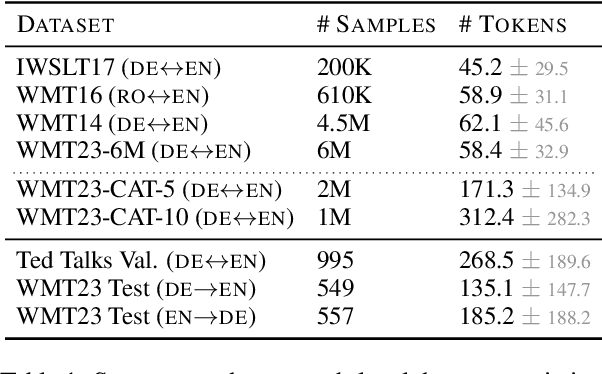
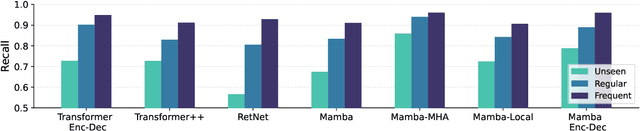
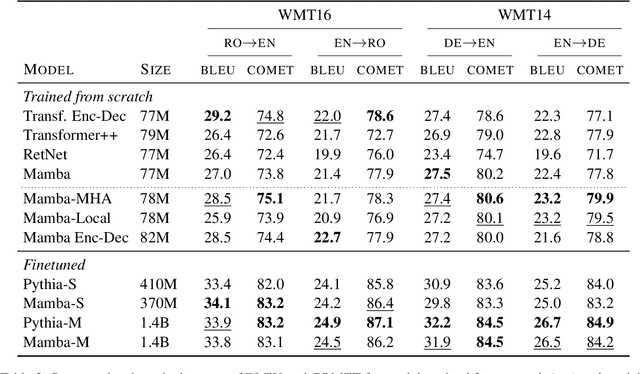
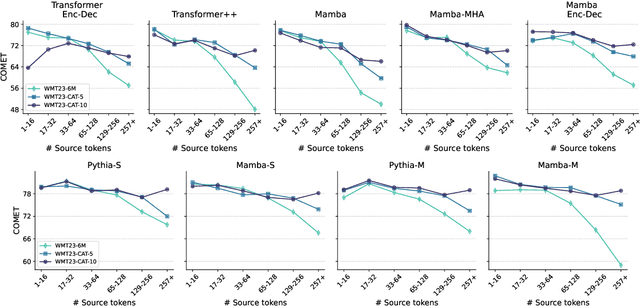
Transformers are the current architecture of choice for NLP, but their attention layers do not scale well to long contexts. Recent works propose to replace attention with linear recurrent layers -- this is the case for state space models, which enjoy efficient training and inference. However, it remains unclear whether these models are competitive with transformers in machine translation (MT). In this paper, we provide a rigorous and comprehensive experimental comparison between transformers and linear recurrent models for MT. Concretely, we experiment with RetNet, Mamba, and hybrid versions of Mamba which incorporate attention mechanisms. Our findings demonstrate that Mamba is highly competitive with transformers on sentence and paragraph-level datasets, where in the latter both models benefit from shifting the training distribution towards longer sequences. Further analysis show that integrating attention into Mamba improves translation quality, robustness to sequence length extrapolation, and the ability to recall named entities.