 Add to Chrome
 Add to Firefox
 Add to Edge
Effective Synthetic Image Detection via Noise Residual Clustering
Jul 12, 2026
The rapid advancement of generative artificial intelligence (AI) has made synthetic images remarkably realistic, posing security threats such as misinformation and fraud. It is significant to detect the synthetic image in the manner of passive and blind image authentication. Most existing detectors rely on supervised training with large labeled datasets, leading to high costs and degraded performance on unknown generative models. To attenuate such deficiencies, we propose a training-free detection method. Specifically, noise residual fingerprints are first extracted by a simple yet effective pre-trained Noiseprint++ model. Then multi-scale features are further extracted from such residual by a frozen Vision Transformer (ViT), followed by adaptive weighted fusion. Only a few real image samples are used needed to initialize the clustering centers for unsupervised K-Means, distinguishing real and synthetic images without training. Extensive evaluations on four benchmark datasets show that our proposed scheme achieves an average accuracy of 82.2%, outperforming the state-of-the-art detectors on generalization ability. Superior performance is gained on the popular diffusion type of synthetic images, and the effectiveness of each module is validated by ablation studies. Source code will be publicly available at https://github.com/multimediaFor/NoiseCluSID.

Acceleration of Histogram-Based Contrast Enhancement via Selective Downsampling
Nov 20, 2017
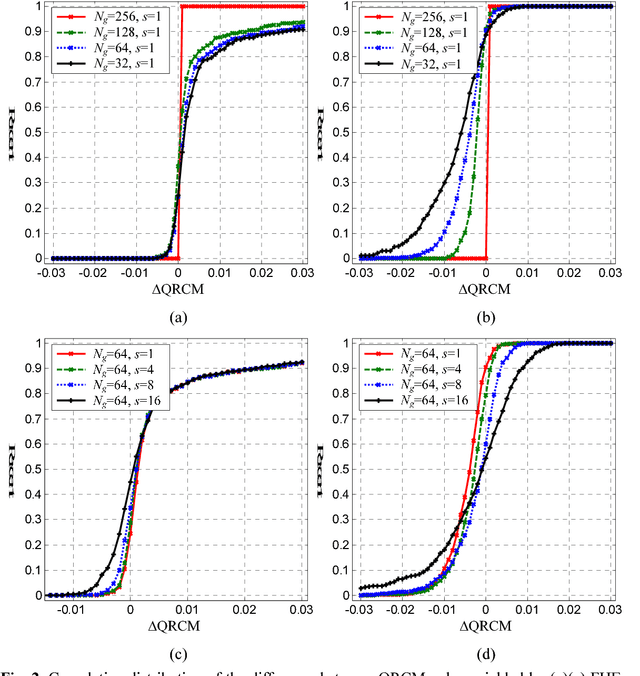
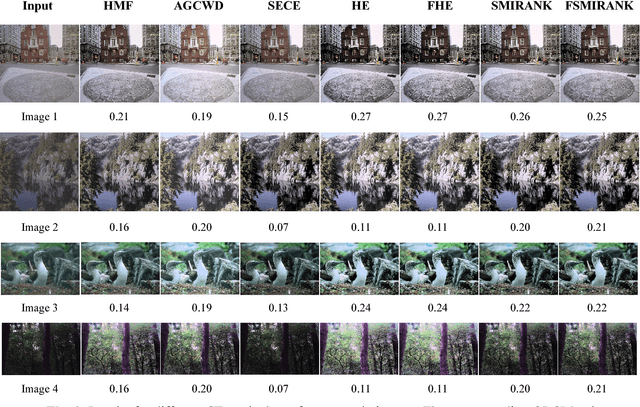

In this paper, we propose a general framework to accelerate the universal histogram-based image contrast enhancement (CE) algorithms. Both spatial and gray-level selective down- sampling of digital images are adopted to decrease computational cost, while the visual quality of enhanced images is still preserved and without apparent degradation. Mapping function calibration is novelly proposed to reconstruct the pixel mapping on the gray levels missed by downsampling. As two case studies, accelerations of histogram equalization (HE) and the state-of-the-art global CE algorithm, i.e., spatial mutual information and PageRank (SMIRANK), are presented detailedly. Both quantitative and qualitative assessment results have verified the effectiveness of our proposed CE acceleration framework. In typical tests, computational efficiencies of HE and SMIRANK have been speeded up by about 3.9 and 13.5 times, respectively.
Contrast Enhancement of Brightness-Distorted Images by Improved Adaptive Gamma Correction
Sep 13, 2017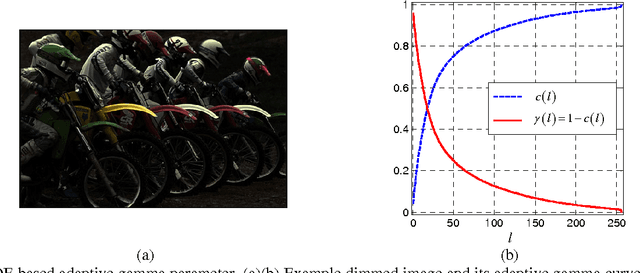
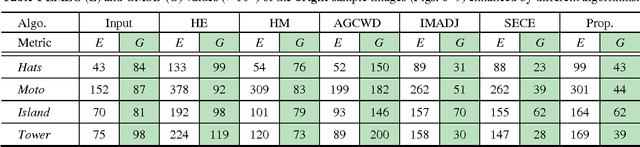
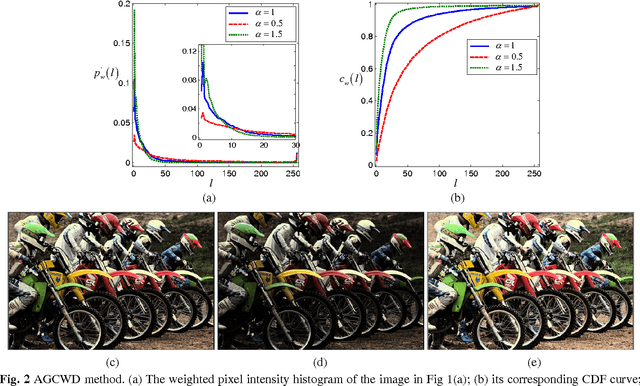
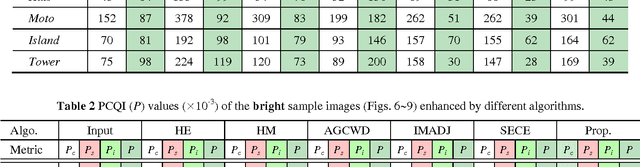
As an efficient image contrast enhancement (CE) tool, adaptive gamma correction (AGC) was previously proposed by relating gamma parameter with cumulative distribution function (CDF) of the pixel gray levels within an image. ACG deals well with most dimmed images, but fails for globally bright images and the dimmed images with local bright regions. Such two categories of brightness-distorted images are universal in real scenarios, such as improper exposure and white object regions. In order to attenuate such deficiencies, here we propose an improved AGC algorithm. The novel strategy of negative images is used to realize CE of the bright images, and the gamma correction modulated by truncated CDF is employed to enhance the dimmed ones. As such, local over-enhancement and structure distortion can be alleviated. Both qualitative and quantitative experimental results show that our proposed method yields consistently good CE results.