 Add to Chrome
 Add to Firefox
 Add to Edge
Navigating Unreliable Parametric and Contextual Knowledge: Explicit Knowledge Conflict Resolution for LLM Inference
Jun 18, 2026
Large language models (LLMs) have achieved strong performance across a wide range of language-based tasks by leveraging both extensive parametric knowledge and in-context learning ability, enabling them to incorporate external information provided in the input prompt. However, the integration of external knowledge can introduce conflicts, not only between the model's internal parametric knowledge and the external information, but also among multiple pieces of external contexts. Existing approaches typically assume that either the model or the provided context is reliable, overlooking the possibility that both sources may contain errors, and avoid conflicts by privileging one source over the other, rather than actively resolving inconsistencies. To address these limitations, we propose a novel framework MACR for LLM knowledge conflict resolution that moves beyond the conventional binary choice paradigm and incorporates an explicit conflict-resolution mechanism based on a multi-agent reasoning approach. Specifically, we first propose an adaptive knowledge assessment and retrieval approach that employs a modified semantic entropy measure to quantify an LLM's confidence in its answer to a given query. Based on this confidence estimation, MACR either externalizes the model's internal knowledge as textual representations or retrieves relevant external knowledge when internal knowledge is insufficient, generating basic contexts for subsequent reasoning. Then we introduce an inductive multi-agent reasoning framework with three specialized agents that, respectively, induce explicit rules, analyze potential conflicts, and resolve inconsistencies across all available contexts. Empirical results demonstrate that MACR significantly outperforms state-of-the-art baselines across benchmarks, while also providing interpretable resolutions of explicit conflicts.

Open Knowledge Base Canonicalization with Multi-task Learning
Mar 21, 2024

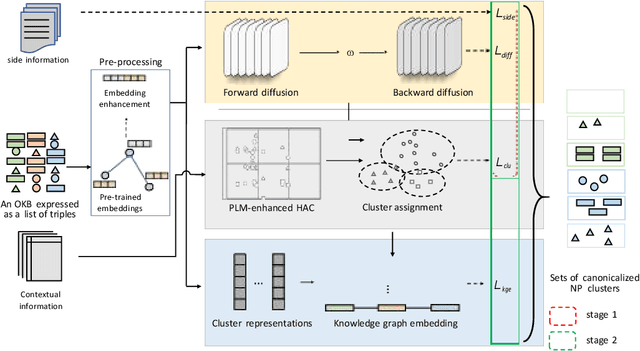

The construction of large open knowledge bases (OKBs) is integral to many knowledge-driven applications on the world wide web such as web search. However, noun phrases and relational phrases in OKBs often suffer from redundancy and ambiguity, which calls for the investigation on OKB canonicalization. Current solutions address OKB canonicalization by devising advanced clustering algorithms and using knowledge graph embedding (KGE) to further facilitate the canonicalization process. Nevertheless, these works fail to fully exploit the synergy between clustering and KGE learning, and the methods designed for these subtasks are sub-optimal. To this end, we put forward a multi-task learning framework, namely MulCanon, to tackle OKB canonicalization. In addition, diffusion model is used in the soft clustering process to improve the noun phrase representations with neighboring information, which can lead to more accurate representations. MulCanon unifies the learning objectives of these sub-tasks, and adopts a two-stage multi-task learning paradigm for training. A thorough experimental study on popular OKB canonicalization benchmarks validates that MulCanon can achieve competitive canonicalization results.