 Add to Chrome
 Add to Firefox
 Add to Edge
Beyond Neural Collapse: Task-Intrinsic Geometry Governs Neural Representations in Modular Arithmetic
Jun 08, 2026
While neural collapse (NC) predicts that a $K$-class-balanced classifier should organize terminal representations as a $(K-1)$-dimensional simplex equiangular tight frame (ETF), modular addition consistently enters a different regime: networks compress to a two-dimensional cyclic geometry in which both classifier weights and token embeddings lie on circles. We refine the explanation of this phenomenon in three directions. First, we formalize a layerwise non-uniform training mechanism: downstream classifier weights are driven by dense cross-entropy gradients into a rank-2 equiangular configuration before upstream embeddings fully reorganize, and once this classifier plane forms, backpropagated feature gradients constrain embedding motion to the same plane while weight decay suppresses orthogonal components. Second, after this subspace locking, the induced in-plane dynamics admit an entropy-regularized transport interpretation on $S^1$; combined with modular-addition labels, this reduces embedding formation to phase alignment, whose minimizers are single-frequency characters of $\mathbb{Z}/P\mathbb{Z}$ and hence equal-angle points on a circle. Third, we quantify why this solution prevails over NC: a simplex ETF gains only an $O(1)$ advantage in cross-entropy, whereas the cyclic rank-2 solution enjoys a $Θ(K)$ advantage under Schatten or weight-decay surrogates, yielding a critical threshold $λ_{\mathrm{crit}} = Θ(1/K)$. Our results explain both why classifier weights move first and why embeddings subsequently align with them, showing that grokking on modular arithmetic is governed not by maximal separation alone but by a task-structured trade-off between separation, symmetry, and complexity.

Deciphering Two Training Clocks in Grokking via Deep Linear Network Theory with Conditional ReLU Reduction
Jun 04, 2026Grokking suggests that fitting the training data and learning a simple underlying rule may occur on different time scales. We formalize this phenomenon by separating the fast decay of the classification loss from the slower simplification of the learned representation, and we call the resulting pair of stopping times two training clocks. For deep linear networks, we show that a post-margin gap-growth or one-step tail-contraction condition reduces the cross-entropy loss to level epsilon on a logarithmic time scale. In contrast, when layerwise weight decay is present, the induced regularization on the end-to-end map can be expressed as a Schatten-type penalty; under a sharp late-time Kurdyka-Lojasiewicz tail, this structural energy closes on a polynomial time scale. The two clocks, therefore, separate fitting from representation simplification. We then explain how the same mechanism can appear in ReLU MLPs. In regions where the activation patterns on the training set remain fixed, the network reduces to a linear model in the active coordinates. In a two-layer ReLU embedding model, chain-rule estimates further show that the classifier head can receive larger effective gradients than the embedding block under controlled downstream norms. This supports a two-stage mechanism in which the classifier fits first, while the representation continues to simplify later. We use modular addition as the main experimental setting. The deep linear theory provides the rigorous core of the analysis. But the ReLU results are formulated as conditional reductions that account for empirical behavior without claiming a global proof for nonlinear training dynamics.
Hybrid Time-Domain Behavior Model Based on Neural Differential Equations and RNNs
Mar 28, 2025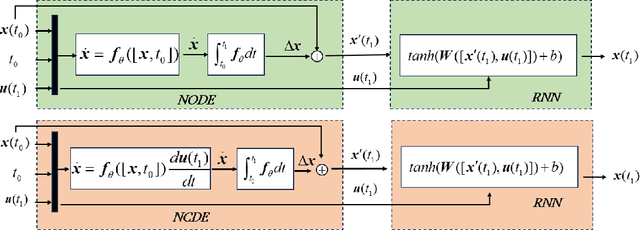
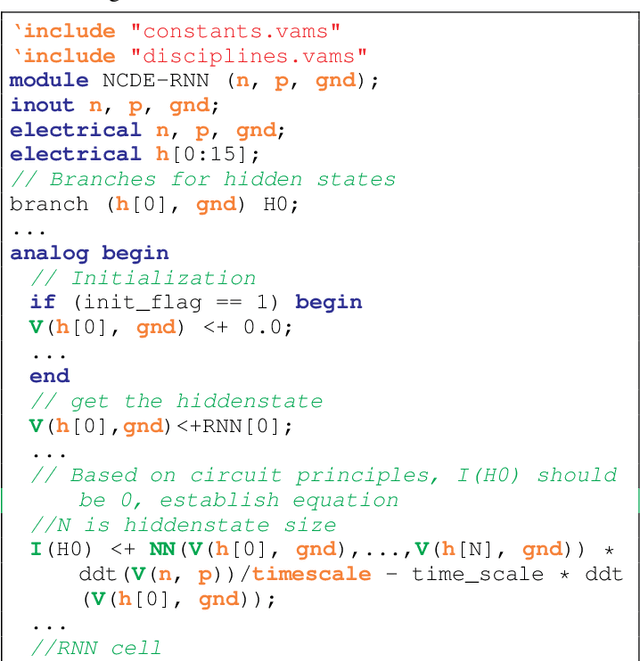
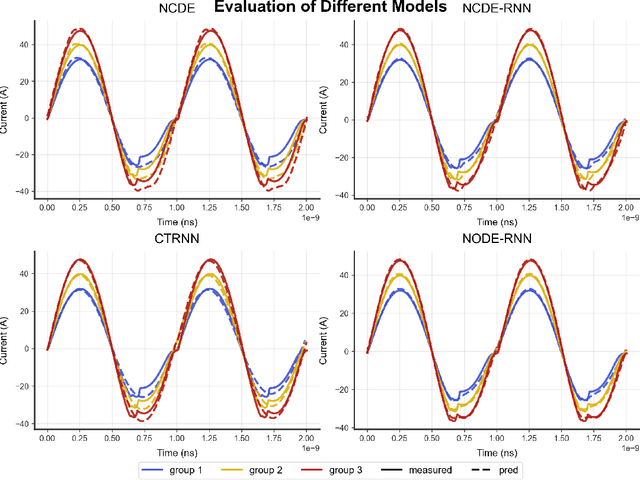
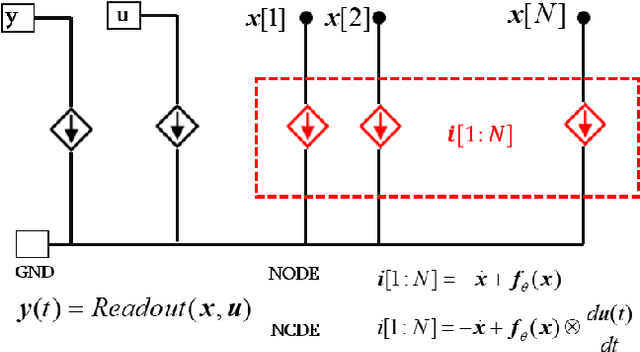
Nonlinear dynamics system identification is crucial for circuit emulation. Traditional continuous-time domain modeling approaches have limitations in fitting capability and computational efficiency when used for modeling circuit IPs and device behaviors.This paper presents a novel continuous-time domain hybrid modeling paradigm. It integrates neural network differential models with recurrent neural networks (RNNs), creating NODE-RNN and NCDE-RNN models based on neural ordinary differential equations (NODE) and neural controlled differential equations (NCDE), respectively.Theoretical analysis shows that this hybrid model has mathematical advantages in event-driven dynamic mutation response and gradient propagation stability. Validation using real data from PIN diodes in high-power microwave environments shows NCDE-RNN improves fitting accuracy by 33\% over traditional NCDE, and NODE-RNN by 24\% over CTRNN, especially in capturing nonlinear memory effects.The model has been successfully deployed in Verilog-A and validated through circuit emulation, confirming its compatibility with existing platforms and practical value.This hybrid dynamics paradigm, by restructuring the neural differential equation solution path, offers new ideas for high-precision circuit time-domain modeling and is significant for complex nonlinear circuit system modeling.