 Add to Chrome
 Add to Firefox
 Add to Edge
Structure-Preserving Projection for Mitigating Modality Bias in LLM-Based Sequential Recommendation
Aug 09, 2026
Recent LLM-based recommenders integrate textual and collaborative signals by projecting collaborative embeddings into the embedding space of the LLM. However, this projection can introduce modality bias that distorts the underlying collaborative structure and limits the usefulness of projected embeddings. To address this issue, we propose a novel structure-preserving projection approach that maintains the relational geometry of collaborative embeddings through dedicated structure-preserving losses. Comprehensive experiments demonstrate that our approach consistently improves recommendation performance, providing a more reliable path for LLM-based recommendation.

RADAR: Retrieval-Augmented Detector with Adversarial Refinement for Robust Fake News Detection
Jan 07, 2026To efficiently combat the spread of LLM-generated misinformation, we present RADAR, a retrieval-augmented detector with adversarial refinement for robust fake news detection. Our approach employs a generator that rewrites real articles with factual perturbations, paired with a lightweight detector that verifies claims using dense passage retrieval. To enable effective co-evolution, we introduce verbal adversarial feedback (VAF). Rather than relying on scalar rewards, VAF issues structured natural-language critiques; these guide the generator toward more sophisticated evasion attempts, compelling the detector to adapt and improve. On a fake news detection benchmark, RADAR achieves 86.98% ROC-AUC, significantly outperforming general-purpose LLMs with retrieval. Ablation studies confirm that detector-side retrieval yields the largest gains, while VAF and few-shot demonstrations provide critical signals for robust training.
Dixit: Interactive Visual Storytelling via Term Manipulation
Mar 11, 2019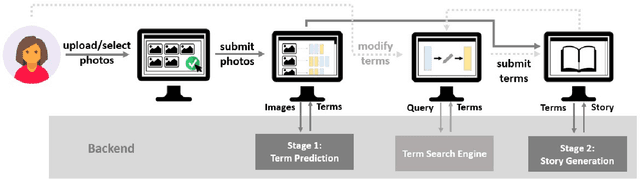
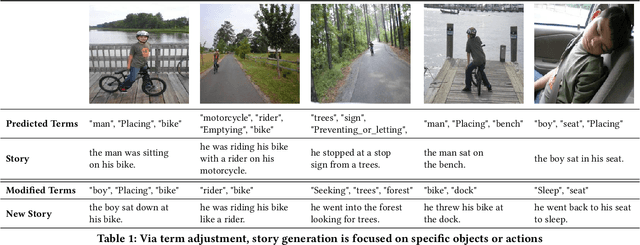
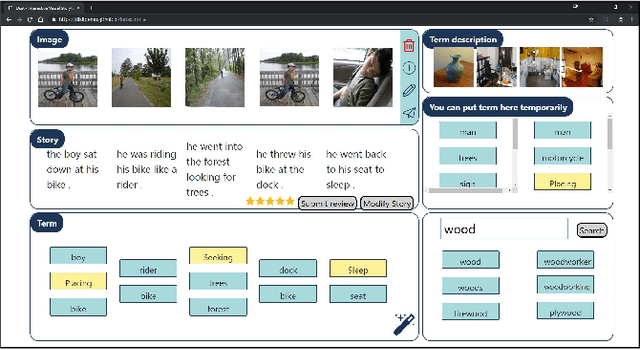
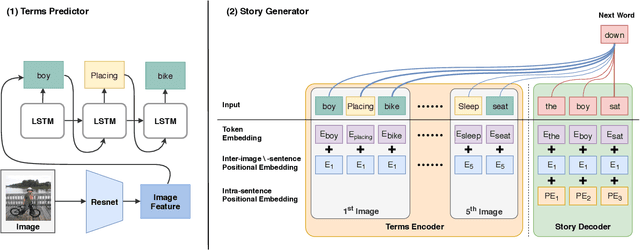
In this paper, we introduce Dixit, an interactive visual storytelling system that the user interacts with iteratively to compose a short story for a photo sequence. The user initiates the process by uploading a sequence of photos. Dixit first extracts text terms from each photo which describe the objects (e.g., boy, bike) or actions (e.g., sleep) in the photo, and then allows the user to add new terms or remove existing terms. Dixit then generates a short story based on these terms. Behind the scenes, Dixit uses an LSTM-based model trained on image caption data and FrameNet to distill terms from each image and utilizes a transformer decoder to compose a context-coherent story. Users change images or terms iteratively with Dixit to create the most ideal story. Dixit also allows users to manually edit and rate stories. The proposed procedure opens up possibilities for interpretable and controllable visual storytelling, allowing users to understand the story formation rationale and to intervene in the generation process.