 Add to Chrome
 Add to Firefox
 Add to Edge
Latent Refinement via Flow Matching for Training-free Linear Inverse Problem Solving
Nov 08, 2025
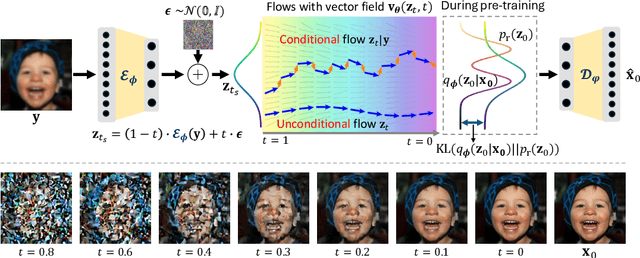
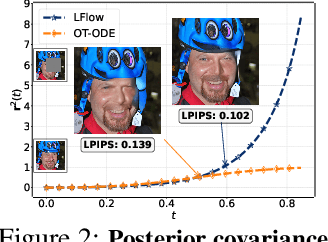

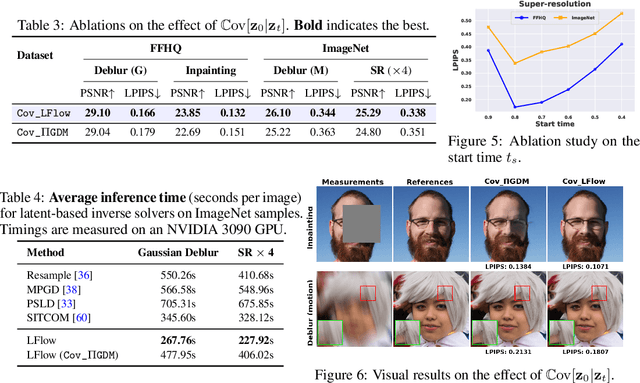
Recent advances in inverse problem solving have increasingly adopted flow priors over diffusion models due to their ability to construct straight probability paths from noise to data, thereby enhancing efficiency in both training and inference. However, current flow-based inverse solvers face two primary limitations: (i) they operate directly in pixel space, which demands heavy computational resources for training and restricts scalability to high-resolution images, and (ii) they employ guidance strategies with prior-agnostic posterior covariances, which can weaken alignment with the generative trajectory and degrade posterior coverage. In this paper, we propose LFlow (Latent Refinement via Flows), a training-free framework for solving linear inverse problems via pretrained latent flow priors. LFlow leverages the efficiency of flow matching to perform ODE sampling in latent space along an optimal path. This latent formulation further allows us to introduce a theoretically grounded posterior covariance, derived from the optimal vector field, enabling effective flow guidance. Experimental results demonstrate that our proposed method outperforms state-of-the-art latent diffusion solvers in reconstruction quality across most tasks. The code will be publicly available at https://github.com/hosseinaskari-cs/LFlow .

Bi-level Guided Diffusion Models for Zero-Shot Medical Imaging Inverse Problems
Apr 04, 2024In the realm of medical imaging, inverse problems aim to infer high-quality images from incomplete, noisy measurements, with the objective of minimizing expenses and risks to patients in clinical settings. The Diffusion Models have recently emerged as a promising approach to such practical challenges, proving particularly useful for the zero-shot inference of images from partially acquired measurements in Magnetic Resonance Imaging (MRI) and Computed Tomography (CT). A central challenge in this approach, however, is how to guide an unconditional prediction to conform to the measurement information. Existing methods rely on deficient projection or inefficient posterior score approximation guidance, which often leads to suboptimal performance. In this paper, we propose \underline{\textbf{B}}i-level \underline{G}uided \underline{D}iffusion \underline{M}odels ({BGDM}), a zero-shot imaging framework that efficiently steers the initial unconditional prediction through a \emph{bi-level} guidance strategy. Specifically, BGDM first approximates an \emph{inner-level} conditional posterior mean as an initial measurement-consistent reference point and then solves an \emph{outer-level} proximal optimization objective to reinforce the measurement consistency. Our experimental findings, using publicly available MRI and CT medical datasets, reveal that BGDM is more effective and efficient compared to the baselines, faithfully generating high-fidelity medical images and substantially reducing hallucinatory artifacts in cases of severe degradation.
Hybrid Inception Architecture with Residual Connection: Fine-tuned Inception-ResNet Deep Learning Model for Lung Inflammation Diagnosis from Chest Radiographs
Oct 05, 2023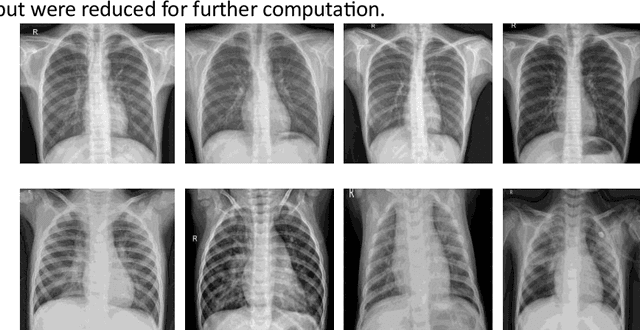
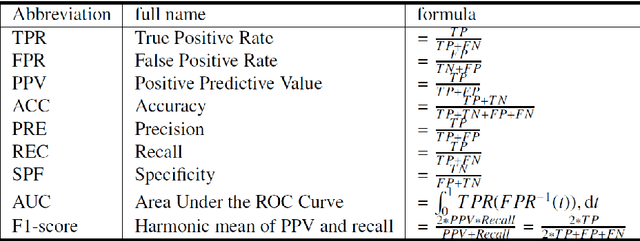
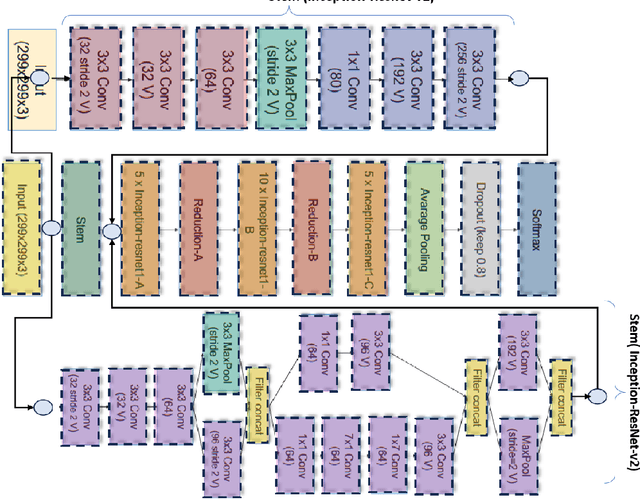
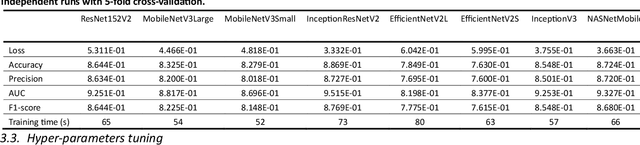
Diagnosing lung inflammation, particularly pneumonia, is of paramount importance for effectively treating and managing the disease. Pneumonia is a common respiratory infection caused by bacteria, viruses, or fungi and can indiscriminately affect people of all ages. As highlighted by the World Health Organization (WHO), this prevalent disease tragically accounts for a substantial 15% of global mortality in children under five years of age. This article presents a comparative study of the Inception-ResNet deep learning model's performance in diagnosing pneumonia from chest radiographs. The study leverages Mendeleys chest X-ray images dataset, which contains 5856 2D images, including both Viral and Bacterial Pneumonia X-ray images. The Inception-ResNet model is compared with seven other state-of-the-art convolutional neural networks (CNNs), and the experimental results demonstrate the Inception-ResNet model's superiority in extracting essential features and saving computation runtime. Furthermore, we examine the impact of transfer learning with fine-tuning in improving the performance of deep convolutional models. This study provides valuable insights into using deep learning models for pneumonia diagnosis and highlights the potential of the Inception-ResNet model in this field. In classification accuracy, Inception-ResNet-V2 showed superior performance compared to other models, including ResNet152V2, MobileNet-V3 (Large and Small), EfficientNetV2 (Large and Small), InceptionV3, and NASNet-Mobile, with substantial margins. It outperformed them by 2.6%, 6.5%, 7.1%, 13%, 16.1%, 3.9%, and 1.6%, respectively, demonstrating its significant advantage in accurate classification.