 Add to Chrome
 Add to Firefox
 Add to Edge
Bit-Efficient Quantisation for Two-Channel Modulo-Sampling Systems
Jan 20, 2026
Two-channel modulo analog-to-digital converters (ADCs) enable high-dynamic-range signal sensing at the Nyquist rate per channel, but existing designs quantise both channel outputs independently, incurring redundant bitrate costs. This paper proposes a bit-efficient quantisation scheme that exploits the integer-valued structure of inter-channel differences, transmitting one quantised channel output together with a compact difference index. We prove that this approach requires only 1-2 bits per signal sample overhead relative to conventional ADCs, despite operating with a much smaller per-channel dynamic range. Simulations confirm the theoretical error bounds and bitrate analysis, while hardware experiments demonstrate substantial bitrate savings compared with existing modulo sampling schemes, while maintaining comparable reconstruction accuracy. These results highlight a practical path towards high-resolution, bandwidth-efficient modulo ADCs for bitrate-constrained systems.

Difference-Based Recovery for Modulo Sampling: Tightened Bounds and Robustness Guarantees
Sep 16, 2025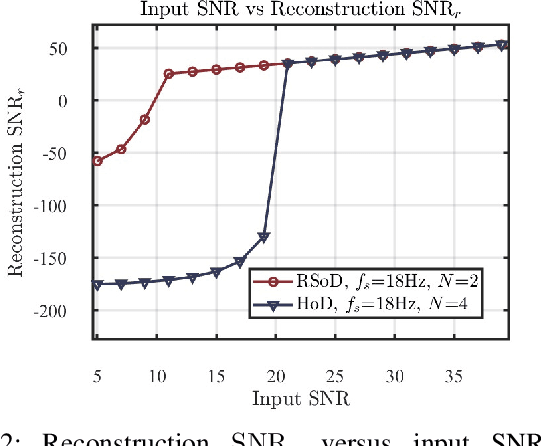
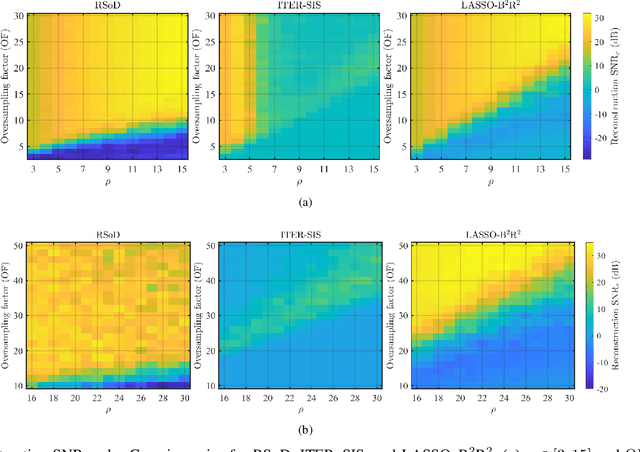
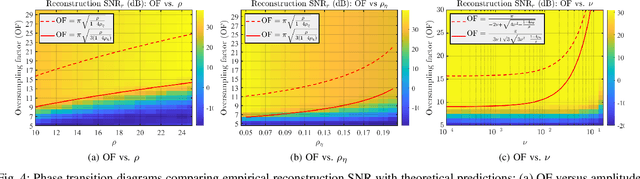
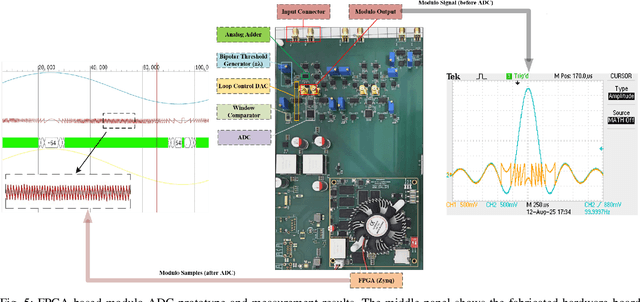
Conventional analog-to-digital converters (ADCs) clip when signals exceed their input range. Modulo (unlimited) sampling overcomes this limitation by folding the signal before digitization, but existing recovery methods are either computationally intensive or constrained by loose oversampling bounds that demand high sampling rates. In addition, none account for sampling jitter, which is unavoidable in practice. This paper revisits difference-based recovery and establishes new theoretical and practical guarantees. In the noiseless setting, we prove that arbitrarily high difference order reduces the sufficient oversampling factor from $2\pi e$ to $\pi$, substantially tightening classical bounds. For fixed order $N$, we derive a noise-aware sampling condition that guarantees stable recovery. For second-order difference-based recovery ($N=2$), we further extend the analysis to non-uniform sampling, proving robustness under bounded jitter. An FPGA-based hardware prototype demonstrates reliable reconstruction with amplitude expansion up to $\rho = 108$, confirming the feasibility of high-performance unlimited sensing with a simple and robust recovery pipeline.