 Add to Chrome
 Add to Firefox
 Add to Edge
Graph Navier Stokes Networks
May 20, 2026
Graph Neural Networks (GNNs) have emerged as a cornerstone of deep learning, with most existing methods rooted in graph signal processing and diffusion equations to model message passing. However, these approaches inherently suffer from the oversmoothing problem, where node features become indistinguishable as the network depth increases. Inspired by the Navier Stokes equations, we introduce Graph Navier Stokes Networks (GNSN), a novel architecture that transcends conventional diffusion-based message passing by incorporating convection into graph structures. GNSN defines a dynamic velocity field on the graph to govern convection, enabling more efficient and direct message propagation. By adaptively balancing convection and diffusion, GNSN is able to efficiently handle datasets with varying levels of homophily. Extensive evaluations across twelve real-world datasets demonstrate that GNSN consistently outperforms state-of-the-art baselines in classification accuracy. Moreover, experimental results further emphasize its effectiveness in alleviating the oversmoothing problem.

HOP: Heterogeneous Topology-based Multimodal Entanglement for Co-Speech Gesture Generation
Mar 03, 2025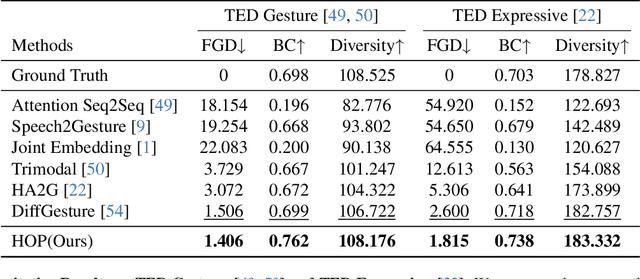
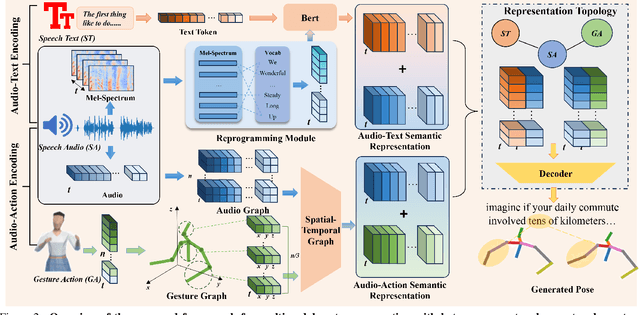

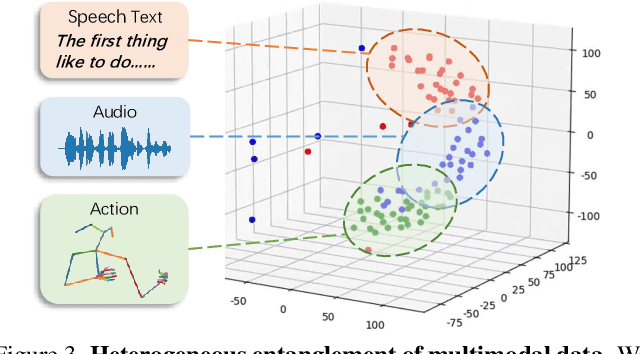
Co-speech gestures are crucial non-verbal cues that enhance speech clarity and expressiveness in human communication, which have attracted increasing attention in multimodal research. While the existing methods have made strides in gesture accuracy, challenges remain in generating diverse and coherent gestures, as most approaches assume independence among multimodal inputs and lack explicit modeling of their interactions. In this work, we propose a novel multimodal learning method named HOP for co-speech gesture generation that captures the heterogeneous entanglement between gesture motion, audio rhythm, and text semantics, enabling the generation of coordinated gestures. By leveraging spatiotemporal graph modeling, we achieve the alignment of audio and action. Moreover, to enhance modality coherence, we build the audio-text semantic representation based on a reprogramming module, which is beneficial for cross-modality adaptation. Our approach enables the trimodal system to learn each other's features and represent them in the form of topological entanglement. Extensive experiments demonstrate that HOP achieves state-of-the-art performance, offering more natural and expressive co-speech gesture generation. More information, codes, and demos are available here: https://star-uu-wang.github.io/HOP/