 Add to Chrome
 Add to Firefox
 Add to Edge
Adaptive Combinatorial Experimental Design: Pareto Optimality for Decision-Making and Inference
Feb 27, 2026
In this paper, we provide the first investigation into adaptive combinatorial experimental design, focusing on the trade-off between regret minimization and statistical power in combinatorial multi-armed bandits (CMAB). While minimizing regret requires repeated exploitation of high-reward arms, accurate inference on reward gaps requires sufficient exploration of suboptimal actions. We formalize this trade-off through the concept of Pareto optimality and establish equivalent conditions for Pareto-efficient learning in CMAB. We consider two relevant cases under different information structures, i.e., full-bandit feedback and semi-bandit feedback, and propose two algorithms MixCombKL and MixCombUCB respectively for these two cases. We provide theoretical guarantees showing that both algorithms are Pareto optimal, achieving finite-time guarantees on both regret and estimation error of arm gaps. Our results further reveal that richer feedback significantly tightens the attainable Pareto frontier, with the primary gains arising from improved estimation accuracy under our proposed methods. Taken together, these findings establish a principled framework for adaptive combinatorial experimentation in multi-objective decision-making.

Characterizing the Dilemma of Performance and Index Size in Billion-Scale Vector Search and Breaking It with Second-Tier Memory
May 07, 2024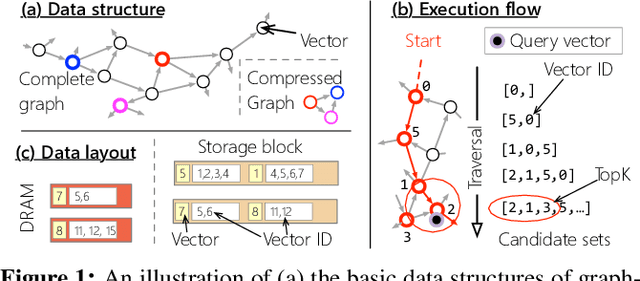
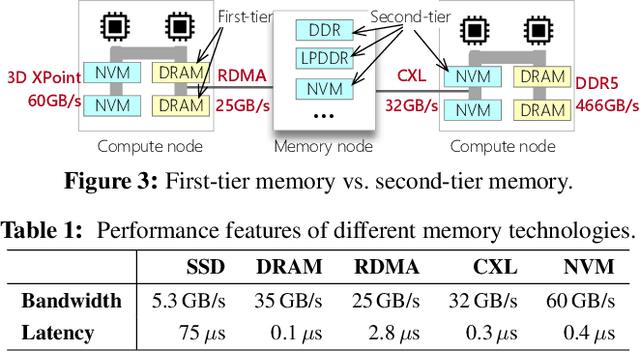
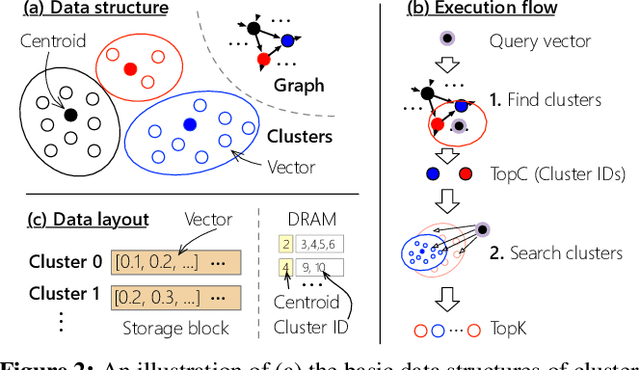
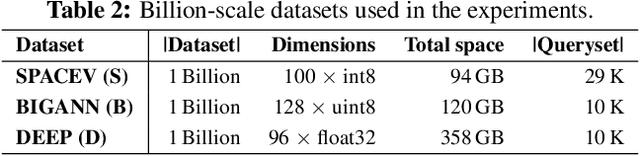
Vector searches on large-scale datasets are critical to modern online services like web search and RAG, which necessity storing the datasets and their index on the secondary storage like SSD. In this paper, we are the first to characterize the trade-off of performance and index size in existing SSD-based graph and cluster indexes: to improve throughput by 5.7$\times$ and 1.7$\times$, these indexes have to pay a 5.8$\times$ storage amplification and 7.7$\times$ with respect to the dataset size, respectively. The root cause is that the coarse-grained access of SSD mismatches the fine-grained random read required by vector indexes with small amplification. This paper argues that second-tier memory, such as remote DRAM/NVM connected via RDMA or CXL, is a powerful storage for addressing the problem from a system's perspective, thanks to its fine-grained access granularity. However, putting existing indexes -- primarily designed for SSD -- directly on second-tier memory cannot fully utilize its power. Meanwhile, second-tier memory still behaves more like storage, so using it as DRAM is also inefficient. To this end, we build a graph and cluster index that centers around the performance features of second-tier memory. With careful execution engine and index layout designs, we show that vector indexes can achieve optimal performance with orders of magnitude smaller index amplification, on a variety of second-tier memory devices. Based on our improved graph and vector indexes on second-tier memory, we further conduct a systematic study between them to facilitate developers choosing the right index for their workloads. Interestingly, the findings on the second-tier memory contradict the ones on SSDs.