 Add to Chrome
 Add to Firefox
 Add to Edge
Information-Dense Reasoning for Efficient and Auditable Security Alert Triage
Dec 09, 2025
Security Operations Centers face massive, heterogeneous alert streams under minute-level service windows, creating the Alert Triage Latency Paradox: verbose reasoning chains ensure accuracy and compliance but incur prohibitive latency and token costs, while minimal chains sacrifice transparency and auditability. Existing solutions fail: signature systems are brittle, anomaly methods lack actionability, and fully cloud-hosted LLMs raise latency, cost, and privacy concerns. We propose AIDR, a hybrid cloud-edge framework that addresses this trade-off through constrained information-density optimization. The core innovation is gradient-based compression of reasoning chains to retain only decision-critical steps--minimal evidence sufficient to justify predictions while respecting token and latency budgets. We demonstrate that this approach preserves decision-relevant information while minimizing complexity. We construct compact datasets by distilling alerts into 3-5 high-information bullets (68% token reduction), train domain-specialized experts via LoRA, and deploy a cloud-edge architecture: a cloud LLM routes alerts to on-premises experts generating SOAR-ready JSON. Experiments demonstrate AIDR achieves higher accuracy and 40.6% latency reduction versus Chain-of-Thought, with robustness to data corruption and out-of-distribution generalization, enabling auditable and efficient SOC triage with full data residency compliance.

DegreEmbed: incorporating entity embedding into logic rule learning for knowledge graph reasoning
Dec 18, 2021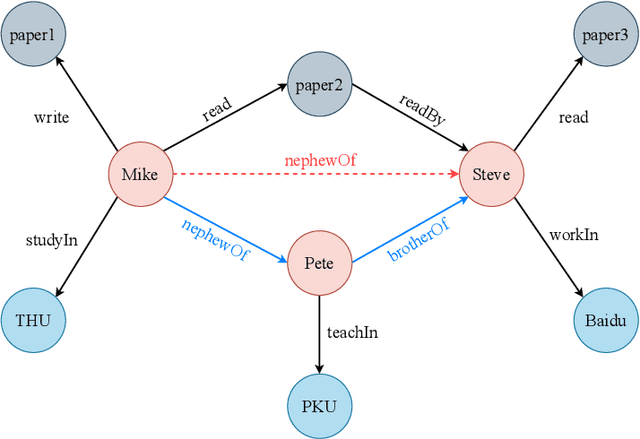
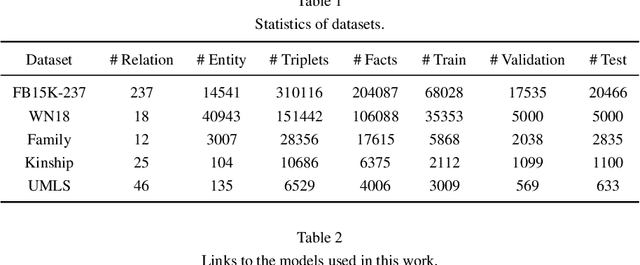
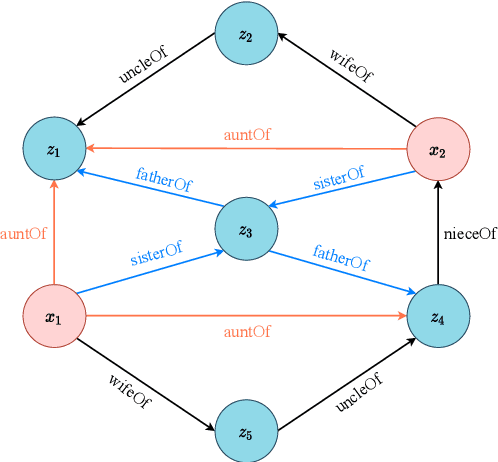
Knowledge graphs (KGs), as structured representations of real world facts, are intelligent databases incorporating human knowledge that can help machine imitate the way of human problem solving. However, due to the nature of rapid iteration as well as incompleteness of data, KGs are usually huge and there are inevitably missing facts in KGs. Link prediction for knowledge graphs is the task aiming to complete missing facts by reasoning based on the existing knowledge. Two main streams of research are widely studied: one learns low-dimensional embeddings for entities and relations that can capture latent patterns, and the other gains good interpretability by mining logical rules. Unfortunately, previous studies rarely pay attention to heterogeneous KGs. In this paper, we propose DegreEmbed, a model that combines embedding-based learning and logic rule mining for inferring on KGs. Specifically, we study the problem of predicting missing links in heterogeneous KGs that involve entities and relations of various types from the perspective of the degrees of nodes. Experimentally, we demonstrate that our DegreEmbed model outperforms the state-of-the-art methods on real world datasets. Meanwhile, the rules mined by our model are of high quality and interpretability.