 Add to Chrome
 Add to Firefox
 Add to Edge
Can Generative Artificial Intelligence Survive Data Contamination? Theoretical Guarantees under Contaminated Recursive Training
Feb 17, 2026
Generative Artificial Intelligence (AI), such as large language models (LLMs), has become a transformative force across science, industry, and society. As these systems grow in popularity, web data becomes increasingly interwoven with this AI-generated material and it is increasingly difficult to separate them from naturally generated content. As generative models are updated regularly, later models will inevitably be trained on mixtures of human-generated data and AI-generated data from earlier versions, creating a recursive training process with data contamination. Existing theoretical work has examined only highly simplified settings, where both the real data and the generative model are discrete or Gaussian, where it has been shown that such recursive training leads to model collapse. However, real data distributions are far more complex, and modern generative models are far more flexible than Gaussian and linear mechanisms. To fill this gap, we study recursive training in a general framework with minimal assumptions on the real data distribution and allow the underlying generative model to be a general universal approximator. In this framework, we show that contaminated recursive training still converges, with a convergence rate equal to the minimum of the baseline model's convergence rate and the fraction of real data used in each iteration. To the best of our knowledge, this is the first (positive) theoretical result on recursive training without distributional assumptions on the data. We further extend the analysis to settings where sampling bias is present in data collection and support all theoretical results with empirical studies.

Deep Generative Models: Complexity, Dimensionality, and Approximation
Apr 01, 2025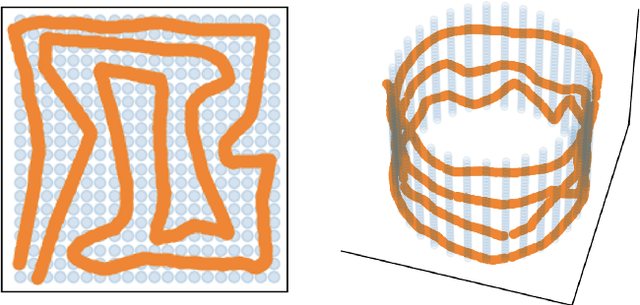
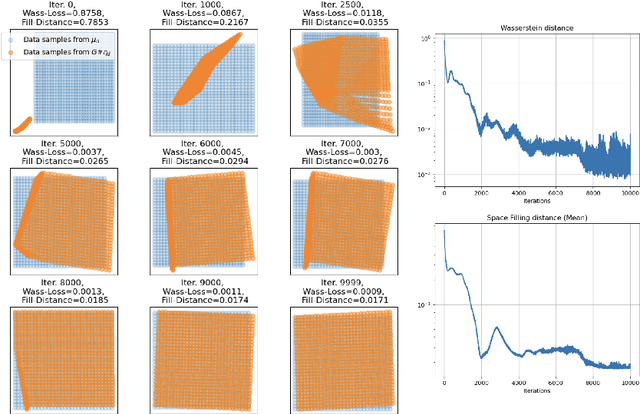
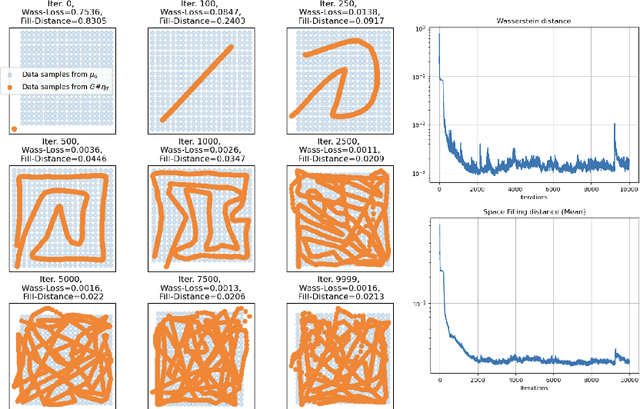
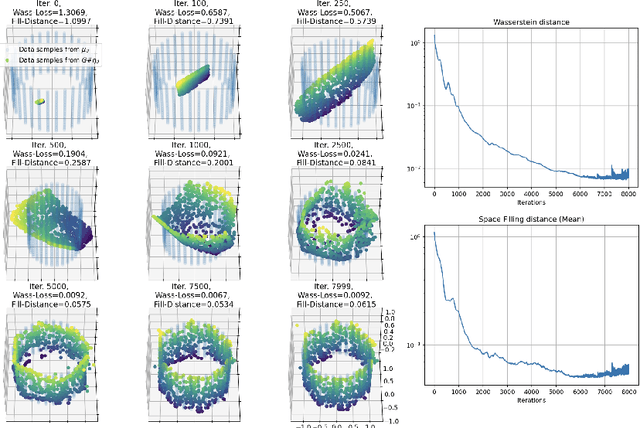
Generative networks have shown remarkable success in learning complex data distributions, particularly in generating high-dimensional data from lower-dimensional inputs. While this capability is well-documented empirically, its theoretical underpinning remains unclear. One common theoretical explanation appeals to the widely accepted manifold hypothesis, which suggests that many real-world datasets, such as images and signals, often possess intrinsic low-dimensional geometric structures. Under this manifold hypothesis, it is widely believed that to approximate a distribution on a $d$-dimensional Riemannian manifold, the latent dimension needs to be at least $d$ or $d+1$. In this work, we show that this requirement on the latent dimension is not necessary by demonstrating that generative networks can approximate distributions on $d$-dimensional Riemannian manifolds from inputs of any arbitrary dimension, even lower than $d$, taking inspiration from the concept of space-filling curves. This approach, in turn, leads to a super-exponential complexity bound of the deep neural networks through expanded neurons. Our findings thus challenge the conventional belief on the relationship between input dimensionality and the ability of generative networks to model data distributions. This novel insight not only corroborates the practical effectiveness of generative networks in handling complex data structures, but also underscores a critical trade-off between approximation error, dimensionality, and model complexity.