 Add to Chrome
 Add to Firefox
 Add to Edge
Teaching Foundation Models to Read mmWave: Pose-Guided Kinematic Representation for Human Behavior Understanding
Aug 04, 2026
Large language model agents need to perceive human behavior in physical environments. Millimeter-wave (mmWave) radar provides a privacy-friendly and contactless sensing modality, but radar observations are difficult to align with language. Existing radar-language methods often rely on synthetic data or lack explicit supervision for human body structure and motion. We present mmMind, a radar-language model that uses synchronized 3D pose as training-only supervision. A spatio-temporal radar encoder is pretrained to capture body configuration and motion dynamics, after which the pose head is removed so that inference requires radar alone. The learned radar representations are then aligned with an LLM for behavior captioning and spatio-temporal question answering. We also introduce mmMind-Bench, a real-world mmWave-language benchmark containing 17.9 hours of recordings from 23 participants across seven indoor environments. Experiments on captioning, question answering, and unseen-action generalization show that mmMind consistently outperforms existing radar-language baselines, while ablations confirm the importance of pose-guided pretraining.

Coherent False Seizure Prediction in Epilepsy, Coincidence or Providence?
Oct 26, 2021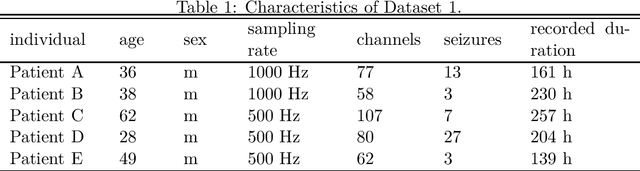
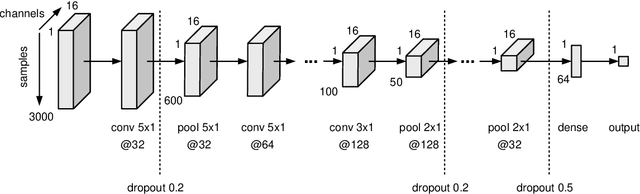
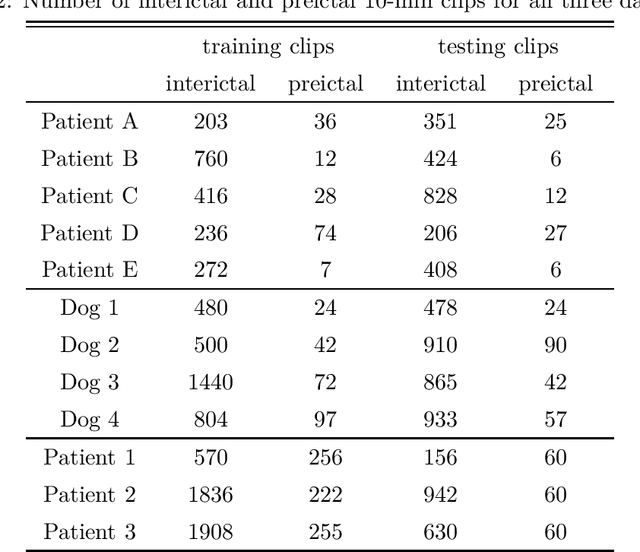
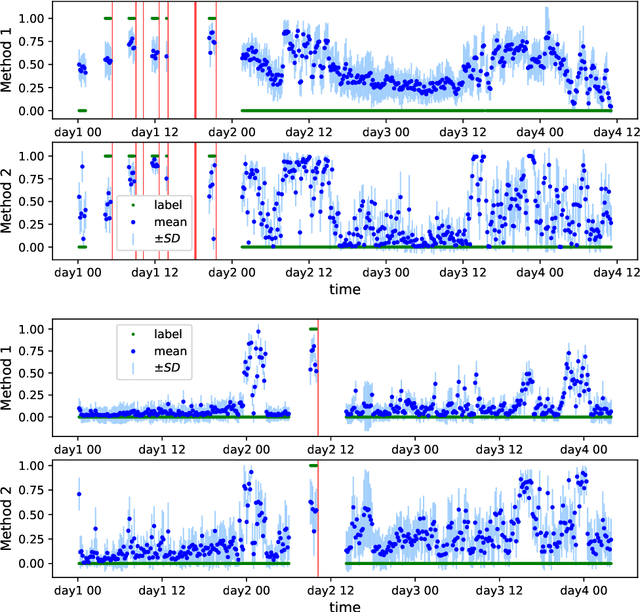
Seizure forecasting using machine learning is possible, but the performance is far from ideal, as indicated by many false predictions and low specificity. Here, we examine false and missing alarms of two algorithms on long-term datasets to show that the limitations are less related to classifiers or features, but rather to intrinsic changes in the data. We evaluated two algorithms on three datasets by computing the correlation of false predictions and estimating the information transfer between both classification methods. For 9 out of 12 individuals both methods showed a performance better than chance. For all individuals we observed a positive correlation in predictions. For individuals with strong correlation in false predictions we were able to boost the performance of one method by excluding test samples based on the results of the second method. Substantially different algorithms exhibit a highly consistent performance and a strong coherency in false and missing alarms. Hence, changing the underlying hypothesis of a preictal state of fixed time length prior to each seizure to a proictal state is more helpful than further optimizing classifiers. The outcome is significant for the evaluation of seizure prediction algorithms on continuous data.