 Add to Chrome
 Add to Firefox
 Add to Edge
A Robust Low-Rank Prior Model for Structured Cartoon-Texture Image Decomposition with Heavy-Tailed Noise
Mar 29, 2026
Cartoon-texture image decomposition is a fundamental yet challenging problem in image processing. A significant hurdle in achieving accurate decomposition is the pervasive presence of noise in the observed images, which severely impedes robust results. To address the challenging problem of cartoon-texture decomposition in the presence of heavy-tailed noise, we in this paper propose a robust low-rank prior model. Our approach departs from conventional models by adopting the Huber loss function as the data-fidelity term, rather than the traditional $\ell_2$-norm, while retaining the total variation norm and nuclear norm to characterize the cartoon and texture components, respectively. Given the inherent structure, we employ two implementable operator splitting algorithms, tailored to different degradation operators. Extensive numerical experiments, particularly on image restoration tasks under high-intensity heavy-tailed noise, efficiently demonstrate the superior performance of our model.

Structured model selection via $\ell_1-\ell_2$ optimization
May 30, 2023Automated model selection is an important application in science and engineering. In this work, we develop a learning approach for identifying structured dynamical systems from undersampled and noisy spatiotemporal data. The learning is performed by a sparse least-squares fitting over a large set of candidate functions via a nonconvex $\ell_1-\ell_2$ sparse optimization solved by the alternating direction method of multipliers. Using a Bernstein-like inequality with a coherence condition, we show that if the set of candidate functions forms a structured random sampling matrix of a bounded orthogonal system, the recovery is stable and the error is bounded. The learning approach is validated on synthetic data generated by the viscous Burgers' equation and two reaction-diffusion equations. The computational results demonstrate the theoretical guarantees of success and the efficiency with respect to the ambient dimension and the number of candidate functions.
A DCT-based Tensor Completion Approach for Recovering Color Images and Videos from Highly Undersampled Data
Oct 18, 2021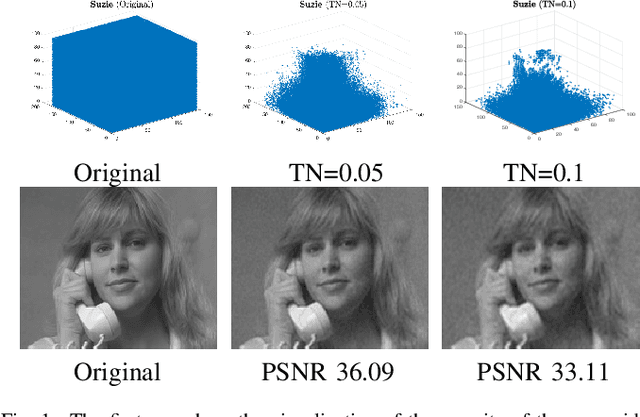
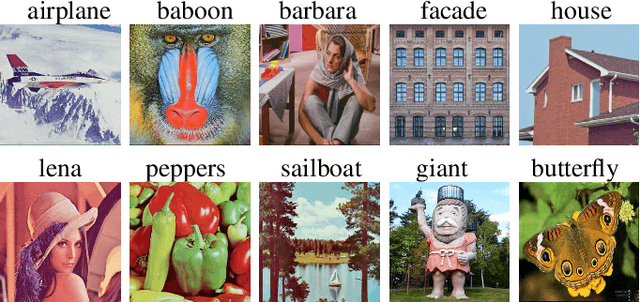
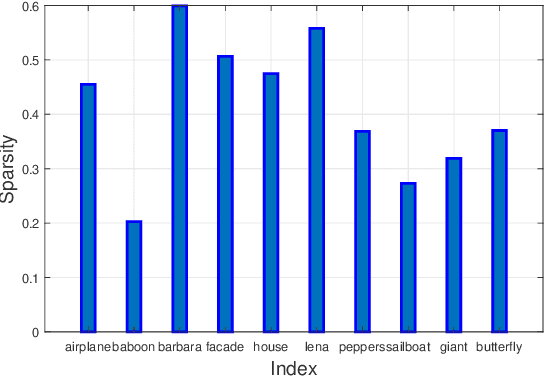

Recovering color images and videos from highly undersampled data is a fundamental and challenging task in face recognition and computer vision. By the multi-dimensional nature of color images and videos, in this paper, we propose a novel tensor completion approach, which is able to efficiently explore the sparsity of tensor data under the discrete cosine transform (DCT). Specifically, we introduce two DCT-based tensor completion models as well as two implementable algorithms for their solutions. The first one is a DCT-based weighted nuclear norm minimization model. The second one is called DCT-based $p$-shrinking tensor completion model, which is a nonconvex model utilizing $p$-shrinkage mapping for promoting the low-rankness of data. Moreover, we accordingly propose two implementable augmented Lagrangian-based algorithms for solving the underlying optimization models. A series of numerical experiments including color and MRI image inpainting and video data recovery demonstrate that our proposed approach performs better than many existing state-of-the-art tensor completion methods, especially for the case when the ratio of missing data is high.
Low-Rank and Sparse Enhanced Tucker Decomposition for Tensor Completion
Oct 18, 2020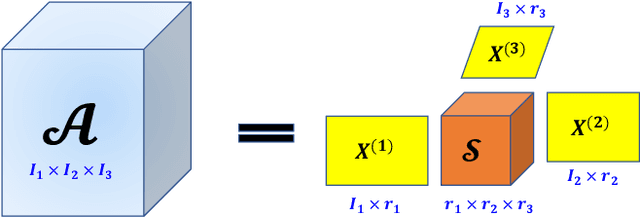
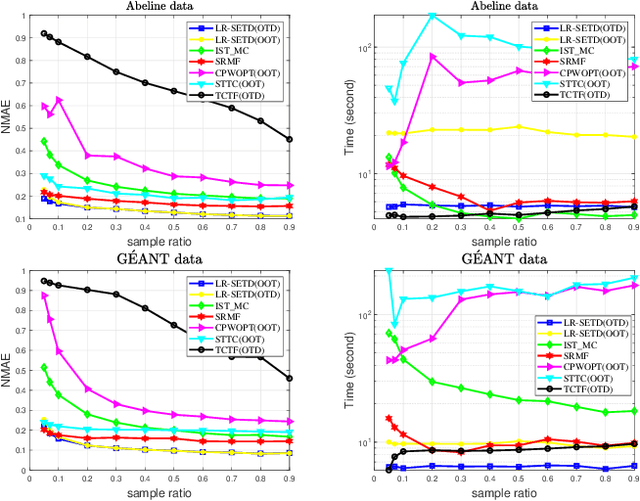
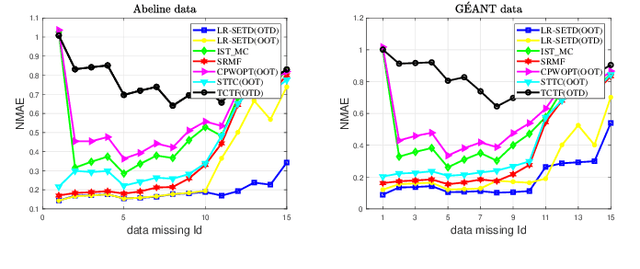
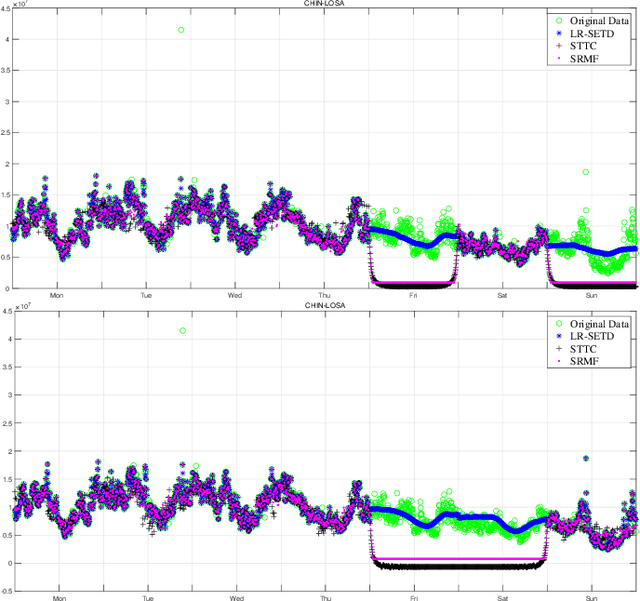
Tensor completion refers to the task of estimating the missing data from an incomplete measurement or observation, which is a core problem frequently arising from the areas of big data analysis, computer vision, and network engineering. Due to the multidimensional nature of high-order tensors, the matrix approaches, e.g., matrix factorization and direct matricization of tensors, are often not ideal for tensor completion and recovery. Exploiting the potential periodicity and inherent correlation properties appeared in real-world tensor data, in this paper, we shall incorporate the low-rank and sparse regularization technique to enhance Tucker decomposition for tensor completion. A series of computational experiments on real-world datasets, including internet traffic data, color images, and face recognition, show that our model performs better than many existing state-of-the-art matricization and tensorization approaches in terms of achieving higher recovery accuracy.