 Add to Chrome
 Add to Firefox
 Add to Edge
Digitally enriching a screening population for pancreatic cancer using routine blood-based measures and clinical histories
May 28, 2026
Earlier detection of pancreatic cancer is key to enabling wider access to curative treatment and reducing cancer deaths; however, screening is presently not viable. Latent indicators of pathology are evident in an individual's disease and blood test trajectories and may predict the development of pancreatic cancer. Longitudinal sequences of coded diagnoses and blood test values accrued by patients throughout their clinical interactions were used to train a custom Transformer-based neural network with a multi-head attention mechanism to predict risk of pancreatic cancer with a multi-year lead time and risk-stratify populations for targeted screening. The cohort comprised 6,017 adults with pancreatic cancer and 177,081 controls (overall median age 75, 45% female) with median 12 years (interquartile range 6.9-16.2) of medical history prior to pancreatic cancer diagnosis. External validation via leave-one-site-out, out-of-sample testing predicting pancreatic cancer 1-, 2-, and 3-years prior to diagnosis demonstrated mean area under the receiver operating characteristic of 0.837 (95% confidence interval 0.827-0.848), 0.797 (95% confidence interval 0.782-0.813), and 0.760 (95% confidence interval 0.745-0.776), respectively. Estimated pancreatic cancer risks were well-calibrated (calibration plot slope 1.08, intercept of -0.077; Brier score 0.025), and a Bayesian population pancreatic cancer prevalence update allows estimated cancer risk outputs to be transportable across settings. At testing, a screening threshold of >3.3% risk of pancreatic cancer in 1-year offered a diagnostic odds ratio of 18.2. Our work therefore lays the foundation for a first population-level digital enrichment tool to widen access to curative-intent management of pancreatic cancer.

GraD-IBD: Graph Representation Learning from Diagnosis Trajectories for Early Detection of Inflammatory Bowel Disease
May 27, 2026International Classification of Diseases (ICD) is a globally recognized coding system that records diagnostic events during each patient encounter, providing a standardized data foundation for various clinical tasks. However, the irregular and hierarchical nature of ICD code sequences poses challenges for N-D lattice-based sequential modeling methods, leading to overly complex model designs. In this paper, we propose GraD-IBD, a graph diagnosis model that reformulates longitudinal ICD trajectories as visit-bucketized, temporally directed graphs to detect the risk of inflammatory bowel disease (IBD). A novel context-aware, time-decay message passing mechanism was developed to capture temporal dependencies while reducing model complexity. The experimental results using a real-world clinical dataset demonstrated consistent and robust improvements in IBD detection over state-of-the-art methods, with significant reductions in computational complexity compared to sequential models. These findings highlight the potential of graph representation learning to enable efficient, scalable, and accurate disease risk prediction from longitudinal ICD diagnosis codes.
Beyond Amplitude: Channel State Information Phase-Aware Deep Fusion for Robotic Activity Recognition
Mar 10, 2026Wi-Fi Channel State Information (CSI) has emerged as a promising non-line-of-sight sensing modality for human and robotic activity recognition. However, prior work has predominantly relied on CSI amplitude while underutilizing phase information, particularly in robotic arm activity recognition. In this paper, we present GateFusion-Bidirectional Long Short-Term Memory network (GF-BiLSTM) for WiFi sensing in robotic activity recognition. GF-BiLSTM is a two-stream gated fusion network that encodes amplitude and phase separately and adaptively integrates per-time features through a learned gating mechanism. We systematically evaluate state-of-the-art deep learning models under a Leave-One-Velocity-Out (LOVO) protocol across four input configurations: amplitude only, phase only, amplitude + unwrapped phase, and amplitude + sanitized phase. Experimental results demonstrate that incorporating phase alongside amplitude consistently improves recognition accuracy and cross-speed robustness, with GF-BiLSTM achieving the best performance. To the best of our knowledge, this work provides the first systematic exploration of CSI phase for robotic activity recognition, establishing its critical role in Wi-Fi-based sensing.
Deep Learning on Hester Davis Scores for Inpatient Fall Prediction
Jan 11, 2025Fall risk prediction among hospitalized patients is a critical aspect of patient safety in clinical settings, and accurate models can help prevent adverse events. The Hester Davis Score (HDS) is commonly used to assess fall risk, with current clinical practice relying on a threshold-based approach. In this method, a patient is classified as high-risk when their HDS exceeds a predefined threshold. However, this approach may fail to capture dynamic patterns in fall risk over time. In this study, we model the threshold-based approach and propose two machine learning approaches for enhanced fall prediction: One-step ahead fall prediction and sequence-to-point fall prediction. The one-step ahead model uses the HDS at the current timestamp to predict the risk at the next timestamp, while the sequence-to-point model leverages all preceding HDS values to predict fall risk using deep learning. We compare these approaches to assess their accuracy in fall risk prediction, demonstrating that deep learning can outperform the traditional threshold-based method by capturing temporal patterns and improving prediction reliability. These findings highlight the potential for data-driven approaches to enhance patient safety through more reliable fall prevention strategies.
Synthetic Feature Augmentation Improves Generalization Performance of Language Models
Jan 11, 2025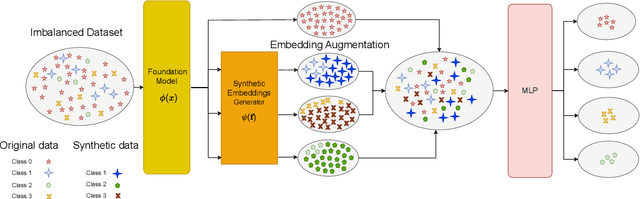
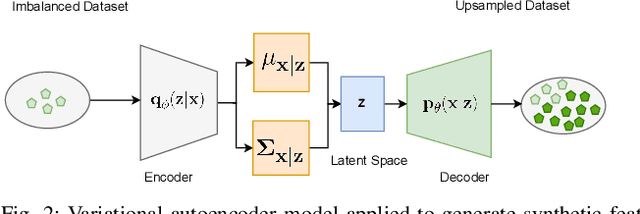
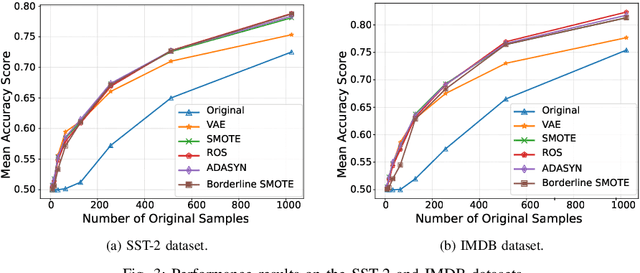
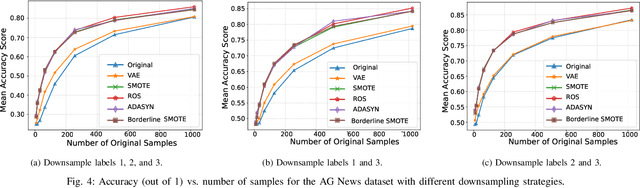
Training and fine-tuning deep learning models, especially large language models (LLMs), on limited and imbalanced datasets poses substantial challenges. These issues often result in poor generalization, where models overfit to dominant classes and underperform on minority classes, leading to biased predictions and reduced robustness in real-world applications. To overcome these challenges, we propose augmenting features in the embedding space by generating synthetic samples using a range of techniques. By upsampling underrepresented classes, this method improves model performance and alleviates data imbalance. We validate the effectiveness of this approach across multiple open-source text classification benchmarks, demonstrating its potential to enhance model robustness and generalization in imbalanced data scenarios.
RoboMNIST: A Multimodal Dataset for Multi-Robot Activity Recognition Using WiFi Sensing, Video, and Audio
Aug 29, 2024We introduce a novel dataset for multi-robot activity recognition (MRAR) using two robotic arms integrating WiFi channel state information (CSI), video, and audio data. This multimodal dataset utilizes signals of opportunity, leveraging existing WiFi infrastructure to provide detailed indoor environmental sensing without additional sensor deployment. Data were collected using two Franka Emika robotic arms, complemented by three cameras, three WiFi sniffers to collect CSI, and three microphones capturing distinct yet complementary audio data streams. The combination of CSI, visual, and auditory data can enhance robustness and accuracy in MRAR. This comprehensive dataset enables a holistic understanding of robotic environments, facilitating advanced autonomous operations that mimic human-like perception and interaction. By repurposing ubiquitous WiFi signals for environmental sensing, this dataset offers significant potential aiming to advance robotic perception and autonomous systems. It provides a valuable resource for developing sophisticated decision-making and adaptive capabilities in dynamic environments.
Enhancing Robotic Arm Activity Recognition with Vision Transformers and Wavelet-Transformed Channel State Information
Jul 08, 2024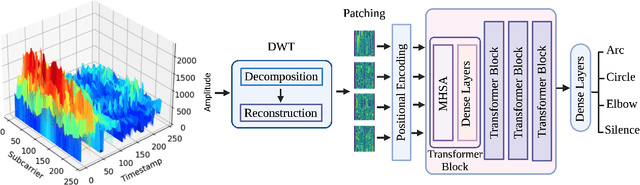
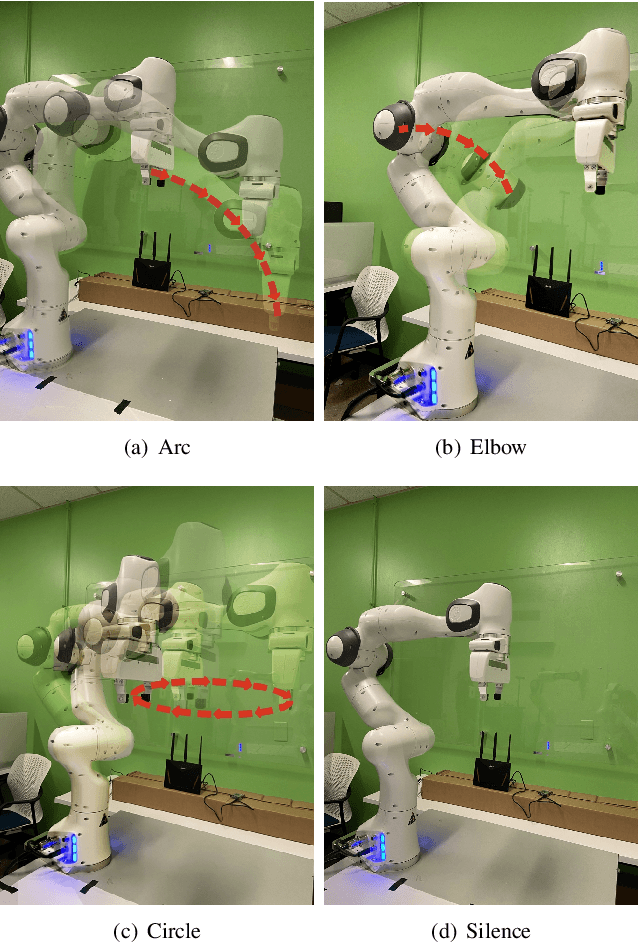
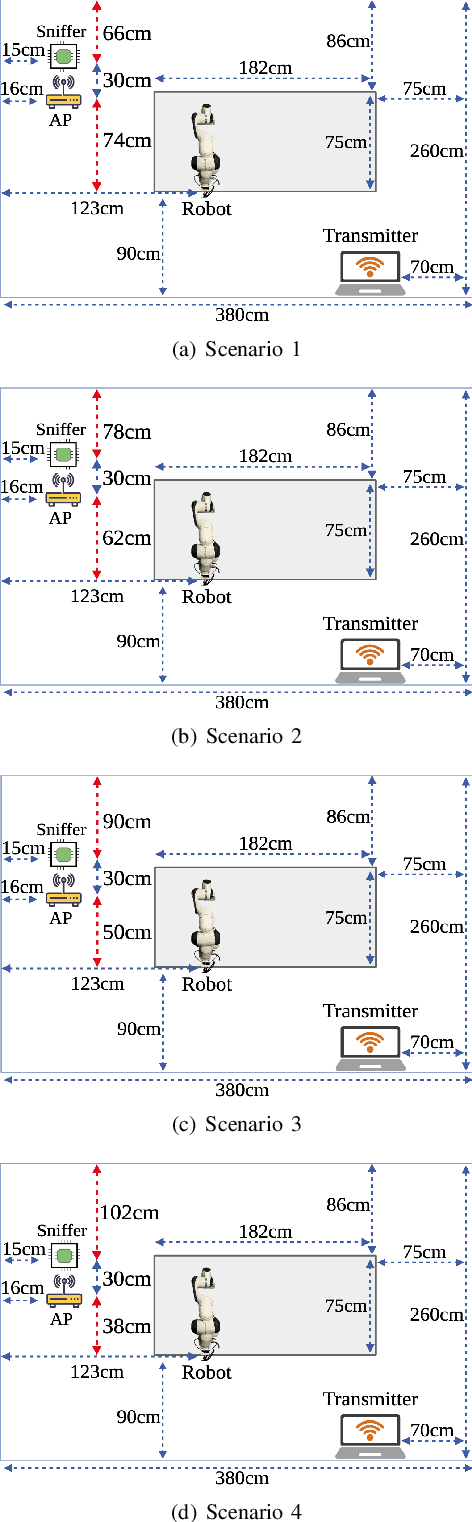
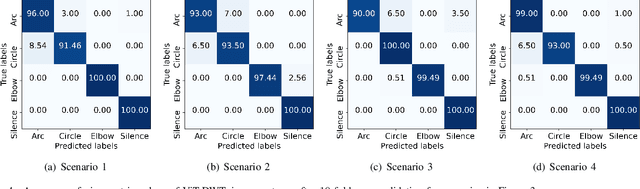
Vision-based methods are commonly used in robotic arm activity recognition. These approaches typically rely on line-of-sight (LoS) and raise privacy concerns, particularly in smart home applications. Passive Wi-Fi sensing represents a new paradigm for recognizing human and robotic arm activities, utilizing channel state information (CSI) measurements to identify activities in indoor environments. In this paper, a novel machine learning approach based on discrete wavelet transform and vision transformers for robotic arm activity recognition from CSI measurements in indoor settings is proposed. This method outperforms convolutional neural network (CNN) and long short-term memory (LSTM) models in robotic arm activity recognition, particularly when LoS is obstructed by barriers, without relying on external or internal sensors or visual aids. Experiments are conducted using four different data collection scenarios and four different robotic arm activities. Performance results demonstrate that wavelet transform can significantly enhance the accuracy of visual transformer networks in robotic arms activity recognition.
Robustness Evaluation of Machine Learning Models for Robot Arm Action Recognition in Noisy Environments
Jan 17, 2024In the realm of robot action recognition, identifying distinct but spatially proximate arm movements using vision systems in noisy environments poses a significant challenge. This paper studies robot arm action recognition in noisy environments using machine learning techniques. Specifically, a vision system is used to track the robot's movements followed by a deep learning model to extract the arm's key points. Through a comparative analysis of machine learning methods, the effectiveness and robustness of this model are assessed in noisy environments. A case study was conducted using the Tic-Tac-Toe game in a 3-by-3 grid environment, where the focus is to accurately identify the actions of the arms in selecting specific locations within this constrained environment. Experimental results show that our approach can achieve precise key point detection and action classification despite the addition of noise and uncertainties to the dataset.
RoboFiSense: Attention-Based Robotic Arm Activity Recognition with WiFi Sensing
Dec 28, 2023Despite the current surge of interest in autonomous robotic systems, robot activity recognition within restricted indoor environments remains a formidable challenge. Conventional methods for detecting and recognizing robotic arms' activities often rely on vision-based or light detection and ranging (LiDAR) sensors, which require line-of-sight (LoS) access and may raise privacy concerns, for example, in nursing facilities. This research pioneers an innovative approach harnessing channel state information (CSI) measured from WiFi signals, subtly influenced by the activity of robotic arms. We developed an attention-based network to classify eight distinct activities performed by a Franka Emika robotic arm in different situations. Our proposed bidirectional vision transformer-concatenated (BiVTC) methodology aspires to predict robotic arm activities accurately, even when trained on activities with different velocities, all without dependency on external or internal sensors or visual aids. Considering the high dependency of CSI data to the environment, motivated us to study the problem of sniffer location selection, by systematically changing the sniffer's location and collecting different sets of data. Finally, this paper also marks the first publication of the CSI data of eight distinct robotic arm activities, collectively referred to as RoboFiSense. This initiative aims to provide a benchmark dataset and baselines to the research community, fostering advancements in the field of robotics sensing.
Hypertension Detection From High-Dimensional Representation of Photoplethysmogram Signals
Jul 31, 2023


Hypertension is commonly referred to as the "silent killer", since it can lead to severe health complications without any visible symptoms. Early detection of hypertension is crucial in preventing significant health issues. Although some studies suggest a relationship between blood pressure and certain vital signals, such as Photoplethysmogram (PPG), reliable generalization of the proposed blood pressure estimation methods is not yet guaranteed. This lack of certainty has resulted in some studies doubting the existence of such relationships, or considering them weak and limited to heart rate and blood pressure. In this paper, a high-dimensional representation technique based on random convolution kernels is proposed for hypertension detection using PPG signals. The results show that this relationship extends beyond heart rate and blood pressure, demonstrating the feasibility of hypertension detection with generalization. Additionally, the utilized transform using convolution kernels, as an end-to-end time-series feature extractor, outperforms the methods proposed in the previous studies and state-of-the-art deep learning models.