 Add to Chrome
 Add to Firefox
 Add to Edge
Generalized Distribution-Free Semi-Supervised Learning with Risk Rewrite
Jul 11, 2026
Typical semi-supervised learning (SSL) methods rely on distributional assumptions, and their performance degrades when these are violated. While PNU learning, a risk rewriting method, offers a distribution-free alternative, it is restricted to binary classification and its variance optimality remains unclear. In this paper, we propose a generalized framework that constructs unbiased risk estimators using linear combinations of component risks, subsuming PNU learning and extending to multiclass classification. We derive the minimum achievable variance, demonstrating our estimator can attain lower variance than PNU in asymmetric loss scenarios. Furthermore, we establish a generalization bound directly linking this variance reduction to improved learning performance. Based on these theoretical insights, we introduce two practical SSL methods that empirically match or outperform existing approaches on binary and multiclass benchmarks.

Robust VAEs via Generating Process of Noise Augmented Data
Jul 26, 2024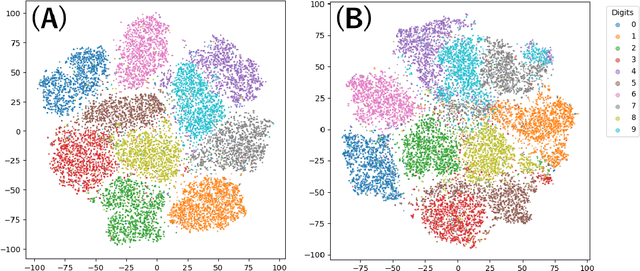
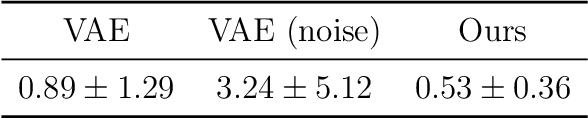
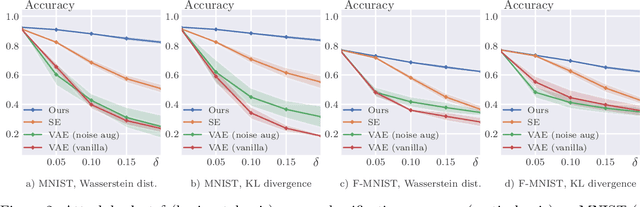
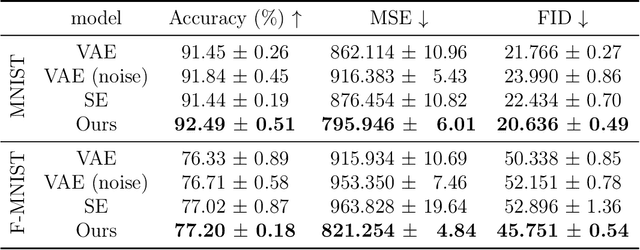
Advancing defensive mechanisms against adversarial attacks in generative models is a critical research topic in machine learning. Our study focuses on a specific type of generative models - Variational Auto-Encoders (VAEs). Contrary to common beliefs and existing literature which suggest that noise injection towards training data can make models more robust, our preliminary experiments revealed that naive usage of noise augmentation technique did not substantially improve VAE robustness. In fact, it even degraded the quality of learned representations, making VAEs more susceptible to adversarial perturbations. This paper introduces a novel framework that enhances robustness by regularizing the latent space divergence between original and noise-augmented data. Through incorporating a paired probabilistic prior into the standard variational lower bound, our method significantly boosts defense against adversarial attacks. Our empirical evaluations demonstrate that this approach, termed Robust Augmented Variational Auto-ENcoder (RAVEN), yields superior performance in resisting adversarial inputs on widely-recognized benchmark datasets.