 Add to Chrome
 Add to Firefox
 Add to Edge
Free Energy-Based Modeling of Emotional Dynamics in Video Advertisements
Dec 22, 2025
Emotional responses during advertising video viewing are recognized as essential for understanding media effects because they have influenced attention, memory, and purchase intention. To establish a methodological basis for explainable emotion estimation without relying on external information such as physiological signals or subjective ratings, we have quantified "pleasantness," "surprise," and "habituation" solely from scene-level expression features of advertising videos, drawing on the free energy(FE) principle, which has provided a unified account of perception, learning, and behavior. In this framework, Kullback-Leibler divergence (KLD) has captured prediction error, Bayesian surprise (BS) has captured belief updates, and uncertainty (UN) has reflected prior ambiguity, and together they have formed the core components of FE. Using 1,059 15 s food video advertisements, the experiments have shown that KLD has reflected "pleasantness" associated with brand presentation, BS has captured "surprise" arising from informational complexity, and UN has reflected "surprise" driven by uncertainty in element types and spatial arrangements, as well as by the variability and quantity of presented elements. This study also identified three characteristic emotional patterns, namely uncertain stimulus, sustained high emotion, and momentary peak and decay, demonstrating the usefulness of the proposed method. Robustness across nine hyperparameter settings and generalization tests with six types of Japanese advertising videos (three genres and two durations) confirmed that these tendencies remained stable. This work can be extended by integrating a wider range of expression elements and validating the approach through subjective ratings, ultimately guiding the development of technologies that can support the creation of more engaging advertising videos.

A Multichannel Convolutional Neural Network For Cross-language Dialog State Tracking
Jan 23, 2017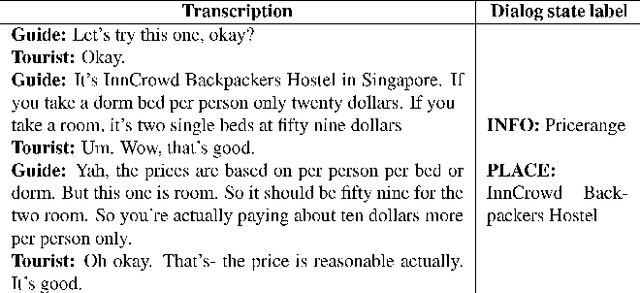


The fifth Dialog State Tracking Challenge (DSTC5) introduces a new cross-language dialog state tracking scenario, where the participants are asked to build their trackers based on the English training corpus, while evaluating them with the unlabeled Chinese corpus. Although the computer-generated translations for both English and Chinese corpus are provided in the dataset, these translations contain errors and careless use of them can easily hurt the performance of the built trackers. To address this problem, we propose a multichannel Convolutional Neural Networks (CNN) architecture, in which we treat English and Chinese language as different input channels of one single CNN model. In the evaluation of DSTC5, we found that such multichannel architecture can effectively improve the robustness against translation errors. Additionally, our method for DSTC5 is purely machine learning based and requires no prior knowledge about the target language. We consider this a desirable property for building a tracker in the cross-language context, as not every developer will be familiar with both languages.