 Add to Chrome
 Add to Firefox
 Add to Edge
Certified Robustness under Heterogeneous Perturbations via Hybrid Randomized Smoothing
May 13, 2026
Randomized smoothing provides strong, model-agnostic robustness certificates, but existing guarantees are limited to single modalities, treating continuous and discrete inputs in isolation. This limitation becomes critical in multimodal models, where decisions depend on cross-modal semantics and adversaries can jointly perturb heterogeneous inputs, rendering unimodal certificates insufficient. We introduce a unified randomized smoothing framework for mixed discrete--continuous inputs based on an analytically tractable Neyman--Pearson formulation of the joint worst-case problem. By analyzing the joint likelihood ordering induced by factorized discrete and continuous noise, our approach yields a closed-form, one-dimensional certificate that strictly generalizes both Gaussian (image-only) and discrete (text-only) randomized smoothing. We validate the framework on multimodal safety filtering, providing, to our knowledge, the first model-agnostic Neyman--Pearson certificate for joint discrete-token and continuous-image perturbations in interaction-dependent text--image safety filtering.

Membership Inference Attacks on Large-Scale Models: A Survey
Mar 25, 2025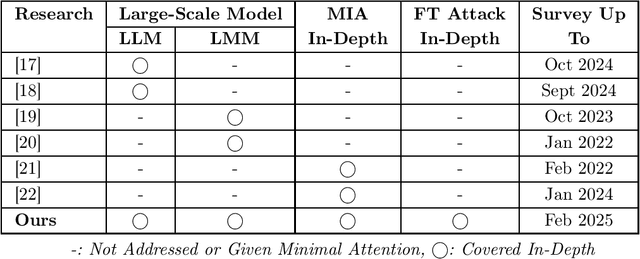

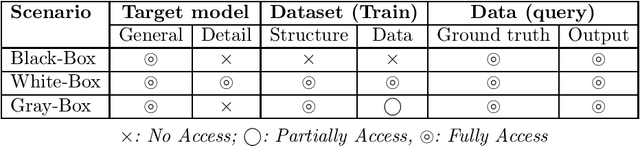
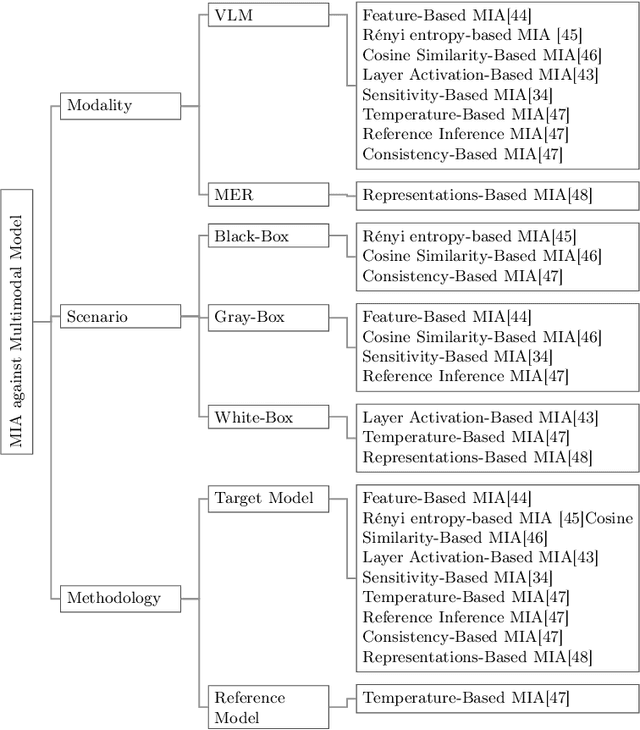
The adoption of the Large Language Model (LLM) has accelerated dramatically since the ChatGPT from OpenAI went online in November 2022. Recent advances in Large Multimodal Models (LMMs), which process diverse data types and enable interaction through various channels, have expanded beyond the text-to-text limitations of early LLMs, attracting significant and concurrent attention from both researchers and industry. While LLMs and LMMs are starting to spread widely, concerns about their privacy risks are increasing as well. Membership Inference Attacks (MIAs), techniques used to determine whether a particular data point was part of a model's training set, serve as a key metric for assessing the privacy vulnerabilities of machine learning models. Hu et al. show that various machine learning algorithms are vulnerable to MIA. Despite extensive studies on MIAs in traditional models, there remains a lack of systematic surveys addressing their effectiveness and implications in modern large-scale models like LLMs and LMMs. In this paper, we systematically reviewed recent studies of MIA against LLMs and LMMs. We analyzed and categorized each attack based on their methodology and scenario and discussed the limitations in existing research. Additionally, we examine privacy concerns associated with the fine-tuning process. Finally, we provided some suggestions for future research in this direction.