 Add to Chrome
 Add to Firefox
 Add to Edge
MineGrad: Gradient Inversion Attacks on LoRA Fine-Tuning
Aug 02, 2026
Parameter-efficient fine-tuning (PEFT), such as low-rank adaptation (LoRA), has recently been adopted in federated learning to reduce communication and computation costs. In this setup, users download a pretrained model from the server prior to fine-tuning, and then fine-tune lightweight LoRA modules locally while keeping the pretrained model frozen, sharing only the gradients of the fine-tuning parameters with the server. Despite its growing popularity, robustness of federated fine-tuning against an adversarial server remains underexplored, where the server maliciously tampers with the training protocol to breach the privacy of users' data. In this work, we investigate gradient inversion attacks on LoRA fine-tuning. We propose an analytical attack that enables a malicious server to recover private user data by leveraging a poisoned pretrained model and fine-tuning parameters. Our design embeds fine-tuning data within the shared gradients, to allow the server to analytically reconstruct user data. Unlike prior works, our attack is applicable to both language and vision tasks, does not rely on computationally expensive (adversarial) pretraining with public datasets or require the number of training tokens to be less than the rank of LoRA modules. Experimental results on both language and vision tasks demonstrate high-fidelity data recovery across multiple baselines, revealing several critical vulnerabilities.

Gradient Inversion Attacks on Parameter-Efficient Fine-Tuning
Jun 04, 2025Federated learning (FL) allows multiple data-owners to collaboratively train machine learning models by exchanging local gradients, while keeping their private data on-device. To simultaneously enhance privacy and training efficiency, recently parameter-efficient fine-tuning (PEFT) of large-scale pretrained models has gained substantial attention in FL. While keeping a pretrained (backbone) model frozen, each user fine-tunes only a few lightweight modules to be used in conjunction, to fit specific downstream applications. Accordingly, only the gradients with respect to these lightweight modules are shared with the server. In this work, we investigate how the privacy of the fine-tuning data of the users can be compromised via a malicious design of the pretrained model and trainable adapter modules. We demonstrate gradient inversion attacks on a popular PEFT mechanism, the adapter, which allow an attacker to reconstruct local data samples of a target user, using only the accessible adapter gradients. Via extensive experiments, we demonstrate that a large batch of fine-tuning images can be retrieved with high fidelity. Our attack highlights the need for privacy-preserving mechanisms for PEFT, while opening up several future directions. Our code is available at https://github.com/info-ucr/PEFTLeak.
Sparsified Secure Aggregation for Privacy-Preserving Federated Learning
Dec 23, 2021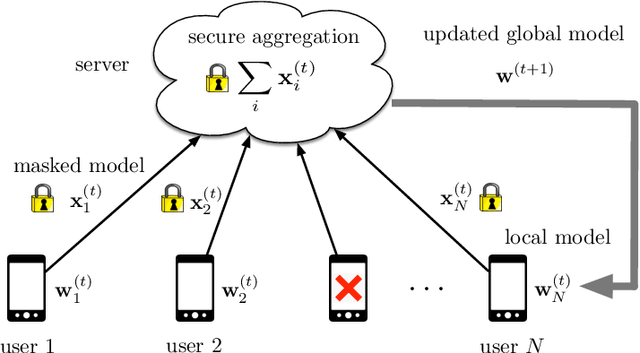
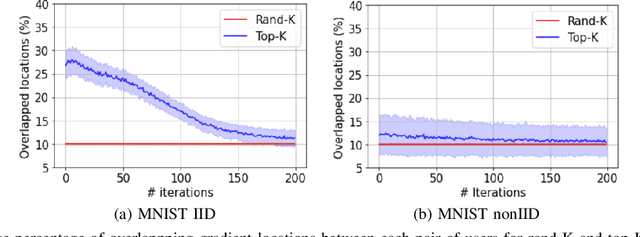
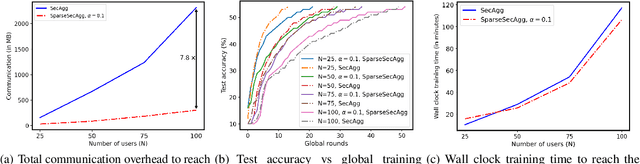
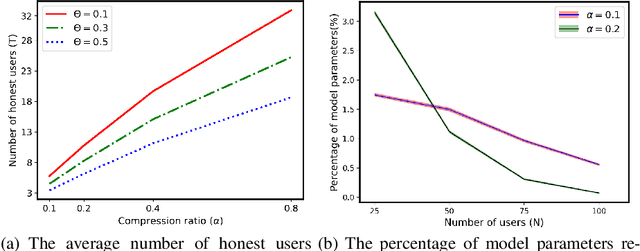
Secure aggregation is a popular protocol in privacy-preserving federated learning, which allows model aggregation without revealing the individual models in the clear. On the other hand, conventional secure aggregation protocols incur a significant communication overhead, which can become a major bottleneck in real-world bandwidth-limited applications. Towards addressing this challenge, in this work we propose a lightweight gradient sparsification framework for secure aggregation, in which the server learns the aggregate of the sparsified local model updates from a large number of users, but without learning the individual parameters. Our theoretical analysis demonstrates that the proposed framework can significantly reduce the communication overhead of secure aggregation while ensuring comparable computational complexity. We further identify a trade-off between privacy and communication efficiency due to sparsification. Our experiments demonstrate that our framework reduces the communication overhead by up to 7.8x, while also speeding up the wall clock training time by 1.13x, when compared to conventional secure aggregation benchmarks.