 Add to Chrome
 Add to Firefox
 Add to Edge
Multiscale Euclidean Network Trajectories: Second-Moment Geometry, Attribution, and Change Points
May 06, 2026
A central challenge in dynamic network analysis is to represent temporal evolution in a way that is both geometrically meaningful and statistically identifiable. One approach embeds a sequence of network snapshots as trajectories in a Euclidean space and relates these trajectories to node embeddings. In multilayer and unfolded spectral constructions, however, node embeddings and their underlying latent positions are identifiable only up to general linear transformations. Although this ambiguity preserves edge probabilities, it can distort geometry and invalidate distance based temporal comparisons at both the trajectory and node-levels. We develop Multiscale Euclidean Network Trajectories (MENT), a framework for multiscale temporal trajectories based on second-moment geometry. By imposing an isotropic normalization on the anchor latent positions, we reduce the relevant ambiguity to orthogonal transformations and prevent distortion of the second-moment geometry. In this canonical representation, we define a trace variation distance and mode-wise variation distances along orthogonal directions, and use multidimensional scaling to obtain low-dimensional trajectories of time points at both global and mode-wise levels. The resulting trajectories support interpretation and inference. They admit mode-wise decompositions, support attribution of global and mode-wise temporal changes to nodes, and enable change point detection through 1D trajectories. We prove consistency of the proposed unfolded spectral embedding and of the induced temporal trajectories. Experiments on two synthetic and two real dynamic networks illustrate stable and interpretable recovery of temporal structure and show strong performance against existing change point detection baselines.

Unfolded Laplacian Spectral Embedding: A Theoretically Grounded Approach to Dynamic Network Representation
Aug 18, 2025
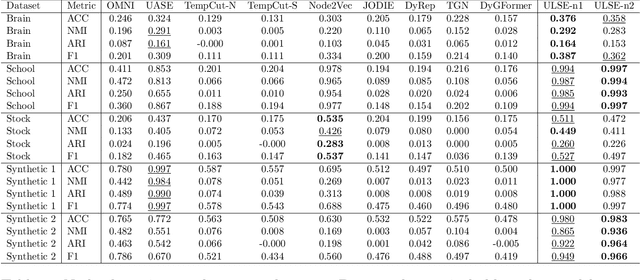
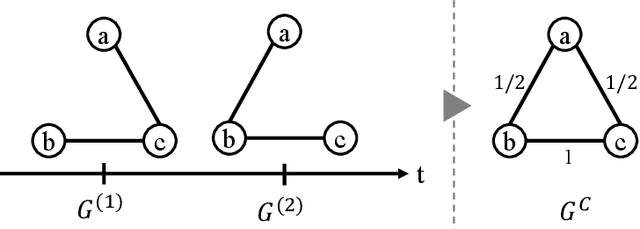
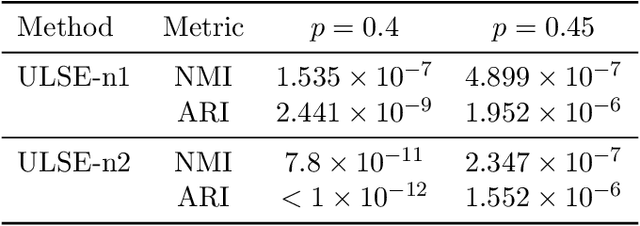
Dynamic relational structures play a central role in many AI tasks, but their evolving nature presents challenges for consistent and interpretable representation. A common approach is to learn time-varying node embeddings, whose effectiveness depends on satisfying key stability properties. In this paper, we propose Unfolded Laplacian Spectral Embedding, a new method that extends the Unfolded Adjacency Spectral Embedding framework to normalized Laplacians while preserving both cross-sectional and longitudinal stability. We provide formal proof that our method satisfies these stability conditions. In addition, as a bonus of using the Laplacian matrix, we establish a new Cheeger-style inequality that connects the embeddings to the conductance of the underlying dynamic graphs. Empirical evaluations on synthetic and real-world datasets support our theoretical findings and demonstrate the strong performance of our method. These results establish a principled and stable framework for dynamic network representation grounded in spectral graph theory.
Learning Method for S4 with Diagonal State Space Layers using Balanced Truncation
Mar 05, 2024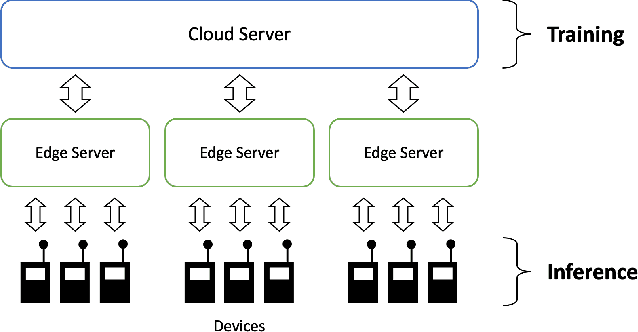
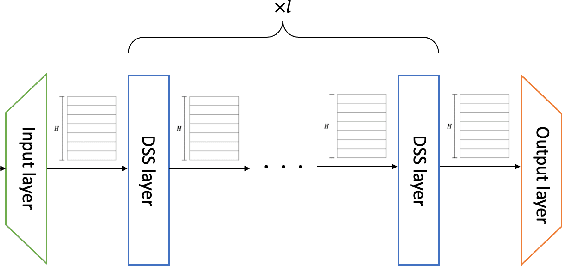
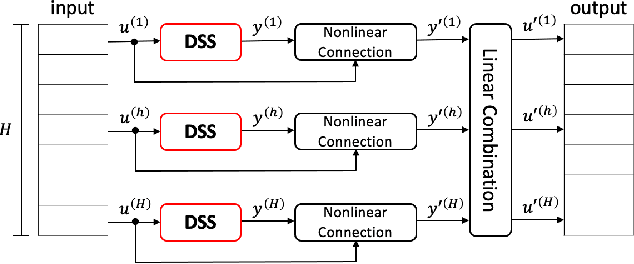
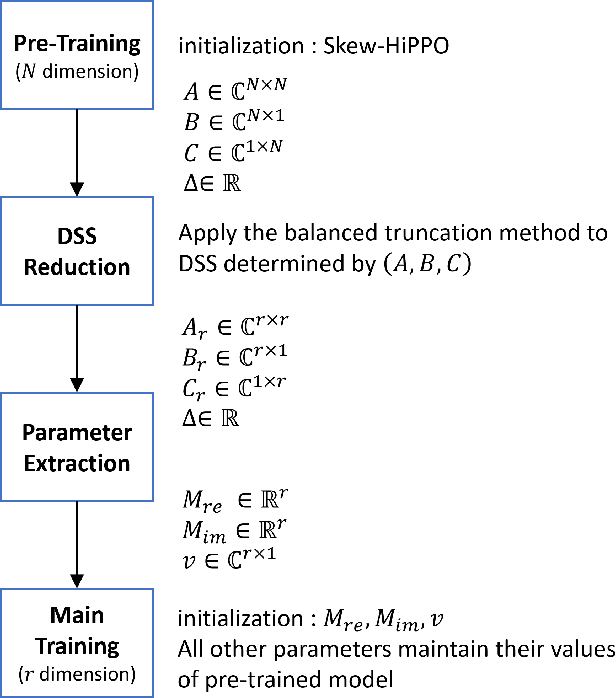
We introduce a novel learning method for Structured State Space Sequence (S4) models incorporating Diagonal State Space (DSS) layers, tailored for processing long-sequence data in edge intelligence applications, including sensor data analysis and real-time analytics. This method utilizes the balanced truncation, a prevalent model reduction technique in control theory, applied specifically to DSS layers to reduce computational costs during inference. By leveraging parameters from the reduced model, we refine the initialization process of S4 models, outperforming the widely used Skew-HiPPO initialization in terms of performance. Numerical experiments demonstrate that our trained S4 models with DSS layers surpass conventionally trained models in accuracy and efficiency metrics. Furthermore, our observations reveal a positive correlation: higher accuracy in the original model consistently leads to increased accuracy in models trained using our method, suggesting that our approach effectively leverages the strengths of the original model.